
The 7 Best Contentstack Alternatives for 2026

Contentstack is a digital experience platform (DXP) that delivers content to websites, mobile apps, and other channels. Originally built on a headless CMS, the platform was repositioned as an Agentic Experience Platform, where the CMS sits alongside a real-time CDP and a personalization engine.
However, that isn’t the right fit for every enterprise, especially those seeking pricing transparency, an easier learning curve, and the flexibility for marketing teams to accomplish tasks without needing a developer.
In this article, we’ll outline the best Contentstack alternatives for 2026 that can help you avoid those problems and more.
Key Takeaways
-
Contentstack delivers content across websites, apps, and other channels, but the CMS now sits inside a wider Agentic Experience Platform alongside a real-time CDP and a personalization engine, so roadmap attention is split across several products.
-
Enterprises looking for an alternative are usually struggling with pricing they cannot model before a sales cycle, a learning curve that slows time to value, and content modeling that keeps routine page work in a developer queue.
-
Alternatives range from headless CMSs like Contentful, Storyblok and dotCMS that compete on visual editing, hosting flexibility and developer experience, to full DXP suites like Optimizely, Sitecore and Adobe Experience Manager that bring experimentation, governance and marketing automation at a higher total cost of ownership.
-
Agility CMS combines published pricing tiers with usage limits, a free proof of concept built on your own content before a contract, an MCP server that lets an AI agent create and publish content, and page management inside the CMS so marketers can publish without a developer.
Why Teams Look for a Contentstack Alternative
Here are a few reasons companies might consider a Contentstack alternative, whether you’re a current customer or have it on your shortlist.
You cannot model the cost before you are in a sales cycle
Contentstack’s pricing page lacks the transparency that companies need to make a real buying decision. While it includes capabilities like visual editing, personalization, AI agents, permissions, and more, it doesn’t include seat counts, API limits, storage figures, or overage terms.
Even though enterprise teams are accustomed to speaking with a sales rep, other headless CMSs and DXP vendors provide something that internal teams can benchmark against their current systems while building a business case. And according to reviewers, Contentstack can be pricier than other options available on the market.
Additionally, this means companies are more likely to get caught out in the 2nd or 3rd year of using Contentstack as traffic increases, they expand to a new region, or they acquire another brand without the ability to plan ahead properly.
Proving fit costs weeks before you learn anything
Ask a CMS vendor for a demo, and what usually arrives is a sandbox with a generic template, sample content, no branding, and a login. It proves the product exists but doesn’t answer the question the committee is actually asking, which is what their site looks like inside the platform.
And when organizations need to wait until then to find certainties, the fit problems surface very soon after signature during the implementation phase, and sometimes not until it’s complete.
The product is becoming a platform
Contentstack now presents the headless CMS as one tier inside an Agentic Experience Platform. The same pricing page groups the CMS alongside a real-time CDP and an agentic tier, with an agent layer described as included across every plan.
For a team that moved to headless specifically to get out of a monolithic suite, it might feel like they’re returning to the same problem. While Contentstack doesn’t force teams to adopt the CDP and personalization solutions as well, its focus is split across multiple products, meaning the roadmap will differ and each product can’t get equal prioritization and feature development.
Routine page work still needs a developer
Every headless CMS needs a developer to build the first set of components so marketers can use them to build landing pages and other content experiences. However, one drawback reviewers have reported with Contentstack in particular is how difficult it is to use those components, with complex content modeling and a user interface that isn't as user-friendly as they expected.
Read More: Learn how to choose a headless CMS that fits your needs.
The Best Contentstack Alternatives
If any of the reasons above resonated with you, consider the Contentstack Alternatives listed below instead.
1. Agility CMS
Agility CMS is a headless CMS designed to empower enterprise teams to manage websites, applications, and digital channels at scale.
Marketing teams can use a user-friendly visual interface to build pages and preview changes in real time, so they can maintain control over their content without requiring coding skills. Meanwhile,, developers can work with any preferred framework and access content through RESTful or GraphQL APIs. The platform also offers several features including:
-
Published tier pricing with the usage limits attached so that costs can be modelled before a sales call
-
The ability to build a proof of concept on your own content and branding before there is a contract
-
An MCP server to connect an AI agent to the CMS itself, not only to the codebase
-
The flexibility to keep routine page and campaign work out of the developer queue
-
All of the security, compliance, and scale requirements an enterprise needs in its platform
Pricing you can model before you speak to anyone
The problem with an unpriced pricing page is that it stalls the evaluation. Nobody can score a shortlist that has a blank where the cost should be. Agility’s pricing page lists Essentials at $699 per month and states what that buys: 5 users, 25,000 entries, 500GB of asset storage, 500GB of monthly bandwidth.
Enterprise moves to 50 users, 500,000+ entries, 20TB of storage, 15TB+ of monthly bandwidth, and a 99.9%+ SLA. Content models, API requests, and locales are unlimited on every tier, helping teams avoid the surprise invoices that can come with other CMSs.
And while enterprise buyers will need to discuss their exact use cases, like with any other platform, Agility CMS’s transparency allows teams to build a working model from the tier limits first and negotiate against it, instead of arriving at the conversation with nothing.
Learn More: Try our ROI calculator to see how much you can save by switching.
A proof of concept on your own site, before you sign
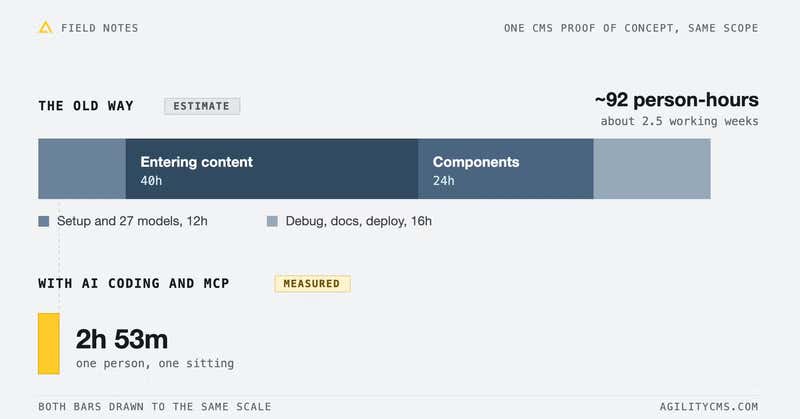
Committees decide on demos because a real proof of concept has historically been too expensive to justify for a deal that might not close. With Agility CMS’s free Proof of Concept tier, we build a POC with you, using your content, your branding, and your locales, before there is a contract in play.
In just a few hours, you can see how the platform works and whether it fits your needs. We measured two builds that took 2 hours 29 minutes and 2 hours 53 minutes of hands-on time, respectively, cutting what used to be almost 100 people-hours.
Try your own proof of concept now to see what this looks like for your brand.
An AI agent that can put content into the CMS
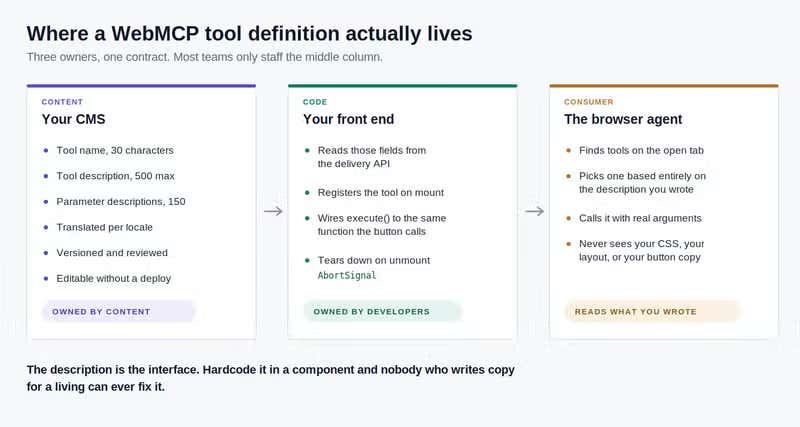
A coding agent will hand you a component library, a routing layer, and a language switcher, and then leave you with a site that renders correctly and contains nothing. But content entry is the half that has to happen before anyone can look at the result and judge it.
Agility’s MCP server exposes 19 tools over OAuth 2.0 covering content models, component models, containers, locales, sitemaps, media uploads, and content items, which gives an agent the same API surface a developer works with. The same session that writes the component rendering a product card can create the model, define its fields, enter the items, wire them into a page list,, and publish them, giving teams more flexibility and speed than ever before.
Learn More: See how your website can become a tool for AI agents with Agility’s MCP server.
Page changes that do not become tickets
Agility CMS offers features that help content teams accomplish more without filing a developer ticket. With Page Management, you can build pages using your templates and UI components (Modules) with complete control over sitemaps/routing.
Additionally, Agility CMS offers an intuitive editing interface to manage and output rich text within your content as well as content preview, scheduling, versioning, and approval workflows. These features let content editors assemble pages from existing components, control their own URL structure, and publish without a developer. This way,, a new regional page or a campaign variant is an editorial task rather than a backlog item, which keeps the marketing cadence independent of the engineering one.
Enterprise requirements without a tier upgrade conversation
Agility CMS offers the flexibility mid-sized organizations need, but it was also built to serve enterprise needs, providing REST and GraphQL APIs, open-source JavaScript and .NET SDKs, a content sync API, webhooks, and custom fields on the development side.
We’re a Gold Certified Microsoft Partner offering GDPR compliance, enterprise SSO, MFA, custom roles and teams, and security audit support. We offer a Fastly-backed CDN, 24/7 monitoring, 30-day point-in-time backups, and a choice of data center regions across the USA, Canada, Europe, and Australia.
Get a personalized walkthrough to see how Agility CMS can help you accelerate content delivery.
2. Contentful
Contentful is another digital experience platform (DXP) designed for marketers, developers, and digital teams. Like Contentstack, Contentful is a headless CMS that offers localization, multi-channel delivery, and a strong app framework and integration ecosystem. It offers features including AI actions & generation, modular content modeling, and the Contentful Studio add-on, making it a viable alternative to Contentstack.
3. Storyblok
Storyblok is a headless CMS whose differentiator is the visual editor, with in-context live preview so editors see the rendered page as they change it. Content is structured as reusable components that map cleanly onto frameworks like Next.js, Nuxt, and Astro. This gives developers the API-first workflow they expect and marketers an interface they can learn quickly.
4. dotCMS
dotCMS is a Java-based hybrid headless platform available as cloud, self-hosted, or hybrid, making it viable in many regulated and compliance-focused environments. It offers marketing-focused features, including visual drag-and-drop page building, plus AI capabilities and security and governance features like audit trails.
5. Optimizely
Optimizely is a digital experience platform that brings content, experimentation, and personalization into one suite, and experimentation is its strongest part. For teams running a serious testing and experimentation program, it offers a viable alternative to Contentstack;; however, replacing a headless CMS with Optimizely is not a like-for-like swap and means a higher total cost of ownership and greater architectural commitment.
6. Sitecore
Sitecore is an enterprise DXP that helps brands plan, create, personalize, and deliver content across every channel. Its SitecoreAI product brings content management, customer data, and personalization into one platform with deep governance, workflow, and marketing automation. However, businesses considering it as a Contentstack alternative should be prepared for the higher total cost of ownership and reliance on external partners.
7. Adobe Experience Manager
Adobe Experience Manager (AEM) is a DXP that makes the most sense when the rest of the Adobe stack is already in place. It offers features like asset management, workflow customization, and integration with Adobe’s analytics, campaign, and creative tooling. However, as a Contentstack alternative, it also carries one of the highest implementation costs and the longest time to value on the market.
|
Platform |
Architecture |
Hosting |
Transparent Pricing |
Can editors build without a developer? |
Can companies try before they commit? |
|
Agility CMS |
Hybrid headless with page management |
SaaS |
Yes, tiers with usage limits, from $699/mo. Enterprise quoted |
Yes, page, sitemap and URL management in the CMS |
Free POC built on your content, plus 30-day trial |
|
Contentstack |
Headless, packaged inside a wider platform |
SaaS |
No figures published |
Visual builder, components developer-built |
Free trial, sandbox demo |
|
Contentful |
Headless |
SaaS |
Partial, entry tiers listed, Premium quoted |
Partial, via Studio and Compose |
Free tier |
|
Storyblok |
Headless with visual editor |
SaaS |
Partial, entry tiers listed, enterprise quoted |
Yes, visual editor with live preview |
Free tier |
|
dotCMS |
Hybrid headless CMS |
SaaS, self-hosted or hybrid |
Partial, community edition free, commercial tiers vary |
Yes, page building in core |
Community edition, trial |
|
Optimizely |
DXP suite |
SaaS |
Quoted |
Yes, within the suite |
Demo |
|
Sitecore |
DXP suite |
SaaS or self-managed |
Quoted |
Yes, within the platform |
Demo, partner-led evaluation |
|
Adobe Experience Manager |
DXP suite |
SaaS or managed services |
Quoted |
Yes, via Universal Editor |
Demo, partner-led evaluation |
Find the Right Contentstack Alternative with Agility CMS
When you’re trying to choose your next headless CMS, you need a platform that fits exactly what you need and your unique use case. While every headless CMS comes with its own strengths and weaknesses, there is only one best headless CMS for you. With Agility CMS, you get:
-
Transparent pricing tiers you can use to build your business case
-
A free proof of concept on your own content and branding
-
An MCP server that lets an agent create and publish content
-
Page management inside the CMS so your marketing team doesn’t need to depend on a developer
Mitsubishi Electric Power Products (MEPPI) manufactures electric power and electronic technology for the North American energy, rail transportation, and large-scale video display markets, and came to Agility during a full digital transformation, aiming to build digital properties that match their leadership position in the market.
On Agility CMS, the MEPPI website runs content across three major markets, sixteen industries, and dozens of products. It adds new products and industries as the business expands rather than commissioning work each time. The team reports a 15x improvement in the back-end experience and page management, 80x easier than what they replaced.
What they credit it to is the architecture that includes page management, URL, and sitemap control living in the CMS; design and content are separated, so technical work does not disturb either, and front end, back end, and content can move independently, which is what removes the bottlenecks that make enterprise content teams slow.
Book a demo today to get a personalized walkthrough and proof of concept to see how Agility CMS can be a great fit for you too.

About the Author
Joanna Olaru-Boyle is a B2B SaaS marketing manager specializing in demand generation and lifecycle campaigns. She has built her career across companies in technology, retail and events, driving multi-channel programs that create demand and attract new customers.
She holds a Bachelor's degree in History and English from the University of Toronto, a Corporate Communications diploma from Centennial College, and is certified as both a Salesforce AI Associate and Salesforce Pardot Specialist.
Joanna thrives where data and creativity meet and is just as passionate about supporting others in their mental health journey as she is about pipeline growth.