
Best Sitecore Alternatives for Mid-Market Enterprises

Key Takeaways
-
Mid-market enterprises are moving away from Sitecore primarily due to high total cost of ownership, heavy reliance on developers, and a platform roadmap that has shifted multiple times since 2020.
-
The strongest Sitecore alternatives offer predictable pricing, marketing team autonomy without constant developer involvement, and a stable product direction that supports multi-year planning.
-
Other options like Optimizely, Contentstack, Storyblok, and Umbraco each address parts of the problem but come with their own trade-offs in terms of cost, complexity, or scalability.
-
Agility CMS is built to solve all three core Sitecore pain points at once, with headless architecture, an intuitive authoring experience, transparent SaaS pricing, and a consistent roadmap that doesn’t force disruptive migrations.
Many mid-market enterprises, whether they’re doing $50-$500M in revenue or have 50-200 employees, initially chose Sitecore because it was seen as a safe bet for enterprises and complex deployments. But now the Sitecore license is coming up for renewal, and the conversation with leadership is getting harder to win. The platform that once looked like a safe bet is now consuming a budget your team could invest elsewhere.
From the high licensing costs and total cost of ownership to the third-party agency dependency and a confusing roadmap over the last few years, there are a number of reasons for companies to second-guess their current Sitecore investment and consider alternatives.
In this guide, we’ll dive deeper into the reasons mid-market enterprises are looking for Sitecore alternatives and provide five alternatives that would be better fits, including our own Agility CMS, which solves many of the challenges these enterprises face.
Why Mid-Market Enterprises Are Moving Off Sitecore
While Sitecore has been a loyal servant for many enterprises, several are becoming fed up with the platform. Here are a few reasons why:
-
High Total Cost of Ownership (TCO): The license cost, systems integration fees, and ongoing retainer costs can push Sitecore’s total cost of ownership to extremely high levels. For many mid-market enterprises, this becomes unsustainable. One mid-market reviewer on G2 noted, “Sometimes the price feels a bit high, and it can be too complicated to use.”
-
Developer Dependencies: Most Sitecore implementations require ongoing involvement from specialized third-party partners. Whether that means updating content models, building new integrations, or even making adjustments to the templates, lean development teams will struggle to cope with the workload and the marketing team's ability to move independently.
Try our Developer Dependency Calculator to see how dependent you are.
-
The Shifting Roadmap: Since 2020, Sitecore has undergone multiple platform changes, shifting from the traditional Sitecore XP to a composable product suite, including XM Cloud, and now to SitecoreAI.
With so many major strategic shifts in such a short time, many mid-market teams need to rethink their current implementation and whether renewing a license or even shifting to another product within the Sitecore ecosystem makes sense, or if they will be going back to the drawing board in a few months.
One G2 reviewer mentioned that, “Over the last few years, there has been a large push to make the product more composable, but at the cost of further development of the original product. All products/features now come as new services or modules that need to be purchased at a significant cost. Whilst I appreciate they are a business and need to make returns on their investments, this leaves long standing customers who are not able to further invest; left with a product with less new features.”
What to Look for in a Sitecore Alternative
For enterprises considering an alternative to Sitecore, a few characteristics can offer peace of mind.
Manageable TCO
For mid-market enterprises, a manageable total cost of ownership includes predictable licensing, implementation, and ongoing maintenance costs that don’t force them to break the bank.
Use our ROI Calculator to see whether your total cost of ownership is yielding results.
Flexibility Without Developer Dependency
Most modern platforms offer headless functionality that allows them to deliver content to multiple channels and create omnichannel experiences. While a headless CMS will require developers to set up content models, marketing teams should be able to operate the platform day to day without opening a developer ticket for simple tasks.
Platform Stability
Enterprises can’t plan with a platform that changes every other year. They need a platform with a stable vendor history and roadmap that supports multi-year planning and doesn’t force migrations.
The Best Sitecore Alternatives for Mid-Market Enterprises
Now, let’s look at the best Sitecore alternatives that might be a better fit for your organization, particularly if you’re a mid-market enterprise.
|
Platform |
Manageable TCO |
Marketer Autonomy |
Platform Stability |
No Migration Lock-in |
Mid-Market Fit |
|
Agility CMS |
✓ Strong |
✓ Strong |
✓ Strong |
✓ Strong |
✓ Best fit |
|
Optimizely |
○ Moderate |
○ Moderate |
✓ Strong |
○ Moderate |
○ Enterprise skewed |
|
Contentstack |
○ Moderate |
○ Partial |
✓ Strong |
✓ Strong |
○ Dev-heavy teams |
|
Storyblok |
✓ Strong |
✓ Strong |
✓ Strong |
✓ Strong |
○ Setup dependency |
|
Umbraco |
✓ Lowest TCO |
✓ Moderate |
○ Moderate |
□ Risk |
□ Scaling risk |
Agility CMS
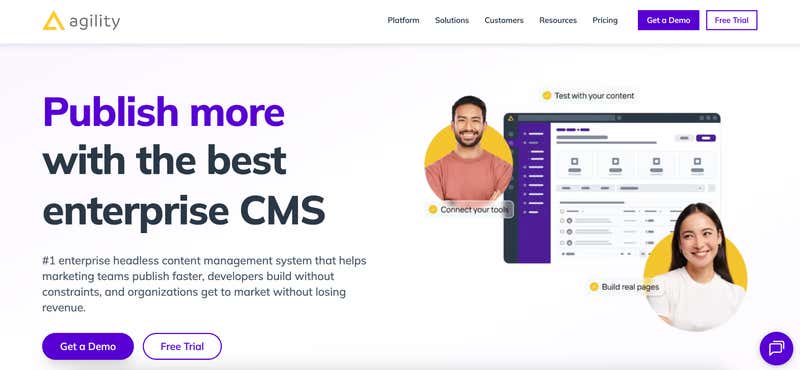
Agility CMS is a headless CMS that helps marketing teams publish faster, developers build without constraints, and organizations get to market without losing revenue. The platform is built around the belief that content teams should be able to operate day-to-day without developer involvement. At the same time, developers should have the freedom to build with whatever frameworks and libraries they choose.
Most importantly, organizations should no longer have to struggle with high total cost of ownership, third-party agency dependency, or roadmap instability. Here are a few other reasons that make Agility CMS an ideal fit as a Sitecore alternative for enterprise teams:
Marketing teams can take full control of their content
While Sitecore has a steep learning curve that can be a difficult adjustment for marketing teams, Agility CMS offers an intuitive UI and a familiar authoring experience, making it easy to deliver exceptional omnichannel experiences.
With intuitive page management, navigation, and sitemap functionality built in, marketing teams can get more done on their own. Teams can get up to speed quickly while following Agility’s structured, content-first approach, which allows them to extend, reuse, and repurpose content as needed.
For mid-market teams where developers and IT teams are already stretched, this allows teams to maintain a high content velocity with reduced developer dependency.
Developers get API-first flexibility with no framework lock-in
On the developer side, Agility CMS is fully API-first. Teams build with whatever front-end stack they're already using, whether that's Next.js, Gatsby, Nuxt, or another modern framework, and fetch content through a clean REST or GraphQL API. This differs from Sitecore, which requires third-party developer support.
Agility CMS is hosted on Microsoft Azure, bringing the same infrastructure that many Sitecore organizations already run, which means your IT and security teams are working within a familiar environment
The TCO is predictable and proportionate to mid-market scale
Agility CMS uses fixed enterprise pricing without the licensing complexity that inflates Sitecore's total cost. There are no surprise infrastructure charges or agency retainer requirements that can drive the total cost of ownership up,, as Agility includes unlimited content models and types, API requests, and locales.
The platform direction hasn't changed in a way that forces migrations
Agility CMS has been a SaaS-based headless CMS for over two decades. The roadmap evolves incrementally through improvements to the editor experience, expanded integrations, performance updates, and new features like our MCP server. For organizations burned by Sitecore's repeated pivots, this consistency enables long-term planning and stability, helping avoid disruptive replatforming or migrations.
Optimizely
Optimizely is a digital experience platform and one of the closest direct alternatives to Sitecore, offering a suite of products including content management, experimentation, personalization, analytics, and other tools. However, it also includes many of Sitecore's drawbacks, including a high total cost of ownership due to licensing and implementation costs. While marketing features are more user-friendly than Sitecore, and there is platform stability unless personalization and experimentation are the priority, teams will run into similar problems as they did with Sitecore.
Contentstack
Contentstack is an agentic experience platform and headless CMS built on a composable architecture. For organizations that want to adopt a best-of-breed approach and have strong internal engineering resources to manage it, Contentstack is a viable Sitecore alternative. However, striking the balance between developer freedom and a user-friendly marketing experience can remain challenging, and teams may still find themselves dependent on developers for many tasks.
Storyblok
Storyblok is a headless CMS with a visual editor that gives developers an API-first architecture while giving content teams a real-time editing experience that shows changes as they happen. However, even after the initial setup, enterprises may still need to rely on developers to add custom functionality and automations. For larger enterprise teams adding this level of scalability can be challenging.
Umbraco
Umbraco is an open-source .NET CMS that works for organizations already running a .NET stack. Given that it’s open source, there are no licensing costs for smaller teams, making it the Sitecore alternative with the lowest TCO. However, growing mid-market enterprises require extensive setup time and can be difficult to scale, and teams may find themselves needing to replatform more often than they would like, reintroducing some of Sitecore's downsides.
Which Sitecore Alternative Is Right for Your Team
Choosing the right Sitecore alternative comes down to your team's current makeup and the issues you're trying to solve.
If you want a platform that solves Sitecore's TCO, developer dependency, and roadmap instability at once, then we’d recommend our own Agility CMS. It's the most complete answer to the mid-market Sitecore problem, offering headless architecture, genuine marketer autonomy, predictable cost, and a product direction that doesn’t require disruptive migrations.
However, if native personalization and experimentation, or the lowest possible platform costs, are your priorities, then one of the other solutions on our list might be worth a look.
Additionally, staying on Sitecore might be the right call for some teams, particularly if you have a large, global enterprise that is deeply integrated into the Sitecore ecosystem or have the budget to cover the total cost of ownership; migrating now might not be the best choice.
If your Sitecore renewal is coming up in the next 6 to 12 months, the window to evaluate alternatives without deadline pressure is now. Contact us today for a personalized demo of Agility CMS as you assess Sitecore alternatives.

About the Author
Bryna is Director of Marketing at Agility CMS. Joining Agility in 2025, she brings over 20 years of experience driving growth for SaaS companies through customer-centric marketing programs. She specializes in building scalable lead generation engines, launching comprehensive webinar series, and designing data-driven email campaigns that deliver measurable results.
She holds a Bachelor of Arts and Communications from York University and a postgraduate certificate in Public Relations and Corporate Communications. As Director of Marketing, Bryna oversees marketing strategy and execution, working closely with the community to deliver valuable content and programs. When she's not driving marketing initiatives,
Bryna enjoys running and cycling, and serves on the Board of Directors for the Canadian Liver Foundation.
View Related Resources
