

7 Best Drupal Alternatives

Joanna Olaru-Boyle
Demand Generation Manager
Key Takeaways
- Drupal gives organizations full control of an open-source codebase, but that control means owning hosting, the PHP runtime, module compatibility, and a major version upgrade every two years.
- Headless CMS alternatives, including Contentful, Storyblok, Optimizely, and Sitecore, are hosted in the cloud with vendor-supported updates. Meanwhile, WordPress VIP manages the PHP stack for you, and dotCMS offers an open-source and self-hosted platform with built-in governance and compliance.
- Agility CMS is a SaaS-hosted headless CMS with built-in page management. It runs on no PHP, requires no version upgrades, and lets marketers publish pages without a developer ticket.
Drupal is an open-source content management system written in PHP. A global contributor community maintains it, and the Drupal Association supports it. Because Drupal’s core software has no license fee and anyone can inspect the code, it became a common choice for government agencies, universities, and other organizations running large, complex sites.
However, that also means that those organizations are completely responsible for Drupal. That means your IT team or agency has to host Drupal, keep PHP and every module patched, and plan a major version upgrade every couple of years, with the latest happening when Drupal 10 reaches end of life in December 2026.
For many organizations, those additional requirements can be too much to handle, especially when critical PHP flaws can force your website offline. If those pains have become too much to bear, we’ll break down other challenges you may not be aware of and share 7 alternatives worth considering, starting with a deep dive into our own Agility CMS.
The Downsides of Drupal
One or two of these challenges may have prompted your search for a Drupal alternative, but the others are worth being aware of before you decide whether to stick with the platform.
- Self-hosting puts security, patching, and maintenance on your team: Your team or agency is responsible for hosting, the PHP runtime, backups, and every security update. Flaws in the runtime itself, like the PHP2Shell vulnerabilities patched on October 21, 2026, can’t be stopped by Drupal modules, which adds to your developer team's concerns.
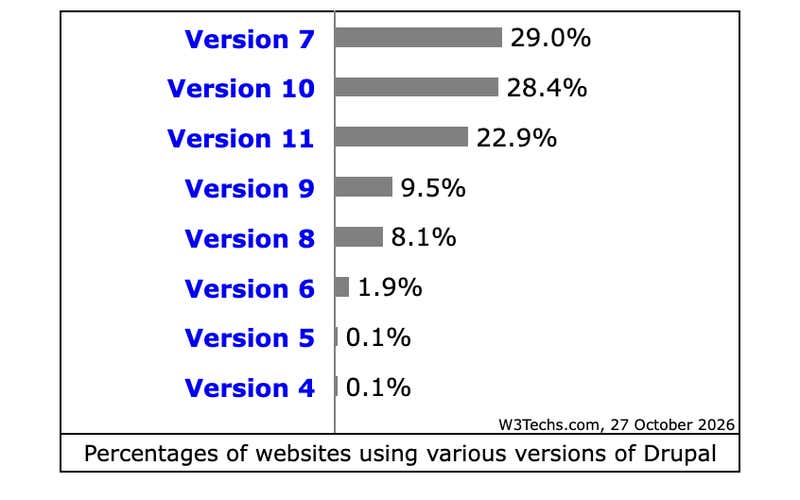
- Replatforming is often required: Drupal releases a new major version every two years, and you must update contributed modules and custom code before you can upgrade. That often means rewriting modules and retesting integrations. As of October 2026, W3Techs still counts 29% of Drupal sites on version 7, almost two years after its January 2025 end of life, showing that organizations struggle to maintain this schedule.
- Headless functionality is only an add-on: Drupal was built to render its own pages, and API-first delivery arrived only when core added JSON: API. A decoupled setup means maintaining a Drupal back end, a separate front-end application, and the preview and caching that connect them.
- Developer dependency for page and layout changes: Editors have to work inside the templates developers built, but don’t get much flexibility outside of that, so adding a new landing page layout or changing navigation usually means waiting on a developer ticket. Even Drupal Canvas, the visual page builder that became the default in Drupal CMS 2.0 in January 2026, requires existing sites to upgrade, rebuild their components, and continue the replatform cycle.
Read More: Why this pattern keeps coming back in the website replatform dilemma.
The Best Drupal Alternatives
If those problems sound familiar, the table below shows how seven platforms handle them, followed by a closer look at each one.
|
Platform |
Architecture |
Hosting |
Who patches and upgrades |
PHP your team maintains |
Marketer page building |
Pricing |
|
Agility CMS |
Headless with page management |
SaaS |
Agility |
No, unless you choose a PHP front end |
Yes; pages, sitemaps, and URLs managed in the CMS |
Free Proof of Concept, Essentials $1,425 USD Per Month, Enterprise Quoted |
|
Contentful |
Headless |
SaaS |
Contentful |
No |
With the Studio add-on |
Free and Lite tiers listed; Enterprise quoted |
|
Storyblok |
Headless with visual editor |
SaaS |
Storyblok |
No |
Yes, with the Visual Editor |
Entry tiers listed; Premium and Elite quoted |
|
WordPress VIP |
Traditional, headless, or hybrid WordPress |
Managed by VIP |
WordPress VIP |
No; runs on PHP, but VIP maintains it |
Yes, with the block editor |
Quoted |
|
dotCMS |
Hybrid headless |
SaaS, your cloud, or on-premises |
dotCMS on SaaS; your team when self-hosted |
No; built on Java |
Yes, with the Universal Visual Editor |
Free for non-production use; commercial quoted |
|
Optimizely |
DXP suite |
SaaS |
Optimizely |
No |
Yes, within the suite |
Quoted |
|
Sitecore |
Hybrid headless DXP |
SaaS |
Sitecore |
No |
Yes, within the platform |
Quoted |
Agility CMS
Agility CMS is a headless CMS that has served leading teams across sectors like entertainment, manufacturing, and insurance and finance since 2003. It delivers content through REST and GraphQL APIs to any front-end framework, and marketers get page management, visual editing, and previews inside the CMS to make managing content easier. For teams leaving Drupal, Agility CMS offers:
- Hosting, patching, and platform updates handled by Agility on Microsoft Azure
- Native headless architecture with page and sitemap management built in
- An MCP server that lets AI tools like Claude, Cursor, and GitHub Copilot work with content models, pages, and media
- SOC 2 Type II certification and a choice of five data regions
- A proof of concept built with you before you sign
No PHP to patch and no upgrade cycle to plan around
Agility’s platform, APIs, and CDN don’t execute PHP, so PHP2Shell didn’t affect them, and customers had nothing to patch on the CMS side. Because Agility is SaaS, there’s also no version 12 or 13 to migrate to. Agility runs on Microsoft Azure and ships updates continuously, so new features and security fixes reach every customer without them needing to worry about upgrading or patching things themselves.
Your developers keep ownership of the front end and can host it on Vercel, Netlify, Azure, or your own environment. However, you still maintain the runtime behind that front end.
For example, a team running a PHP front end against Agility’s Content Fetch API needed the PHP2Shell update on its own servers, while teams on Next.js, Astro, or another non-PHP framework had nothing to do.
Learn More: Use the ROI calculator to estimate what your current upgrade and maintenance cycle is costing you.
Headless from day one, with page management included
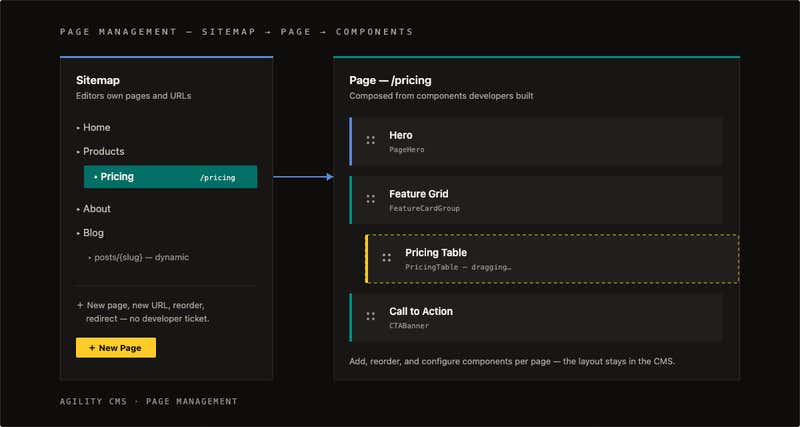
Agility was built API-first, so we designed the content model, delivery APIs, and preview together rather than adding them to a page-rendering system. Starter kits for Next.js, Nuxt, Astro, and .NET give developers a working base, and SDKs, webhooks, and a content sync API cover the build pipeline. Agility also includes Page Management, which lets editors build pages from developer-made components and directly control sitemaps and URLs, something many pure headless platforms leave to front-end code.
Marketers publish without filing a ticket
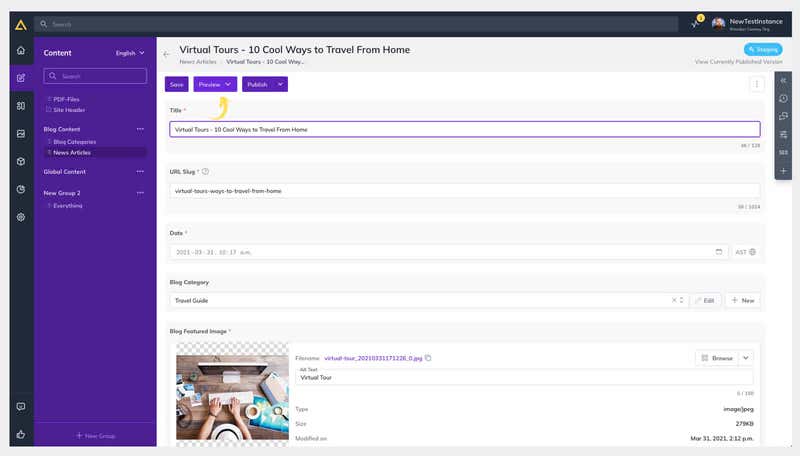
After developers build the component library, editors can assemble pages, reorder modules, and move content through approval workflows on their own. Content preview, versioning, and batch publishing are also core editor features, so a new campaign page or regional variant becomes an editorial task. Developers stay focused on the front end and integrations instead of responding to layout tickets.
At California State University, Long Beach, the College of Professional and International Education evaluated more than 25 CMS packages before choosing Agility to replace four separate content tools. The team kept its existing registration system, connected Agility to Higher Reach, Salesforce, and PeopleSoft, and pointed to faster time to market and less reliance on IT as reasons for the move.
Learn More: The Developer-Dependent CMS Calculator estimates how much of your developers’ time currently goes to content requests.
AI tools that work inside the CMS
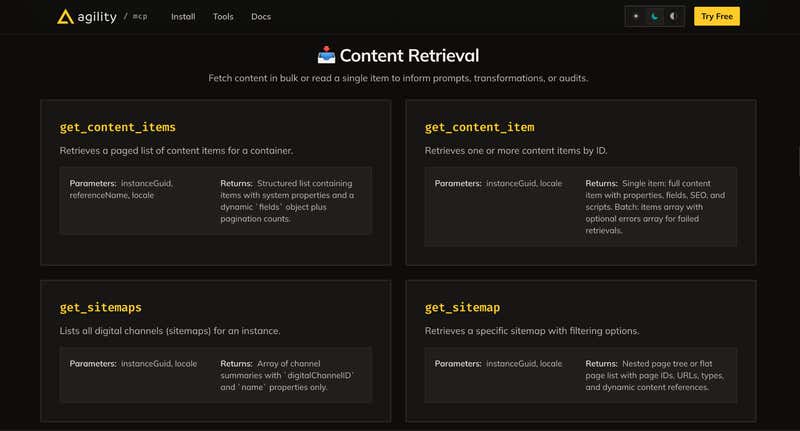
Agility’s MCP server connects AI assistants such as Claude, GitHub Copilot, Cursor, and Windsurf directly to your instance over OAuth 2.0. An agent can read and create content models, build pages, upload media, move items through workflow, and publish, all under the same roles and permissions your team already uses. Because Agility stores content as structured models rather than page HTML, the agent works with clean data instead of parsing markup.
Enterprise security without running the stack yourself
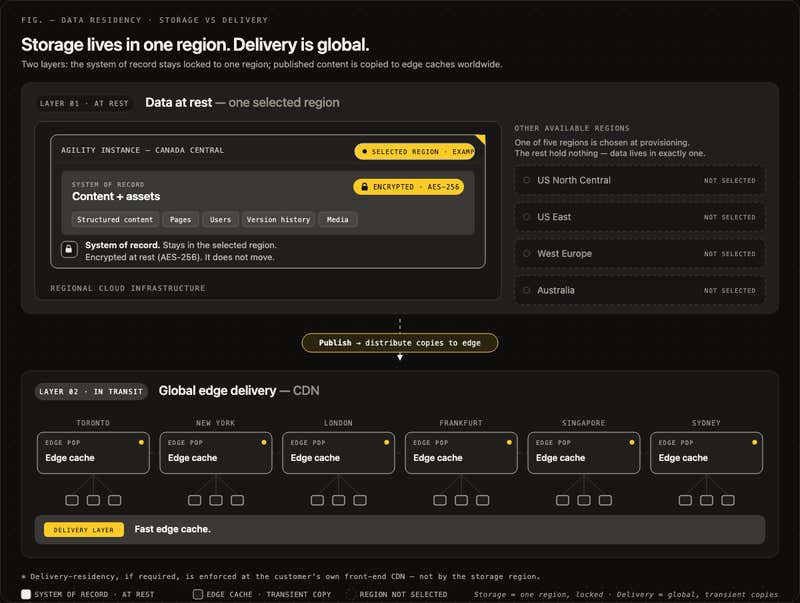
Agility is SOC 2 Type II certified and hosted on Microsoft Azure, with AES-256 encryption at rest and TLS 1.2 or higher in transit. Agility supports single sign-on (SSO) through SAML providers such as Microsoft Entra; multi-factor authentication; and fine-grained roles.
You choose one of five data regions across the US, Canada, Western Europe, and Australia when your instance is provisioned. Agility patches and hardens the platform and APIs, and your team or implementation partner secures the front end and deployment pipeline.
Scotiabank’s security team runs its own platform audits, and Agility has passed them every year. Bank staff sign in with their existing corporate credentials through Azure Active Directory, so the access rules the bank’s IT team sets carry over to the CMS. ActZero, a cybersecurity company whose buyers rank security first in procurement, pairs Agility with a statically rendered front end that keeps its public website separate from the editing layer.
Want to see your own content running on Agility? Request a proof of concept, and we’ll build it with you.
Contentful
Contentful is a headless content platform, now part of Salesforce, that enterprise brands use to deliver structured content across web, apps, and other channels. Contentful is a SaaS-based platform, so everything is hosted and managed in the cloud.
Contentful Studio handles visual page assembly, and AI Actions handle tasks like translation and SEO metadata. However, both sit on Enterprise plans and are priced separately, so if marketer page building is your main reason for leaving Drupal, factor those add-ons into the cost.
Storyblok
Storyblok is a headless CMS with a Visual Editor, which comes with every plan and shows editors the rendered page as they make changes. Its components map to frameworks like Next.js, Nuxt, and Astro, and Storyblok hosts and maintains the platform.
WordPress VIP
WordPress VIP is the managed enterprise version of WordPress. The VIP team handles hosting, scaling, and platform support. many government and regulated-industry shortlists, and it supports traditional, headless, and hybrid builds.
However, WordPress runs on PHP, so flaws like PHP2Shell still affect the stack under every VIP site. The difference from self-hosted Drupal is that VIP’s platform team owns the runtime and its patches. Editors can also work in the familiar WordPress block editor.
dotCMS
For organizations that still need to self-host for policy reasons, dotCMS is one of the few options on this list that can run on-premises, in your own cloud, or as a hosted service. It’s built on Java rather than PHP, though a self-hosted install still leaves your team patching the Java stack and servers underneath it. Editors get a Universal Visual Editor with drag-and-drop page building, and AI agents operate under the same roles, workflows, and audit trails as human users.
Optimizely
Optimizely combines content management, experimentation, and personalization into a single digital experience platform. Its CMS now leans on built-in AI agents for SEO, AI search visibility, and content upkeep, and it includes front-end hosting and multi-site management, with Optimizely running the infrastructure on its SaaS CMS. Teams with a mature testing program get the most, though moving from Drupal to a full DXP means a larger contract and more platform than a CMS replacement alone requires.
Sitecore
Sitecore now leads with SitecoreAI, a cloud-native SaaS platform that evolved from XM Cloud and brings content management, digital asset management, personalization, and analytics into one workspace. Sitecore runs and updates the platform, so Drupal teams no longer handle the back-end maintenance they do today. Marketers get an Agentic Studio with prebuilt AI agents for campaign planning, content production, and testing. As a Drupal alternative, expect enterprise licensing and a typically partner-led implementation.
How to Evaluate a Drupal Alternative
Use these questions to pressure-test every platform on your shortlist.
- Who owns hosting, patching, and upgrades?
Ask exactly which parts of the stack the vendor runs and which stay with your team. On SaaS platforms, the vendor usually handles the CMS back end while you host the front end. With self-hosted or hybrid options, confirm who applies security releases and how major updates are delivered. If the answer involves a version migration every few years, you’d be signing up for the cycle you’re trying to leave.
It’s also a good idea to include the runtime in that conversation to understand whether the stack runs on PHP, Node.js, Java, or .NET. Someone has to patch it when the next critical flaw is disclosed, and PHP2Shell showed how little warning that can come with.
- Is it headless by design or by addition?
An API-first platform treats content delivery, preview, and content modeling as one system. A traditional CMS with added APIs can serve content headlessly too, but it usually needs extra configuration for preview, caching, and routing.
- Can marketers build pages without a developer ticket?
Every headless CMS needs developers to build the first set of components, but after that initial setup, you need to understand what happens afterward. Check whether editors can create new pages, change layouts, manage URLs and navigation, and schedule releases on their own. Run that test with your own content team during the evaluation rather than relying on a vendor demo.
- Are the AI and MCP features actually in production?
Vendors often announce AI features well before customers can use them, and the larger DXPs are no exception. Ask for a live demo to confirm which features are generally available and which are still on the roadmap, and check whether AI actions follow the same permissions and approval workflows as human editors. If your developers use coding assistants, ask whether the CMS offers an MCP server and what an agent can use it to do.
- What is the team behind the software like to work with?
Most modern platforms can deliver most projects, so the people behind the software often decide how yours goes. Ask how support is structured, whether you’ll have a named contact, how flexible the vendor is on pricing and contract terms, and how much hands-on help you get during migration.
Choose Agility CMS For Your Modern CMS Needs
Agility CMS takes hosting, patching, and version upgrades off your team’s plate while giving you the headless architecture and marketer tooling that Drupal teams usually have to build themselves. Teams that move to Agility get:
- A SaaS platform on Microsoft Azure with no PHP in the stack and no major version migrations
- Native headless delivery through REST and GraphQL, plus page and sitemap management for editors
- An MCP server that connects AI tools like Claude and Cursor to your content, governed by your existing roles
- SOC 2 Type II certification and a choice of five data regions
- A proof of concept built on your own content, and hands-on migration support from the Agility team
Cineplex runs its website, mobile app, digital place-based media, and amusement properties from a single Agility instance. One content update reaches every surface at once, without a separate publishing queue for each property, and the company has reported a 15% lift in ad revenue since moving to Agility.
Book a demo for a personalized walkthrough and a proof of concept built on your own content, and see how your Drupal site would run on Agility CMS.


