
Drupal vs Joomla: Why Enterprises Are Choosing a Headless CMS Instead

Key Takeaways
-
Drupal excels in complex, developer-managed environments but imposes a high total cost of ownership and disruptive version migrations. Joomla sits between WordPress and Drupal in flexibility but lacks the depth for complex enterprise needs.
-
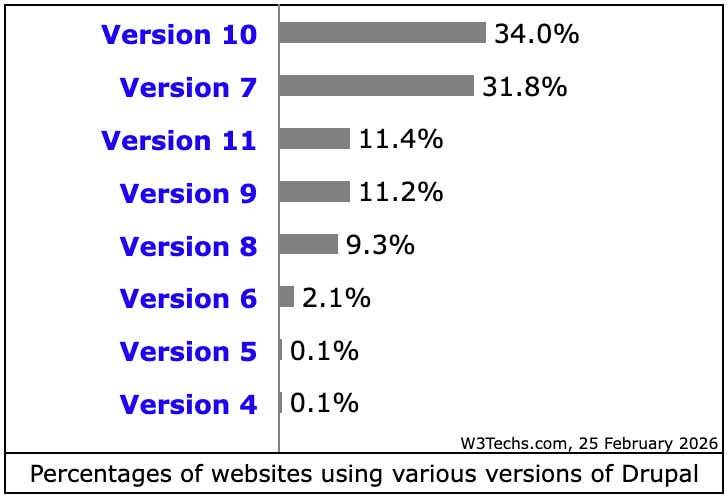
Over 50% of Drupal customers and over 60% of Joomla customers are still running unsupported versions, exposing their organizations to security vulnerabilities and costly forced migrations with no straightforward upgrade path.
-
The headless CMS model solves problems that Drupal and Joomla users suffer with due to their monolithic architecture.
-
Agility CMS is a headless CMS purpose-built for enterprise multi-site management, marketer autonomy, and content operations at scale.
Drupal and Joomla built the modern enterprise web. In the early 2000s, when "having a website" was the goal, both platforms delivered for governments, universities, media companies, and enterprises of all sizes.
But the goal isn't just a website anymore. Instead, it’s multiple channels publishing different content, personalized for different audiences, and updated in real time. And when enterprises try to do that on Drupal or Joomla, the complexity, maintenance, performance, and security cracks start to compound.
If you're like most enterprises comparing these two platforms right now, you’re probably not alone in dealing with frequent end-of-life announcements disrupting your operations every few years.
This guide will give you an honest look at both. But it will also show you why the most important question isn't which one to choose; it's whether either one still fits where your business needs to go.
Drupal vs Joomla (A Quick Comparison)
Drupal is an open-source CMS built for complexity. It's highly flexible and has a strong track record in government, higher education, and large institutional environments where security and customization are non-negotiable.
Where it excels:
-
Complex, custom content structures with deep taxonomy and data relationships
-
Enterprise-grade security and compliance requirements
-
Multilingual and multisite configurations for organizations with dedicated development teams
-
Extensibility for organizations willing to invest in long-term platform ownership
Where it falls short:
-
Drupal is tough for content editors who don’t have a coding background to navigate without developer support
-
Major version upgrades are disruptive and expensive, as thousands of Drupal 7, 8, and 9 customers discovered firsthand, with over 50% of Drupal customers still on these unsecure legacy versions.
-
The total cost of ownership climbs significantly as content operations scale
-
Time to market suffers when marketing velocity depends on development capacity
Joomla is an open-source CMS that operates between WordPress and Drupal. It is more extensible than the former and more accessible than the latter. For basic websites with moderate customization needs, it served its purpose well throughout the 2010s.
Where it excels:
-
Quicker initial setup compared to Drupal for moderately complex sites
-
A broad extension library for standard functionality
-
Lower barrier to entry for organizations without large development teams
Where it falls short:
-
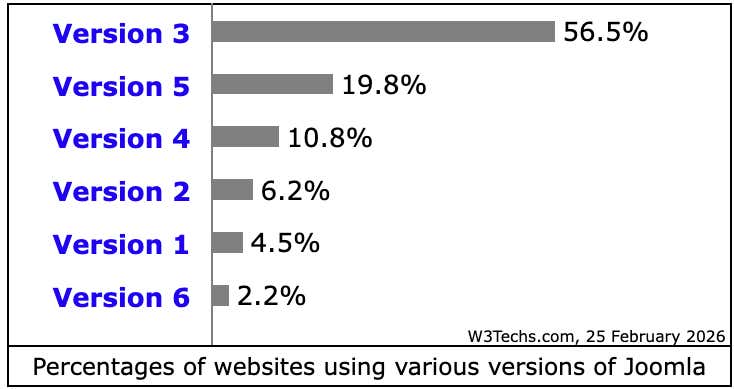
A shrinking developer community and ecosystem that hasn't kept pace with the market. Similarly to Drupal, over 60% of websites are on outdated legacy versions like Joomla 3 or earlier.
-
Editorial experience that feels dated compared to modern CMS platforms
-
Not robust enough for complex enterprise architectures, not agile enough for fast-moving marketing teams
Ultimately, both Drupal and Joomla share the same core limitation of a monolithic architecture that tightly couples content, presentation, and code. This tight coupling creates operational problems that enterprises hit when they try to scale beyond a single website.
Why Enterprises Outgrow Drupal and Joomla
Drupal and Joomla's limitations aren't always obvious at first. A single website with a stable team and a predictable publishing cadence can run on either platform without major friction. The problems surface when enterprises try to move faster, expand to new channels, or manage content across multiple properties.
Developer Dependency
On both platforms, marketers and content teams operate within boundaries set by developers. Updating a page template, adding a new content type, or changing a navigation element typically requires developer support.
Even Acquia, the developers of Drupal, admitted as much, by saying it had “a steep learning curve that frightened away marketers and required a pit crew of developers to maintain.” With many existing customers still on legacy Drupal solutions, this remains a problem.
For enterprises publishing across multiple teams and time zones, this dependency becomes a structural bottleneck that no process improvement can fully eliminate. Additionally, most enterprises are forced to rely on third-party agencies to provide that developer support.
Built for a One-Site World
Both platforms were designed around a single website. Running multiple properties in the form of regional sites, brand microsites, and campaign landing pages means managing separate installs, separate update cycles, and separate codebases.
This eventually becomes a content lifecycle management problem as there is no native mechanism for sharing content, components, or governance across properties, and each site becomes its own operational burden. Workarounds exist, but each requires developer implementation and introduces its own operational complexity.
Omnichannel Delivery
Enterprise content no longer lives only on a website. It needs to reach mobile apps, digital kiosks, in-store displays, partner portals, and email campaigns. Both Drupal and Joomla were built as web-first systems with tightly coupled architecture.
Decoupled or headless implementations, which are required for delivering content to multiple channels, need to be architected and maintained separately. This adds a layer of developer complexity that a purpose-built headless or hybrid CMS would handle natively.
The Update and Security Burden
Both platforms require ongoing developer investment just to remain current. Drupal's major version migrations are notoriously disruptive. They typically leave enterprises facing costly, time-intensive overhauls with no straightforward upgrade path. Joomla faces a quieter version of the same problem due to an aging ecosystem, a shrinking contributor community, and extensions that don't always keep pace with core updates.
Not migrating is where the security issues begin to rise, and for enterprises, this creates a compounding risk. The longer you stay on an aging version, the more expensive and complex the eventual migration becomes.
Why Enterprises Are Switching to Headless CMSs Instead
The shift away from Drupal and Joomla isn't happening because headless CMS platforms have better marketing. It's happening because the architecture solves the specific problems that monolithic platforms can't without requiring enterprises to rebuild their entire content strategy from scratch.
Marketer Autonomy
A headless CMS decouples content from presentation, meaning the publishing interface your marketing team uses depends only on the backend code your developers maintain. Marketers can create, update, and publish content without opening a ticket, while developers can update the frontend without disrupting editorial workflows. This allows teams to move at their own pace in parallel, without producing bottlenecks for one another.
For enterprises where content velocity is a competitive advantage, such as insurance companies updating claim pages during weather events, retailers updating inventory across locations, or media brands responding to breaking news, this operational independence is the difference between capitalizing on a moment and missing it.
A Single Content Hub Across Every Channel
Headless CMS platforms store content as structured data and deliver it via API to any frontend or channel. This means that a content update made once flows everywhere it needs to go. There's no duplicate entry, no channel-specific installs, no separate content management for each property. This is the architecture modern enterprise content operations require.
Multi-Site Management Without the Overhead
Modern headless platforms are built for organizations managing multiple digital properties. So regional teams with brand microsites and campaign sites can all operate from a single instance, all while sharing content models, components, and governance guardrails, and without requiring separate installs or dedicated IT support for each property.
Is Headless Right For Your Enterprise?
A headless CMS isn’t right for everyone. For most organizations, the architectural shift delivers immediate, measurable operational improvements. But for others, the timing isn't right.
It's the right move if:
-
You're managing more than one digital property, and the overhead of operating separate systems is becoming unsustainable
-
Your content team regularly loses time waiting on developer availability for changes that should be within their control
-
Your content needs to reach more than a website, including apps, kiosks, partner portals, or other channels, that are either already in play or on the roadmap
-
You've been through a major version migration on Drupal or Joomla, and the cost and disruption has made you question the sustainability of the platform
-
Your current CMS is creating a ceiling on content velocity that process changes alone haven't been able to raise
It may not be the right move yet if:
-
You're operating a single website with a stable, manageable publishing cadence and no near-term plans to expand
-
Your organization doesn't yet have the development resource for the initial implementation and content modeling work that a headless migration requires
-
A major platform migration would compete for the same development bandwidth you need for other critical business priorities right now
The honest version of this decision boils down to one question. Is your current platform imposing operational limitations that affect your ability to execute? If the answer is yes — and for most enterprises on aging Drupal or Joomla, it is — then headless is worth serious evaluation.
If you want to quantify the operational cost of staying on your current platform, Agility's ROI calculator gives you a baseline to work from.
Why Agility CMS for Enterprises Moving Off Drupal or Joomla
Migrating off a platform you've invested years in is not a decision enterprises make lightly. Will the new platform actually deliver on what's promised? Who supports the migration? What happens when something breaks after go-live?
These are the questions that make enterprise buyers cautious, and rightfully so. Here's why Agility CMS answers them.
Migration Support Through Agency Partners and White-Glove Service
Agility CMS has an established network of implementation partners with direct experience migrating enterprises off Drupal and Joomla. Unlike platforms that hand you documentation and leave you to figure it out, Agility's team stays involved through the build, the migration, and beyond. For organizations that have been burned by a Drupal or Joomla version migration before, this level of support is an absolute necessity.
A Marketer-First Editorial Experience
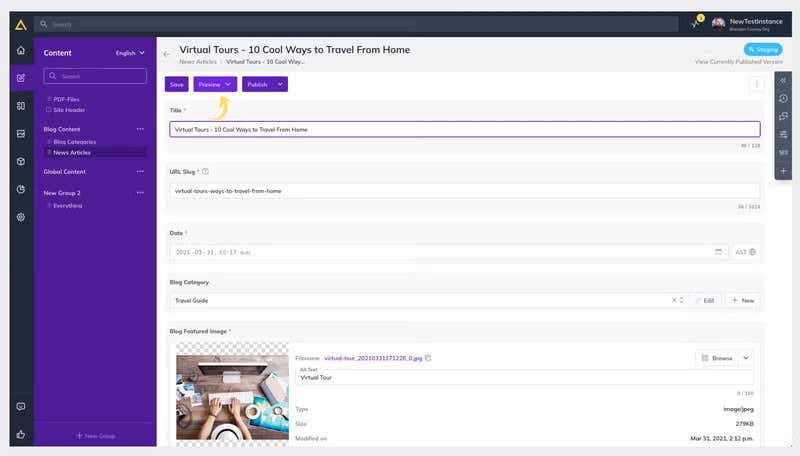
Agility CMS was built to enable marketing teams to operate independently. Visual editing, content previews, customizable workflows, and a straightforward publishing interface mean that the autonomy headless promises in theory actually exist in practice. This allows content teams to stop waiting on developers, and developers to stop fielding requests that have nothing to do with their core work.
Multi-Site Management From a Single Instance
Whether you're managing two regional sites or twenty, Agility CMS handles it from one platform. Shared content models, reusable components, and governance tools mean your teams work consistently without duplicating effort or requiring separate technical oversight for each property.
This is part of what makes Agility a composable content management platform. Rather than locking you into a monolithic system, you connect best-of-breed tools around a flexible content management system.
And for enterprises evaluating long-term platform stability, Agility CMS has been independently owned and operated for over 20 years, ensuring the roadmap is driven by customer needs rather than an exit strategy.
Enterprise-Grade Security & Flexibility
Agility CMS offers enterprise-grade security through multifactor authentication, SOC2- and ISO-compliant infrastructure, role-based authentication, single sign-on, and more, backed by Microsoft Azure.
When the Canadian multinational company Scotiabank approached Agility, they needed to quickly and securely launch several websites for new regions they expanded into. They’ve successfully rebranded and rebuilt the website front ends for each country multiple times as needed over the many years they've been on the Agility CMS platform.
The development teams have reused existing content from Agility to save time and resources on each rebuild and design refresh, without worrying about migration issues they might encounter on platforms like Drupal or Joomla.
|
Drupal |
Joomla |
Agility CMS |
|
|
Architecture |
Monolithic with content, code and presentation tightly coupled together |
Monolithic with content, code and presentation tightly coupled together |
Modern headless and API-first architecture |
|
Best for |
Complex institutional sites, government, higher education |
Non-profits, small businesses and community organizations with developer resources and moderate customization needs |
Mid-market enterprises with multi-site operations across financial services, retail, media, higher education and more |
|
Ease of use |
Steep learning curve, requires experienced developers |
More accessible than Drupal but not user-friendly |
Marketer-friendly interface with full developer flexibility |
|
Omnichannel delivery |
Web-only by default and additional channels requires custom API development |
Web-only by default and additional channels requires custom API development |
Native API-first delivery to any channel or frontend |
|
Multi-site management |
Separate installs per property |
Separate installs per property |
Manage multiple properties from a single instance |
|
Version migrations |
Disruptive Drupal 7, 8, and 9 EOL cycles have stranded thousands of enterprises |
Less dramatic but ecosystem is shrinking |
SaaS so updates are managed by Agility with no frequent migration requirements |
|
Support model |
Community and agency dependency |
Community and agency dependency |
White-glove onboarding with hands-on human team support |
|
Platform stability |
Open source, subject to community shifts |
Open source,but with a declining contributor community |
Independently owned, bootstrapped, 20+ years in operation |
|
Pricing model |
Free (open source) but high TCO from agency developer, and frequent migration costs |
Free (open source) with a moderate TCO |
SaaS subscription, predictable cost, no hidden agency overhead |
|
Security |
Strong security track record provided there is ongoing developer support and consistent migration to new versions, otherwise quickly outdated |
Adequate security provided there is ongoing developer support and consistent migration to new versions, otherwise quickly outdated |
SOC2- and ISO-compliant infrastructure, MFA, RBAC, SSO, backed by Microsoft Azure |
Wrapping Up
The headless CMS model, with platforms like Agility CMS, is purpose-built for enterprise content operations and solves the limitations that Drupal and Joomla have which are difficult to solve by remaining on monolithic architecture.
If your current platform is creating a ceiling on what your content team can execute, that's the signal worth acting on.
Test out Agility CMS today and see if it’s right for your business.

About the Author
Bryna is Director of Marketing at Agility CMS. Joining Agility in 2025, she brings over 20 years of experience driving growth for SaaS companies through customer-centric marketing programs. She specializes in building scalable lead generation engines, launching comprehensive webinar series, and designing data-driven email campaigns that deliver measurable results.
She holds a Bachelor of Arts and Communications from York University and a postgraduate certificate in Public Relations and Corporate Communications. As Director of Marketing, Bryna oversees marketing strategy and execution, working closely with the community to deliver valuable content and programs. When she's not driving marketing initiatives,
Bryna enjoys running and cycling, and serves on the Board of Directors for the Canadian Liver Foundation.


