

Digitization vs Digitalization vs Digital Transformation: What's the Difference?
Andre Oentoro

Key Takeaways
- Nearly nine in ten organizations use AI in at least one business function, but fewer than half (44%) are scaling it across the enterprise. Content and workflows that were never fully digitized or digitalized often hold that progress back.
- Digitization converts analog information into digital form. For AI and multichannel delivery, that content also needs to be structured into fields rather than locked in files and page layouts.
- Digitalization changes how work gets done with digital information. Digital transformation is the organization-wide change that builds on both, including how a company uses AI.
- Agility CMS is a headless CMS with page management. It stores content in a structured format, lets marketers publish without developer help, and connects AI assistants through an MCP server.
Digitization, digitalization, and digital transformation get used interchangeably in strategy decks and RFPs, even though they describe different kinds of change. The first is about the format information is stored in. The other two are about what an organization does with that information once it's digital.
Most organizations are already somewhere in the third stage. The trouble is that the first two are rarely finished everywhere, and AI has made those gaps harder to ignore. A few years ago, a PDF or a page layout counted as digitized. AI tools and AI search engines now need content they can read and reuse in pieces, and much digital content still falls short.
In this article we’ll explain the differences between digitization, digitalization, and digital transformation and how organizations can start to close their digital gaps as they incorporate AI.
What's the Difference Between Digitization, Digitalization, and Digital Transformation?
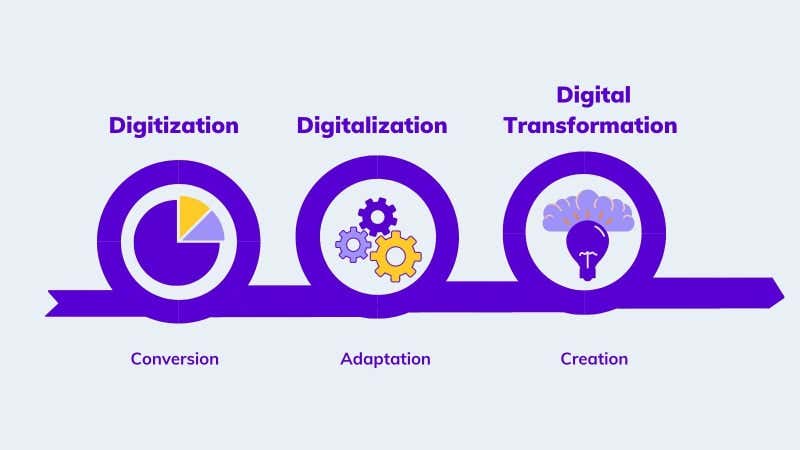
Digitization converts analog information into a digital format, such as scanning a paper contract and saving it as a PDF. Digitalization goes a step further, covering how organizations adopt and use digital technologies across their people, processes, and wider business context. Digital transformation is the broadest of the three, as it involves rewiring how the whole organization operates so it can deploy technology at scale to improve customer experience and lower costs.
| Digitization | Digitalization | Digital transformation | |
| What changes | The format of information | How a process works | How the organization operates |
| Example |
Moving product copy out of page layouts and PDFs into structured content fields | Marketers publishing updates themselves instead of filing a developer ticket | One content source feeding every site, app, and AI tool, with teams organized around it |
| Depends on |
Nothing before it | Digitized information | Digitalized processes across teams |
| What it means for AI |
Content has to be machine-readable, not just digital | AI drafts and updates content inside the approval workflow | AI agents become part of how work runs, with governance and an audit trail |
What Is Digitization?
Digitization is the process of converting analog information into a digital format. Scanning paper records, converting audio and video recordings to digital files, and moving paper forms online all count.
For most organizations, that work happened years ago. What has changed is the standard digital content must meet. Content inside a PDF, a page layout, or application code is digital, but it's tied to the one place it lives. Reusing it on another site, sending it to an app, or handing it to an AI tool means someone has to copy it out by hand.
Machine-readable content is broken into fields, such as a title, summary, body copy, product specs, or a legal disclaimer. An API can deliver each field wherever it's needed, and AI tools can read, update, and reformat it without guessing where one piece of content ends and the next begins.
Digitization solves the problem of information that can't be searched, shared, or reused. However, teams need to finish the job by moving content out of files and page layouts and into structured fields.
What Is Digitalization?
Digitalization is the adoption and use of digital technologies across an organization’s people, processes, and wider business context, along with the changes that adoption sets off. Digitization changes the format of information, while digitalization changes the processes built around it.
In content operations, digitalization usually targets problems like these:
- Updates stuck in a queue: A pricing change or a typo fix waits for a developer, a ticket, and the next deployment.
- Content copied by hand: The same product description, legal notice, or campaign message gets entered separately for each site, region, or brand, and the copies drift out of sync over time.
- Reviews outside the system: Approvals happen over email and chat, so there's no clear record of who signed off on which version.
To fix these problems, teams need modern content platforms with self-serve publishing for marketers, approval workflows inside the CMS, and a single content source that feeds several websites at once. Although none of these change the business model on their own, they can shorten the time between a decision and a published change.
Read More: Content Operations: How Your CMS Makes or Breaks Enterprise Content Velocity
What Is Digital Transformation, and Where Does AI Fit?
Digital transformation is the fundamental rewiring of how an organization operates. The goal is to build a competitive advantage by continuously deploying technology at scale to improve customer experience and lower costs. Digitalization improves individual processes, but transformation changes how those processes connect across teams, channels, and the customer experience.
AI now sits at the center of most transformation programs, yet many teams talk about AI transformation as its own initiative. In reality, it’s just another stage of digital transformation.
In McKinsey’s 2026 State of AI survey, nearly nine in ten organizations reported regular AI use in at least one business function. The share scaling AI across the enterprise rose to 44%, up from 38% a year earlier. Additionally, agent adoption is split sharply by company size: 40% of organizations with more than $1 billion in annual revenue are scaling AI agents in at least one function, up from 27%. In comparison, smaller organizations stayed flat at 22%.
The same survey found that nearly three-quarters of AI high performers have fundamentally redesigned workflows because of their AI use, up from 55% the year before. Only about one-quarter of other organizations have done the same.
The results came from rebuilding work around AI rather than adding AI to existing processes, and that kind of rebuild depends on content and workflows that AI can use.
Why Do Digital Transformation Projects Stall?
Most organizations are already working on digital transformation, but the earlier stages are rarely finished across every team, site, and content type. A company might run its main website on a modern headless CMS while product documentation sits in PDFs and regional sites still depend on hard-coded content.
AI and multichannel delivery both depend on structured content and digitalized workflows, so gaps in either show up as soon as you add AI. An AI assistant can't update content that only exists inside a page layout. Without an approval step and version history to catch mistakes, teams also can't trust it to make changes on its own.
That's why many AI pilots work in a demo and stall in production. It's also why teams often end up restructuring content and publishing workflows in the middle of a replatform, when the work is hardest to fit in.
Where Are the Gaps in Your Organization?
Gaps in your level of digitalization or digital transformation are rarely present across the entire organization. Instead, they tend to sit in specific sites, teams, or content types, and show up as day-to-day friction.
Signs of a Digitization Gap
- Content only exists as finished pages, PDFs, or text inside application code.
- AI tools and AI search engines struggle to pull clean, accurate answers from your content.
Signs of a Digitalization Gap
- Marketers can't publish a page or fix a typo without a developer and a deployment.
- Each site, region, or brand keeps its own copy of content that should be shared.
- Approvals happen in email threads instead of the CMS.
Signs of a Digital Transformation Gap
- AI experiments run in separate tools with no connection to your content system, and nobody can trace what AI changed or who approved it.
- Every new channel still starts as a new content project.
How Agility CMS Supports Each Stage
Agility CMS is a headless CMS with page management that allows teams to close gaps at each stage without rebuilding everything at once.
Digitization: Structured Content Delivered Through APIs
In Agility, content lives in content models that break it into fields, and APIs deliver those fields to any website, app, or channel. One product description or legal notice can appear on several sites from a single source, and AI tools get structured data to work with instead of text scraped from a page.
Digitalization: Page Management, Web Studio, and Workflows
Agility offers page management and other user-friendly marketing features to support digitalization efforts. Content editors can manage the sitemap, add pages, place components, set SEO, and preview changes without a deployment, while your front end renders each page with its own code. Web Studio adds visual editing on the live site, so marketers see their changes in context.
You can enable approval workflows for individual pages and content lists. Editors submit changes for review, and Publishers approve them or send them back with notes before anything goes live.
Digital Transformation: AI Through the Agility CMS MCP Server
To support this new stage of digital transformation, the Agility CMS MCP server connects AI assistants such as Claude, Cursor, and VS Code to your Agility instance. AI can read content models, content items, and the sitemap, and it can create and update content and pages.
Governance is built in too, since by default, the MCP server asks for approval on every write and only reaches instances the user already has access to. It currently has no tools to publish or approve content, so someone on your team reviews what the AI produced and makes the final call.
How Agility CMS Supported a Commercial Real Estate Migration in Under Three Weeks
A leading commercial real estate organization needed a CMS that could connect to its in-house client tool, a leasing API, Walkscore, and other industry systems while meeting enterprise accessibility and data protection requirements. Its existing CMS made it hard for non-technical users to update content.
Working with implementation partner Dotfusion, the organization split the project into two phases. IT led the move to Agility CMS first, and marketing led the website redesign after the migration. The full site migrated in under three weeks, and the marketing team now manages content without developer help.
Want to see how Agility CMS fits your transformation roadmap? We offer a proof of concept, so your team can test it on a real project. Book a demo to learn more.
FAQs
Is AI transformation replacing digital transformation?
No. AI transformation is the current phase of digital transformation, not a separate program. Companies that treat it as a standalone initiative often find their AI tools running into the same content and workflow problems their earlier projects left behind.
Does digital transformation require replacing your CMS?
Not always. If your current CMS stores content as structured data and lets marketers publish without developers, you can often build on it. If content is locked into pages and every update goes through a developer, the CMS is likely holding the organization back. A phased approach, with migration first and redesign second, keeps the risk manageable.
How do you make existing content usable by AI?
Start with the content that changes most often or appears in the most places, such as product details, pricing, or legal text. Model it into structured fields, migrate it section by section, and connect AI through governed access with approvals and version history.


