
Agentic Content Systems Are Already Here: CMS Connect 2026
Peak human traffic has already happened. Two days in Montreal on what that means.

Peak human traffic on the internet has already happened. We passed it. Nobody sent a memo.
That was the single most disorienting thing I heard across two days at CMS Connect 2026 in Montreal, and once you accept it, most of the rest of the conference reorganizes itself around it. Your content has two audiences now. Only one of them is human. And as of this year, the other one is starting to act rather than just read.
I have been building content management systems for 21 years. I came expecting to hear about AI features. What I got was a much more useful conversation about plumbing, economics and trust.
Two people bookended this conference without coordinating. Matt Garrepy opened Day 1 with five patterns. Olivier Dobberkau closed Day 2 with seven shifts. They overlap almost perfectly, which tells me the industry has actually converged on a diagnosis even while it argues about the cure.
Jeff Goldblum also appeared on both days, in three separate decks, which I choose to read as a sign.
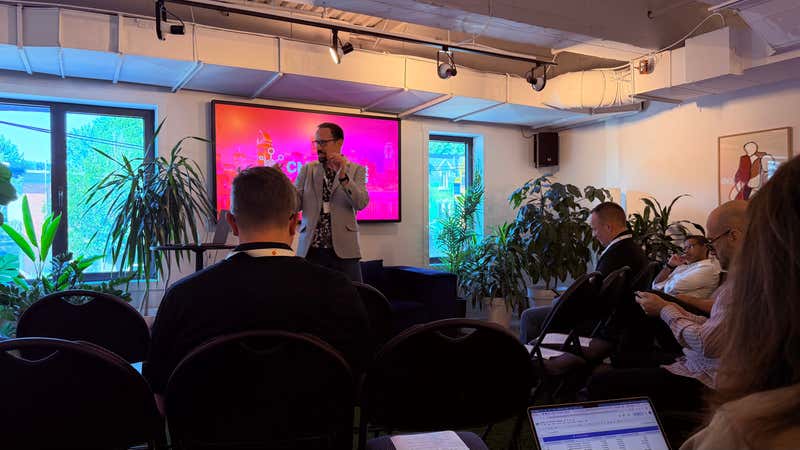
Montreal CoWork in Le Plateau. No sales pitches, and paper evaluation forms. Janus Boye donates money for every one filled in, which is the most effective feedback mechanism I have seen at a conference.
Day 1: the diagnosis
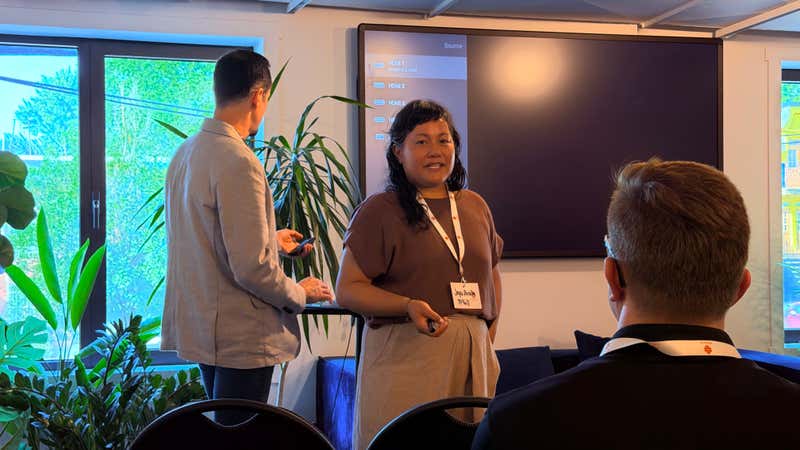
Joyce Peralta of McGill opens with the question that framed both days: how do organizations shift their processes, and their whole philosophy about who they are, when user expectations change?
The market is fragmenting, not consolidating
Matt Garrepy, Chief Critic at CMS Critic, opened with a number that should worry anyone buying software this year. The CMS and web experience management category grew 21.4% in a year, from 504 products to 612. That is not a maturing market. That is a market where everyone is repositioning at once.
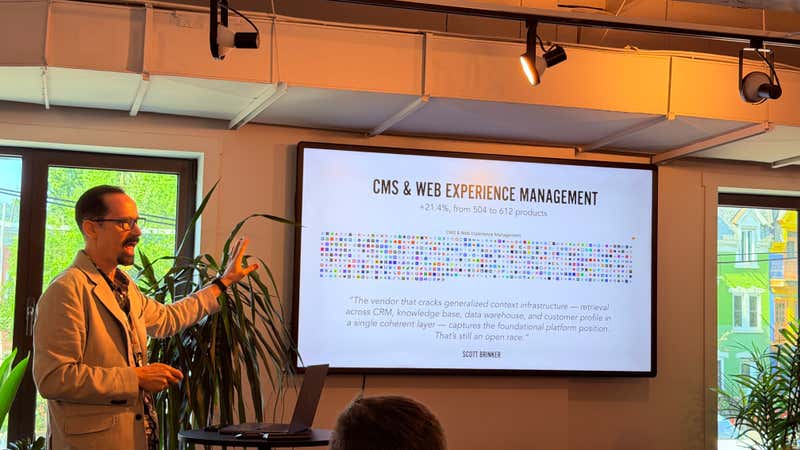
612 products, up 21.4% in a year. The Scott Brinker quote on the right is the one I keep returning to.
Scott Brinker's quote was on that slide: the vendor that cracks generalized context infrastructure, meaning retrieval across CRM, knowledge base, data warehouse and customer profile in a single coherent layer, captures the foundational platform position. And it is still an open race.
That is the actual competition now. Not page builders.
He framed the keynote around The Fly, the 1986 Jeff Goldblum version, and the metaphor held up better than I expected. AI is not an evolution of what we had. It is a mutation. Something went into the transporter and something else came out. His serious point landed harder than the gag: the real horror story is not the technology, it is the fragmentation of our industry.
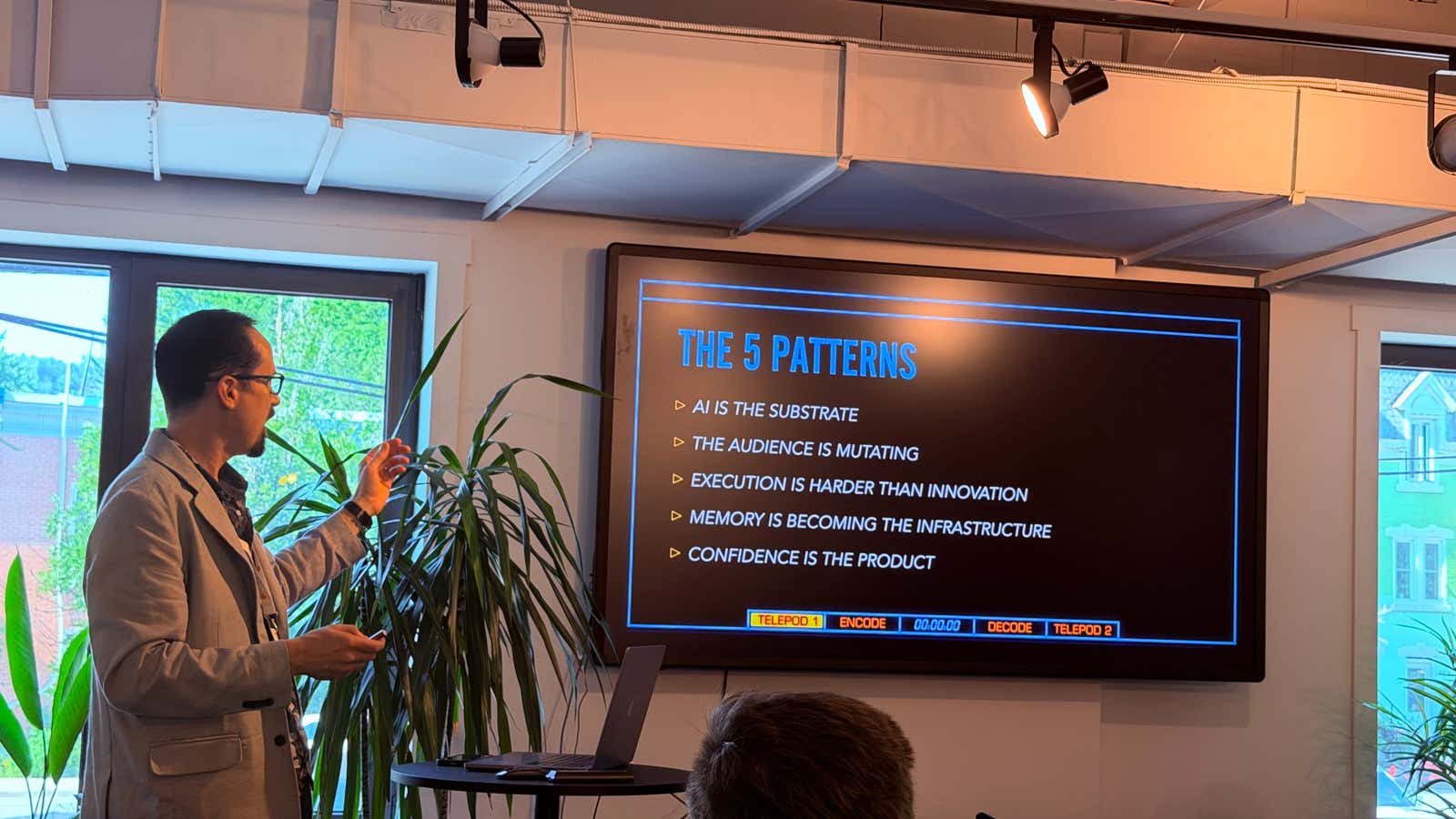
His five patterns:
- AI is the substrate. It is imbued in everything we produce now, not bolted on.
- The audience is mutating. Most websites were never built for machine experience.
- Execution is harder than innovation. Anthropic shipped 120 features in 90 days. Product is dumping features on marketing faster than marketing can position them.
- Memory is becoming the infrastructure. Models change constantly. Institutional memory should not.
- Confidence is the product. Matt's line was that CMS should stand for confidence management system. We sell trust.
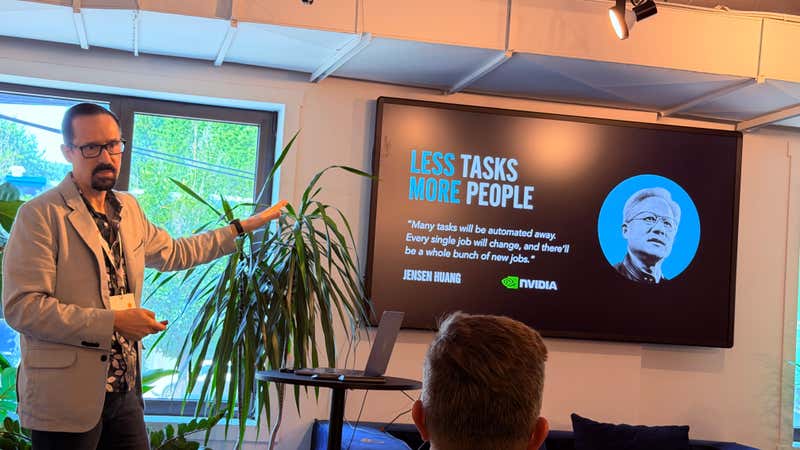
"Less tasks, more people." Jensen Huang's framing of what automation actually does to work.
On the human question he was blunt in a way I appreciated. Intelligence is not judgement. Hallucination rates remain breathtakingly high and we have collectively decided that is an acceptable risk in a way we would accept nowhere else. A human in the loop is not enough. You need a human in control, which is a different thing and a harder one to design for.
Nobody owns the content layer, and that is why AI keeps breaking things
Carrie Hane made the argument that stuck hardest, and she made it without mentioning a single AI product. Her subject was content infrastructure debt.
Billions of web pages exist. Roughly 95% of them get zero views. We built that. Her metaphor was the kudzu vine, the ornamental import that ate the American south. We spent fifteen years getting better at page builders and almost no time getting better at content repositories. We optimized what the boxes looked like instead of what went in them.
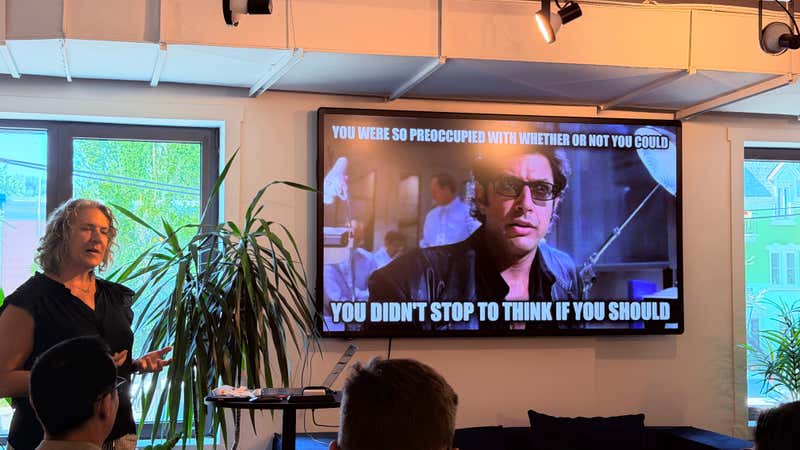
The second Goldblum sighting of the conference, and the most deserved.
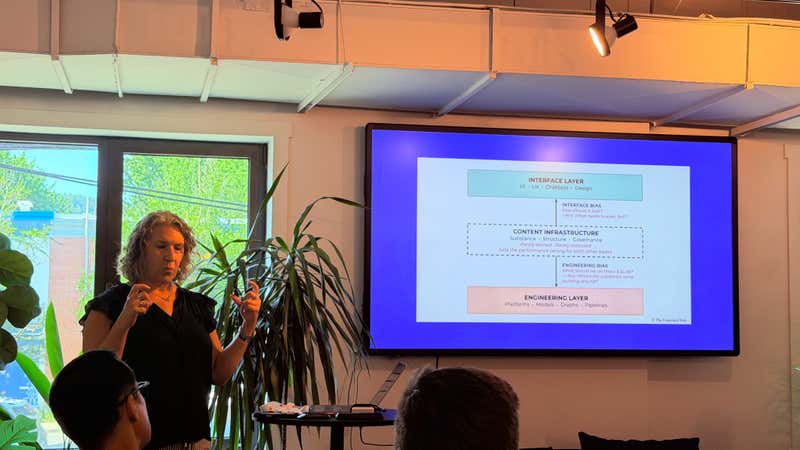
Content infrastructure sits between the interface layer and the engineering layer. Rarely owned, rarely assessed, and it caps the performance of both.
Her diagram named the failure precisely. An interface layer full of UI, UX and design people asking how it should look. An engineering layer full of platform and pipeline people asking what to architect. In between sits content infrastructure, meaning substance, structure and governance. Rarely owned by anyone. Rarely assessed. And it sets the performance ceiling for both of the other layers.
AI did not create that debt. AI made it visible and started compounding it faster.
Her second point is the one I would push on with most teams: the first real opportunity for AI in content is not generation, it is governance. Humans are bad at governance because they are downstream of pressure to produce more. AI is genuinely good at it. The second opportunity is personalization, which remains the least used feature in most CMS platforms despite everyone paying for it.
AI works best on a blank page, and almost nothing real is a blank page
Andrei Kalamkarov from Concordia University gave the most honest talk of the conference.
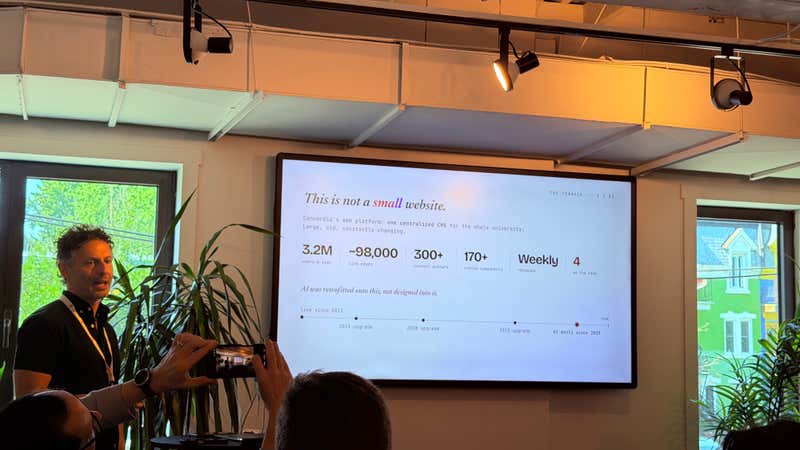
One centralized CMS for an entire university. Thirteen years, four redesigns, four people on the team.
Concordia runs one centralized CMS for the whole university, live since 2013. Roughly 98,000 live pages, 300+ content authors, 170+ custom components, 3.2 million users a year, weekly releases, four people on the team. AI was retrofitted onto that. It was not designed into it.
His examples were painfully familiar. A content model stored HTML inside text fields, and the AI-built renderer did not know enough to render the entities. A field convention depended on a leading space that the code deliberately hid, and an AI update trimmed the whitespace and wrecked formatting across a lot of pages. Editors had been allowed to embed CSS directly in components so they could ship without a code release, which was a reasonable trade in 2016 and is now the reason those components are nearly impossible to change.
In a legacy system, the thing that looks like a mistake is often load-bearing. AI's default instinct is to modernize and standardize. That instinct is frequently wrong.
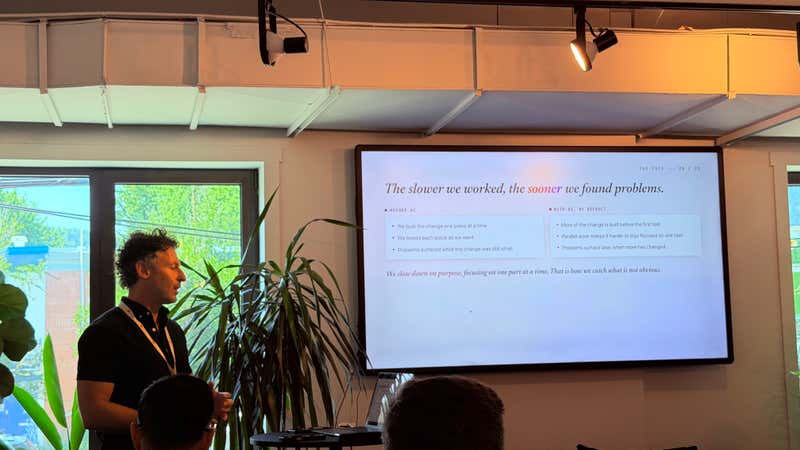
The slide I photographed and then wrote down anyway. Working slower surfaces problems sooner.
Before AI, you built one piece, tested it, and problems surfaced while the change was still small. With AI by default, more gets built before the first test, parallel work splits your attention, and problems surface later when far more has changed. Concordia now slows down on purpose.
That is not a rejection of AI. That is a team that has learned where the risk actually lives.
"Human" has quietly become conditional

Alka Tandan opens the session nobody wanted to have and everybody needed.
Alka Tandan of Reframe and Refine asked the question most organizations are avoiding: what happens when something gets published and nobody clicked publish?
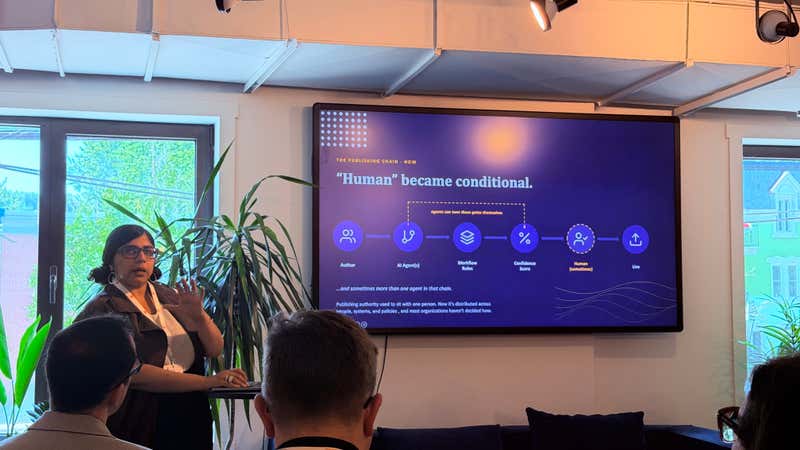
The publishing chain now runs author, AI agents, workflow rules, confidence score, human (sometimes), live.
Publishing authority used to sit with one person. It is now distributed across people, systems and policies, and most organizations have not decided how. And agents can increasingly tune those gates themselves.
Two forces are pushing this fast. Time, because getting content created and live has always been the bottleneck. And scale, because agents operate at a volume no review process was designed for. So we have started skimming the summary and approving the operation. Then auto-approving it.
I am amazed at how quickly we are willing to let AI act on our behalf. What I liked about Alka's framing is that she did not moralize about it. She asked which classes of action you actually want a human on, and which you are comfortable offloading. That is a decision you should make deliberately rather than discover in a postmortem. We went through a version of this exercise internally when we built our own AI data security policy, and the hardest part was never the technology.
Morning break. The other reason to come to these things.
Agents do not need better models. They need your organization's knowledge.
Seb Barre, a staff developer at Shopify, gave the talk I would most want every executive to watch.
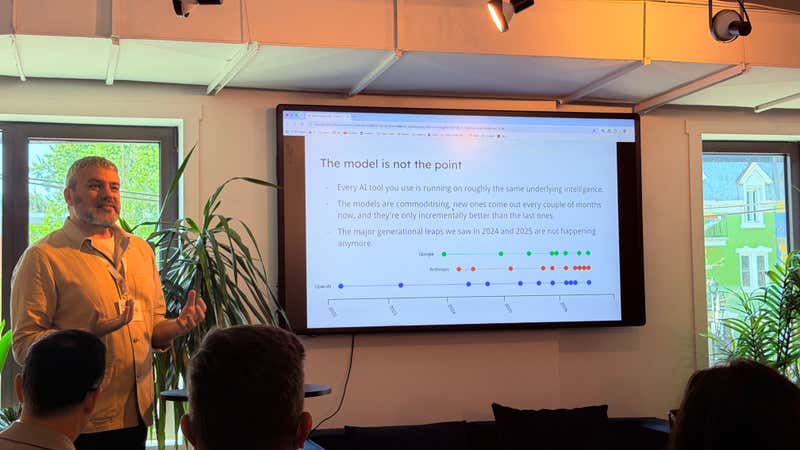
"The model is not the point." Release timelines for Google, Anthropic and OpenAI, converging.
His opening claim: every AI tool you use runs on roughly the same underlying intelligence. Models are commoditizing, new ones land every couple of months, and they are incrementally better than the last. The generational leaps of 2024 and 2025 are not happening anymore. So the leverage does not come from the model. It comes from context.
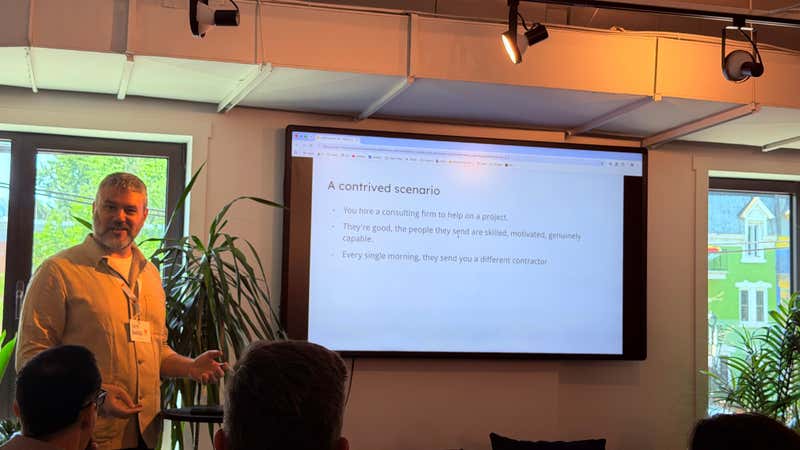
The best analogy of the conference.
You hire a consulting firm. They are good, the people are skilled and motivated and genuinely capable. And every single morning they send you a different contractor.
That is what working with agents feels like when your organization has no captured knowledge. Seb called the cost of re-explaining everything a re-teaching tax, and pointed out that tokens are the cheap part. The human work is expensive. The 200th time costs the same as the first.
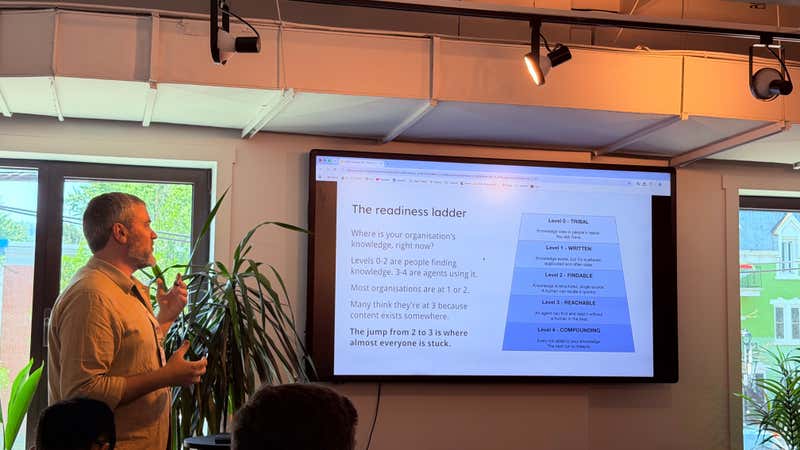
Seb Barre's readiness ladder. Most organizations sit at level 1 or 2 and believe they are at level 3.
His readiness ladder is the most useful diagnostic I picked up all week:
- Level 0, tribal. Knowledge lives in people's heads. You ask Dave.
- Level 1, written. It exists, but scattered, duplicated and often stale.
- Level 2, findable. Structured, single source. A human can locate it fast.
- Level 3, reachable. An agent can find and read it without a human in the loop.
- Level 4, compounding. Every run adds knowledge. The next run is cheaper.
Levels 0 through 2 are humans finding knowledge. Levels 3 and 4 are agents using it. Most organizations are at 1 or 2. Many believe they are at 3 because the content exists somewhere. The jump from 2 to 3 is where nearly everyone is stuck.
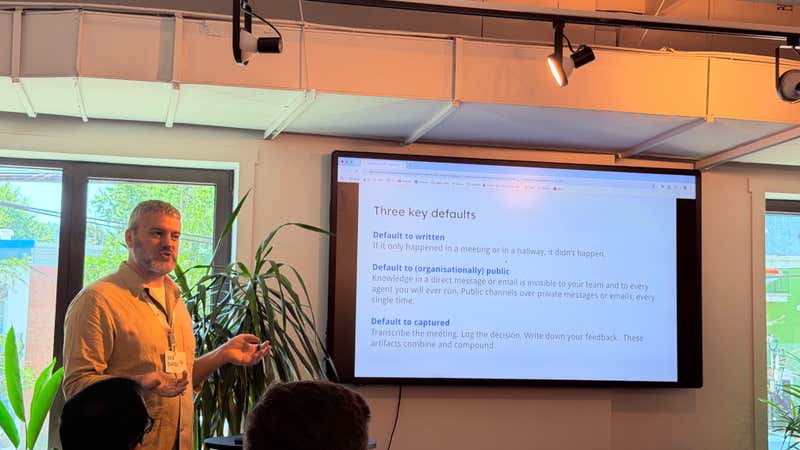
Three defaults that move you up the ladder. None of them require buying anything.
Default to written, because if it only happened in a meeting or a hallway it did not happen. Default to organizationally public, because knowledge in a DM is invisible to your team and to every agent you will ever run. Default to captured, so transcribe the meeting, log the decision, write down the feedback.
Here is where I would extend Seb's argument. He treated contextual data mostly as meeting notes and internal documents. Code, documentation, CRM records and above all your content belong in that same context layer. Your CMS is already the most structured, most governed, most reviewed body of knowledge your organization owns. It should be the first thing an agent can reach, not the last. That is exactly why we shipped the Agility CMS MCP server, and it is why I think "default to captured" is really a content modeling problem wearing a culture costume.
One thing nobody in that room had a good answer for: if you default to captured and organizationally public, what happens to privacy and permissions? What is an agent allowed to say, and to whom? I asked. The honest answer is that we are all still figuring it out.
The words still matter, maybe more than ever
Dayana Kibilds of SimpsonScarborough opened with "I am not going to talk about AI," which got the biggest laugh of the conference, and then delivered the most practical session.
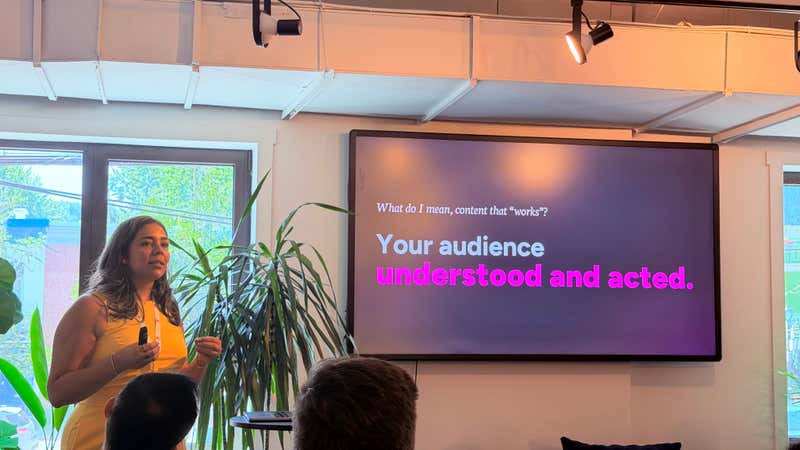
The whole definition, in seven words.
Her definition of content that works: your audience understood, and acted. That is it. Everything else is decoration.
What she taught was craft. Most people only read headings, so a heading should be a summary and not a label.
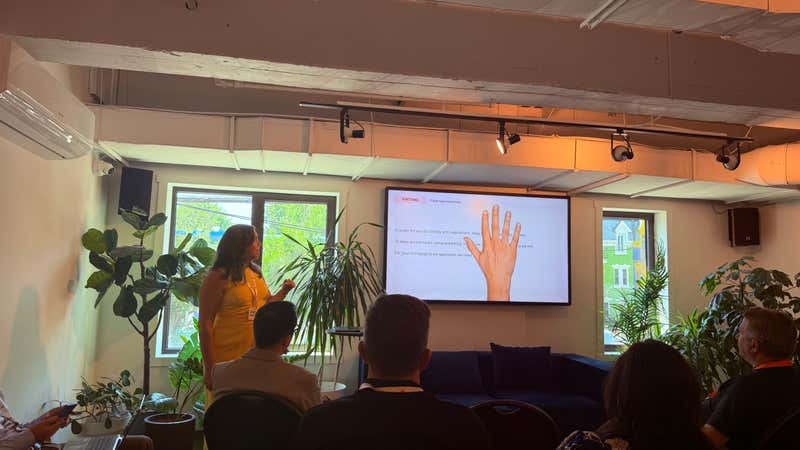
Most people only read the beginnings of sentences. So put the important part there.
Keep words, sentences and paragraphs short. Write at a sixth to eighth grade level. Her trick for getting there: once you start writing, stop, and say it out loud instead, then write that down.
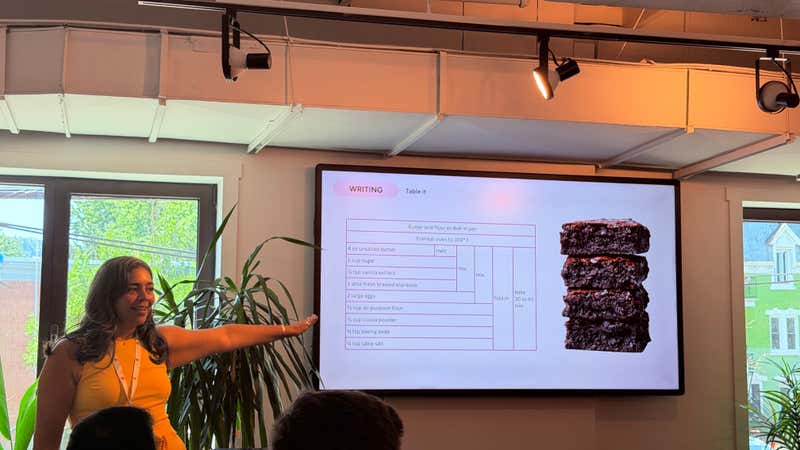
"Table it." A brownie recipe as an argument for structure, which is the most Montreal-in-August way to make that point.
Complicated information in a table lets people understand a lot of things at once. Which is also, not coincidentally, how machines prefer to receive it.
And the reframe I liked most: personalization just means one person trying to help another person. Stop imagining you are addressing a crowd. Imagine one of them.
Every moment a reader spends decoding is a moment they are not absorbing your meaning. That is true of humans. It is also true of machines with finite context windows. Good writing turns out to be the same discipline for both audiences, which is a more hopeful conclusion than I expected to reach.
Her closing advice was almost anti-AI, and she is right: instead of asking AI to summarize something, ask the human who wrote it to explain it to you out loud. Then write that down.
Optimizing for humans and machines at the same time
Chuck Gahun, VP and Principal Analyst at Forrester, presented the research-backed version of the two-audiences thesis. His clients are asking whether their website is dead.
It is not. It has more work to do.
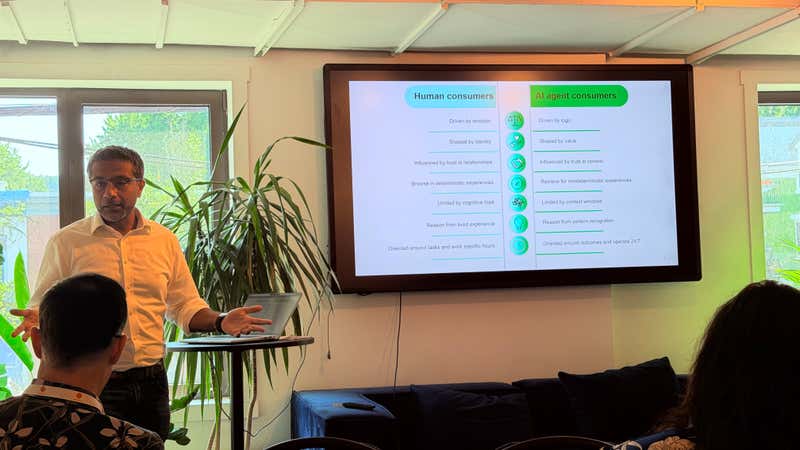
Human consumers versus AI agent consumers. Different motivations, different constraints, same content behind them.
His comparison table is worth sitting with. Human consumers are driven by emotion, shaped by identity, influenced by trust in relationships, browse deterministic experiences, and are limited by cognitive load. AI agent consumers are driven by logic, shaped by value, influenced by trust in context, retrieve for nondeterministic experiences, and are limited by context windows. Humans work specific hours around tasks. Agents run 24/7 around outcomes.
Read that second column again. "Retrieve for nondeterministic experiences" means the experience may never be seen the same way twice. Brands have spent decades learning to persuade humans. In a machine-led world it is less about storytelling and more about content and structure.
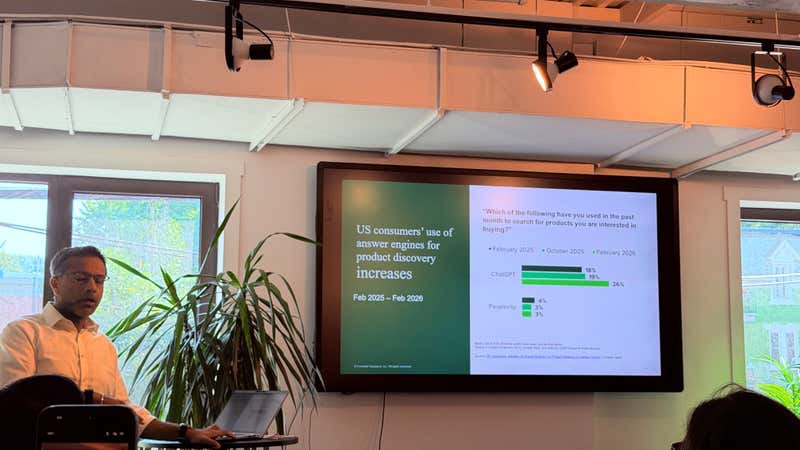
One tool becoming a shopping channel. ChatGPT 18% to 26% in a year, while Perplexity holds flat.
US consumers using ChatGPT to search for products they intend to buy went from 18% in February 2025 to 19% in October 2025 to 26% in February 2026. Perplexity stayed flat at 3 to 4% over the same period. This is not a broad shift across many tools.
He also showed two findings about the people making AI decisions that should give everyone pause. 61% of AI decision makers believe generative AI will always produce the same output given the same prompt. That is false. And 76% believe the models are good at looking up and validating facts. Also generous. Nearly 10,000 respondents. The people buying this technology substantially misunderstand how it behaves.
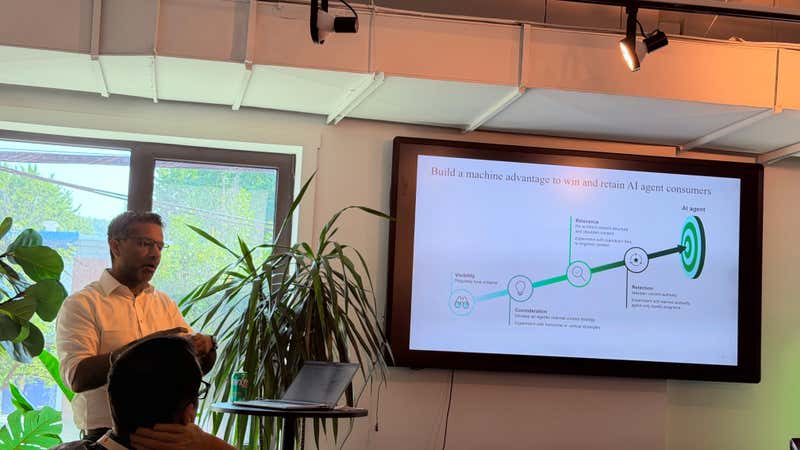
A funnel for an audience that does not have feelings: visibility, consideration, relevance, retention.
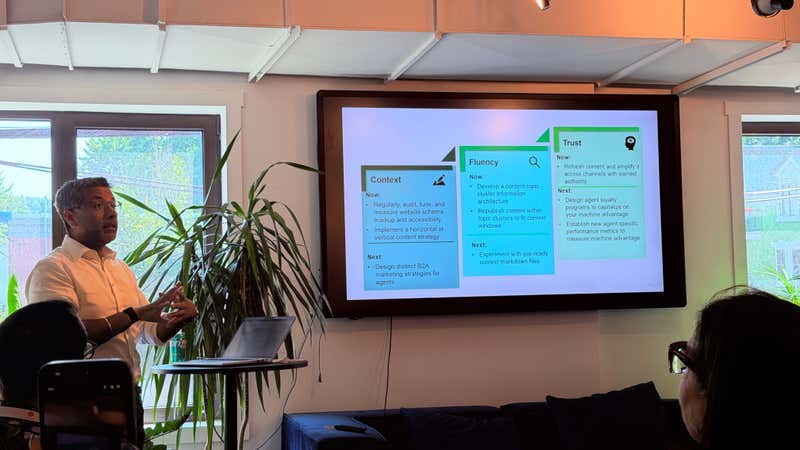
Context, fluency, trust. What to do now, and what comes next.
Fluency is the subtle one. Use the nomenclature models already recognize from third-party sources and you make them more accurate about you, and less likely to hallucinate. If you are weighing what actually works in answer engine optimization against what is noise, that distinction is where I would start.
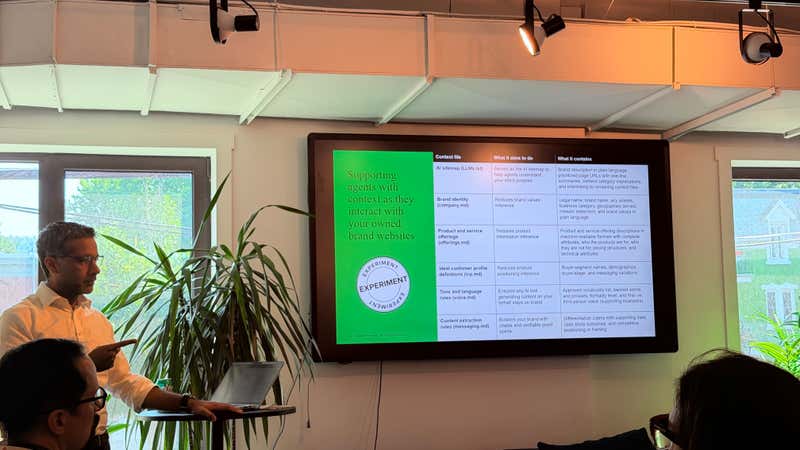
The most actionable slide of Day 1. Six context files, and what each one stops the model from guessing.
Give agents purpose-built context files: an AI sitemap via LLMs.txt, then company.md for brand identity, offerings.md for products and services, icp.md for ideal customer profiles, voice.md for tone and language rules, and messaging.md for citable proof points. Each one reduces what the model has to infer. Inference is where hallucination comes from.
The agency business is repricing itself in real time
The roundtables were where people stopped performing optimism.
Robert Jacobi ran a session on the new agency model. The stories were rough. One team was laid off after a single client took CMS implementation in-house because they could vibe code the solution themselves. Bidding has gone so low in places that the work cannot be delivered sustainably. Clients expect more for less, and not all of it is attributable to AI. Some is platform churn, and some, as one European attendee put it, is that one train can hide another. AI is the train everyone is watching. Deglobalization, the Iran crisis and the war in Ukraine are the trains behind it.
The consensus: time and materials is dead. The definition of an hour has fallen apart. If an agent does in twenty minutes what used to take a day, billing by the hour actively punishes you for being good. Value-based and fixed pricing is the only coherent answer, and that is a sea change in how you demonstrate worth.
The most interesting strategic note was about where agencies now create value. It is moving upstream, into requirements and discovery, before the project formally starts. That is where trust gets built and where the expensive decisions get made. Several people saw real money in AI consultancy work. Someone floated agencies moving to credit consumption models, which I had not heard before and have not stopped thinking about.
Peter Dahlstrom Andersen's roundtable on why management gets design wrong landed in the same place. He is seeing 40 to 50% cuts at European agencies. He argued UX as a term is dying and should be replaced with digital business development, because designers get asked to deliver a PDF when the business needed conversion rates and return on investment. Management calls his team pessimistic for asking hard questions in pre-project analysis. The fix is moving upstream, closer to management, into the discovery phase where value is actually created.
His last point got a lot of nods: the liberal arts side of education needs to come back. Critical thinking, philosophy, writing. When the tooling is commoditized, judgment is the differentiator.
Governance breaks at the last mile
Mike from Sesimi covered the gap between the stack and the storefront, and it is a problem our industry does not talk about enough.
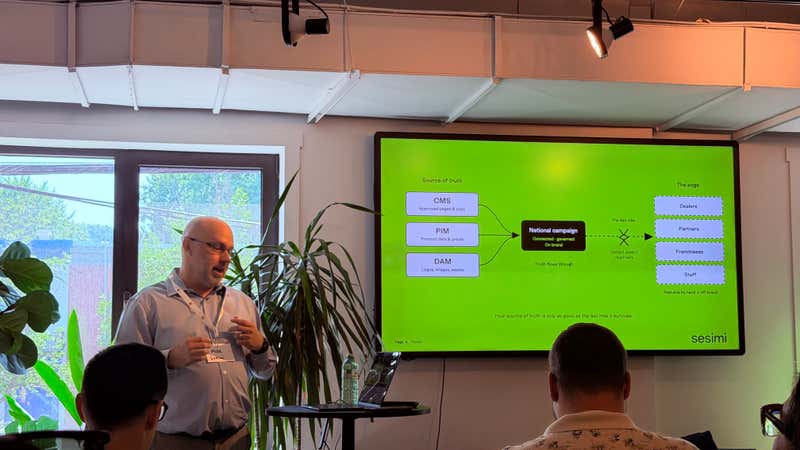
Your source of truth is only as good as the last mile it survives.
Content flows beautifully from CMS, PIM and DAM into a governed national campaign. Then it reaches dealers, partners, franchisees and frontline staff, who rebuild it by hand and take it off brand.
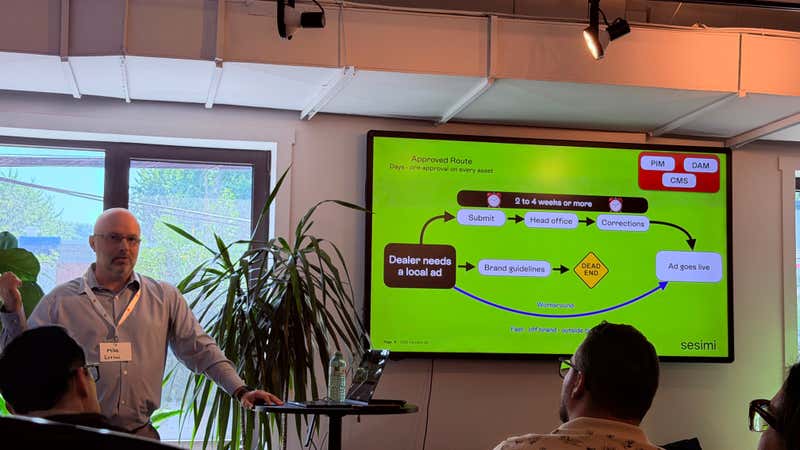
Two to four weeks through the approved route. An afternoon through the workaround. Guess which one wins.
So people either circumvent the process or freeze up entirely because doing anything at all is too hard.
The principle he landed on is one I would put on a wall: the governed route should be faster and easier than the workaround. If compliance is slower than non-compliance, you do not have a governance problem. You have a product problem.
Evelyne Bessette from TELUS made the adjacent point from the chatbot side. Her team built a self-service agent for TELUS Partner Solutions, and the win was that every answer traces back to the core source of content. Matt Garrepy's observation on this was blunt: ChatGPT has ruined on-site chatbots, because people now expect a site's search and chat to answer as well as a frontier model does. That expectation is not going back down.
One small thing across several sessions: people struggle with the word "template." Nobody means the same thing by it. That is worth fixing in how we all talk.
Day 2: the economics, the ethics, and the endurance
Janus Boye opened Day 2 with a claim I would normally treat as conference-organizer boosterism: the real way to future proof yourself is in-person events like this one. Having sat through two days of it, I think he is right, and I would put it more plainly. Getting out of your day-to-day is not a perk. It is the only reliable way to find out what you have stopped noticing.
Every hallucination has an energy bill
Tom Cranstoun set a policy in one sentence: optimize your content for machine experience, or AI will guess it.
Then he made the argument I had not heard anyone make yet, which is that guessing has a physical cost. We are on track for 950 terawatt hours consumed by AI and data centres by 2030. Google's carbon footprint has increased 48% since 2019 even though the company has become dramatically more efficient per operation, because efficiency made it cheaper and cheaper made everyone use more of it. That is Jevons paradox running at civilizational scale.
His reframe: as content practitioners, every avoidable guess and every avoided hallucination saves energy, and that energy is measured in tokens. Structure is not just good practice. It is a smaller bill and a smaller footprint.
His line about how models actually behave is the best plain-language description I have heard: AI is not clever, it is an eighth grader asking why, why, why. It will keep asking until something answers. Your metadata either answers it or it does not.
The fix, in his framing, is not smarter guessing. It is decorate once, ride along everywhere. Annotate the asset properly at the source and every downstream step inherits the answer instead of re-deriving it. That is a content modeling argument dressed as a sustainability argument, and I am here for it.
Where I am not fully sold: Tom argued that because AI does not follow a journey, the context for that journey has to live on every path. I understand the instinct, but I am not sure I agree, and I am not sure I fully understand the mechanism yet. What I actually want to know is how large language models treat context, content and metadata differently during training versus during retrieval and lookup. Those are very different phases with very different economics, and a lot of confident advice in our industry papers over the distinction. I am going to go dig into it.
Peak human traffic has already happened
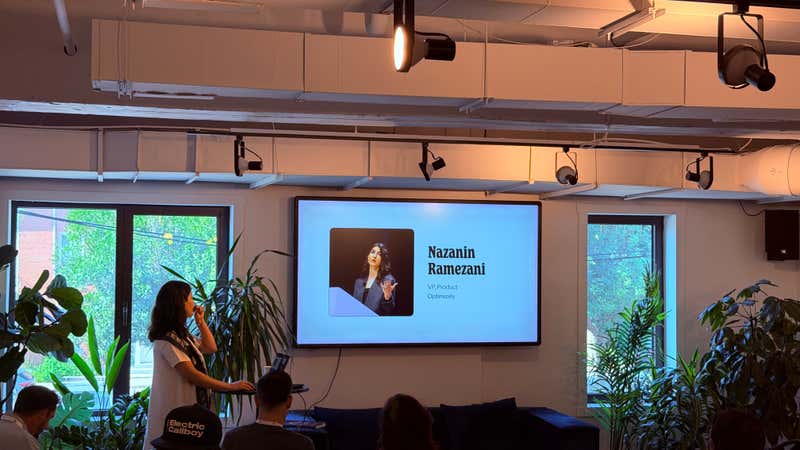
Nazanin Ramezani, VP of Product at Optimizely, with the numbers that reframed the whole conference.
Between 52 and 62% of traffic on the internet now comes from bots, per Cloudflare's measurement. The forecasts had that crossover happening at the end of 2027. It already happened. Across Optimizely's own data, spanning around 9,000 domains, page views declined 34% globally.
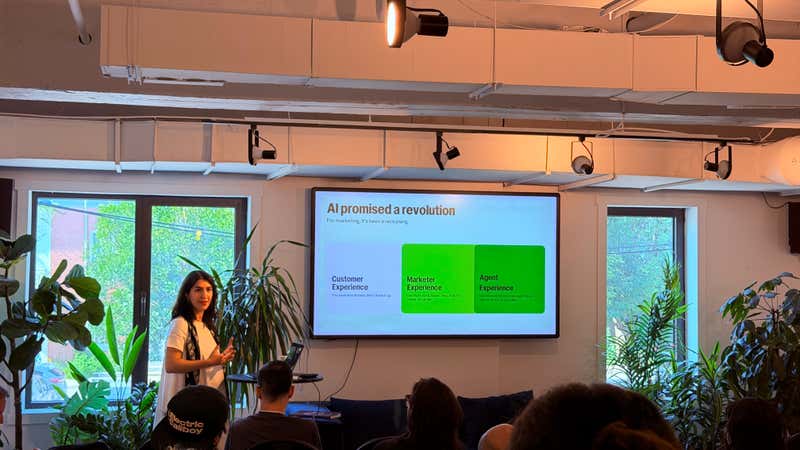
Three experiences to design for now, not one. The customer one comes with a warning: you have fewer at-bats.
Her framing splits the work into three experiences. Customer experience, where you now have fewer at-bats and cannot afford to waste one. Marketer experience, where you get more done faster and still have to make it better. And agent experience, where the job is to get discovered, stay seen, and let agents act on your site.
She was careful in a way I appreciated. Calling agent activity "traffic" is misleading, because intent is not comparable. An agent might be crawling for training. It might be retrieving an answer for someone. It might be about to transact. Rolling those into one number and calling it a visit tells you nothing about conversion. And on the discovery side, we can only imply how we are showing up in answer engines. What we can actually measure, with something close to hard data, is what agents do in our web logs. Measure the thing you can measure.
She also pushed back on the advice industry, which I had been waiting for someone to do. "FAQ everywhere, schema everywhere" is mostly SEO repackaged. It is not wrong, but it is not automatically a fix for answer engines either, and one size does not fit all. Her warning is the one to tape to your monitor: do not make the experience annoying for humans while you are optimizing for machines.
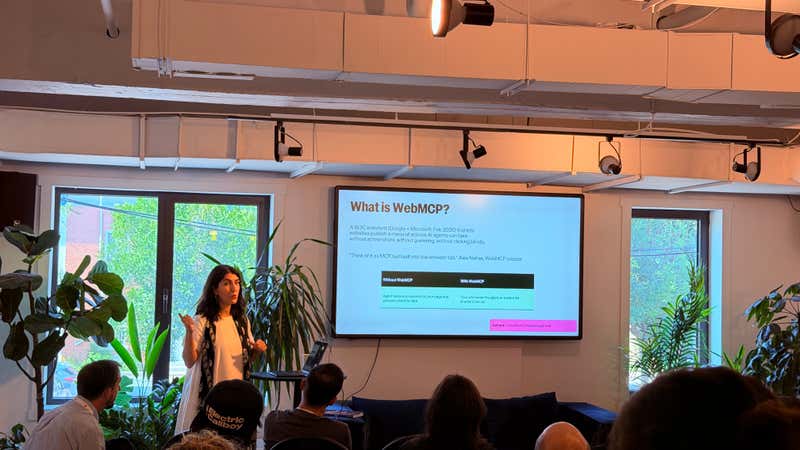
WebMCP in one slide. I have a lot to say about this, so it is getting its own post shortly.
Then the part that made me put my pen down. Agents are not just reading anymore. They are starting to act. WebMCP, a W3C standard from Google and Microsoft currently in a Chrome origin trial, lets a site publish an explicit menu of actions an agent can take instead of making it screenshot your page and guess where to click. That deserves a proper treatment rather than a few paragraphs buried in a conference recap, so I will come back to it in its own post soon.
The conclusion Nazanin drew is the part that belongs in this one, and it is counterintuitive. The assumption was that as answer engines got better, websites would matter less. The opposite is happening in a specific way. Users stay inside the answer engines. Agents come to your website more than ever. The website did not lose its audience. It swapped one.
Build the future you want, not the one investors need
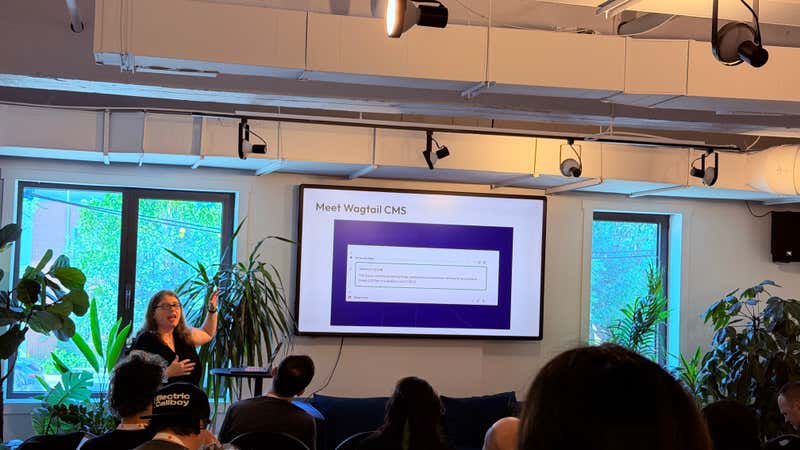
Meagen Voss introduces Wagtail, the open source CMS Torchbox builds and supports.
Meagen Voss, Partnership and Community Manager at Torchbox, gave the session that functioned as the conference's conscience.
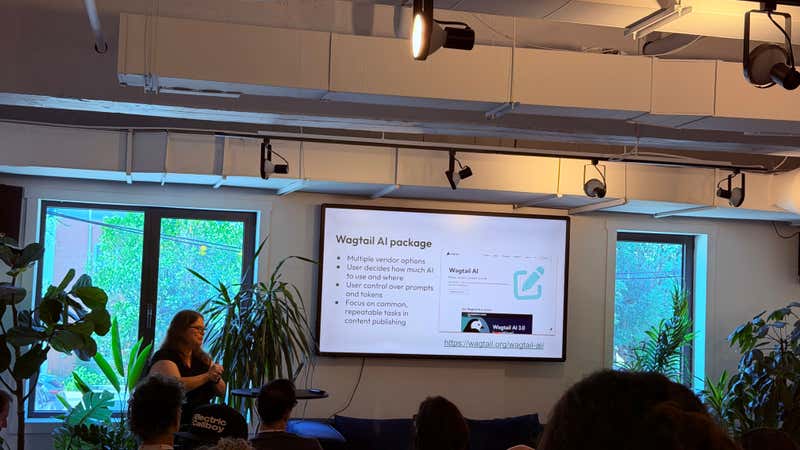
Opt-in by design. Multiple vendors, user-controlled prompts and token budgets, and a focus on repeatable publishing tasks.
Three principles. No AI dependency in core CMS features, so you can always turn it off. A responsible approach to AI, deliberately. And model and provider agnostic, so you are never locked to one vendor's pricing or politics. Users decide how much AI to use and where, with full control over their own prompts and token budgets.
That last part is the one most vendors quietly skip. Control over budget is control, full stop.
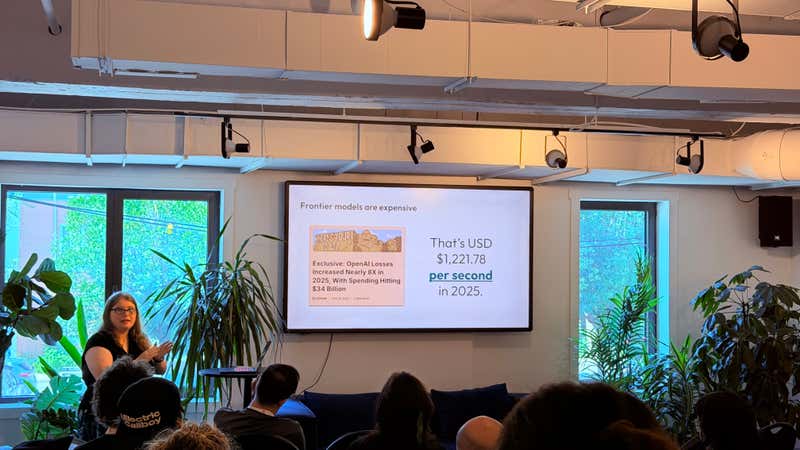
The economics underneath all of this. OpenAI's 2025 losses, expressed per second.
Her case for caution was economic rather than moral. Frontier models are expensive in a way the market has normalized. Citing Ed Zitron's June 2026 reporting, OpenAI's losses increased nearly 8X in 2025 with spending hitting $34 billion. She converted it into the number that actually lands: USD $1,221.78 per second.
Nobody knows what happens next. The bubble, if it is one, keeps getting bigger. Whether it deflates or explodes is not a question any of us can answer, but it is a question you should have a contingency for.
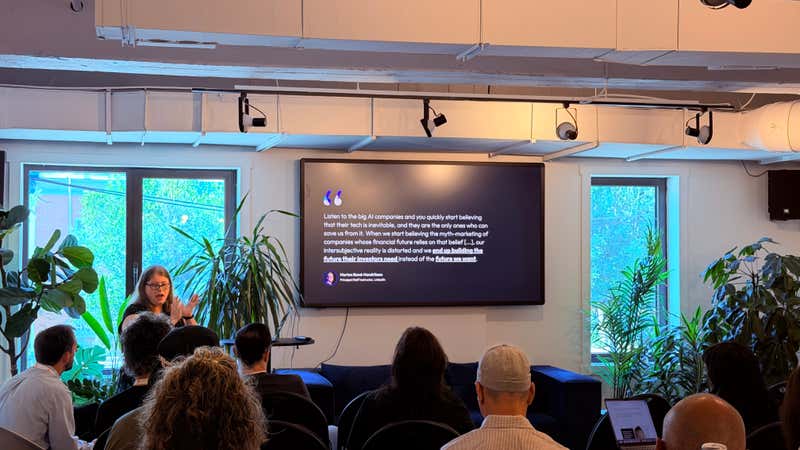
Morten Rand-Hendriksen on myth-marketing, and the future we end up building when we believe it.
The quote she built the session around, from Morten Rand-Hendriksen, is the sharpest thing I read all week:
Listen to the big AI companies and you quickly start believing that their tech is inevitable, and they are the only ones who can save us from it. When we start believing the myth-marketing of companies whose financial future relies on that belief, our intersubjective reality is distorted and we end up building the future their investors need instead of the future we want.
I sell AI-powered software. I demoed AI-powered software at this conference. And I think that quote is correct, and that people in my position should sit with it rather than deflect it. Inevitability is a marketing position, not a fact. The useful posture is to build what genuinely helps the people using your product, and to keep the off switch working.
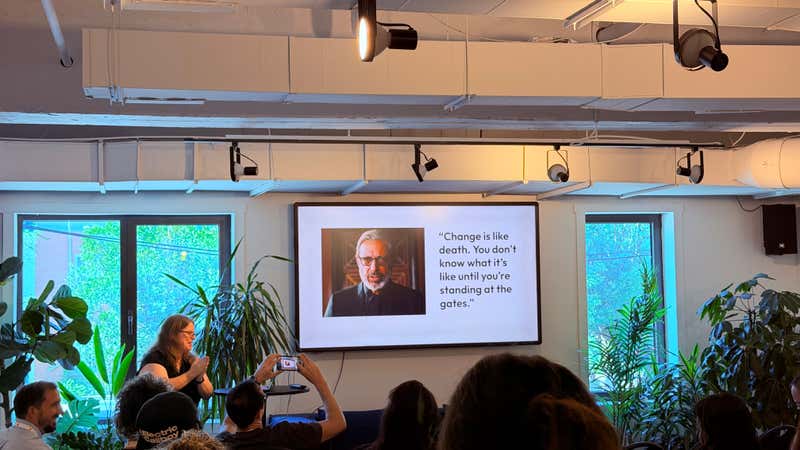
Goldblum, day two, third deck. Nobody planned this.
Change is like death. You do not know what it is like until you are standing at the gates.
What endures: 25 years inside one open source CMS
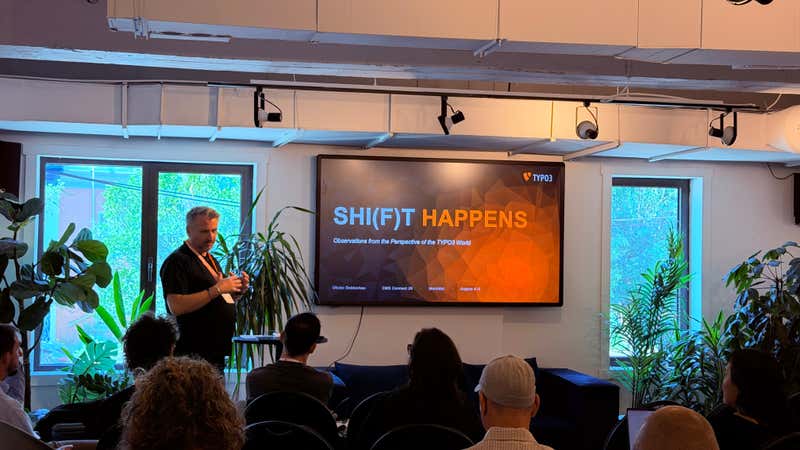
Olivier Dobberkau, President of the TYPO3 Association, closing the conference.
His was the talk I would hand to anyone who thinks this industry started in 2023.
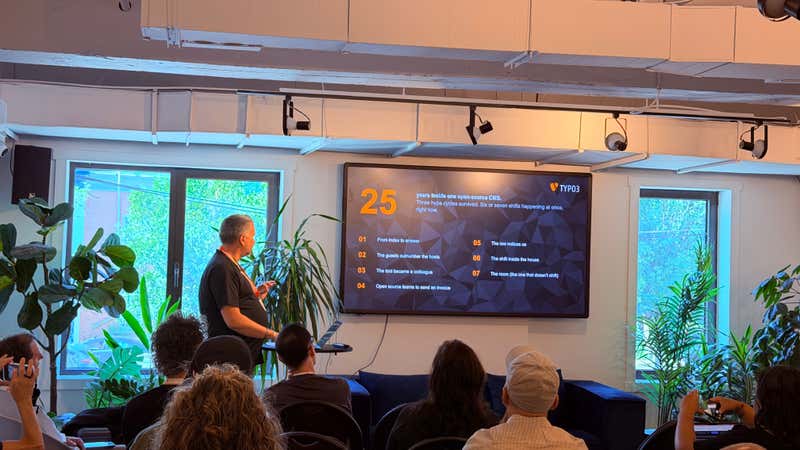
Twenty-five years, three hype cycles survived, and six or seven shifts happening simultaneously.
Twenty-five years inside one open source CMS. Three hype cycles survived. Six or seven shifts happening at once, right now. His seven:
- From index to answer.
- The guests outnumber the hosts.
- The tool became a colleague.
- Open source learns to send an invoice.
- The law notices us.
- The shift inside the house.
- The room, the one that does not shift.
Line them up against Matt Garrepy's five patterns from Day 1 and the overlap is striking. Two people from completely different corners of this industry, one commercial analyst and one open source association president, independently describing the same landscape. That is usually a sign the diagnosis is real.
Number two is Nazanin's bot statistic stated as a philosophy. The guests outnumber the hosts. That is what 52 to 62% actually means.
His line on discovery was the cleanest formulation anyone gave all week. Search has changed into answer, and the currency has changed from rank-ability to cite-ability. The question is no longer whether you rank. It is whether the machine trusts your sentence enough to repeat it.
Write that on the wall next to the last-mile principle. It reframes every content decision you make. You are not competing for position anymore. You are competing to be quotable.
On tools becoming colleagues: AI agents are now part of team structure, not part of the toolchain. That is a management problem as much as a technical one, and almost nobody has an org chart that reflects it.
He opened with a line from the Book of Changes, that the river does not ask permission before it changes course. Neither does our industry. But he also made the case for sitting in the space between two moments rather than rushing through it, which is not advice you often hear from people who ship software.
The hardest section was the one about money. Open source must learn to send an invoice. Olivier and I talked about this the evening before, and he described the idea of an open source tax funded at a governmental level. It is a sharper argument than it first sounds. The French government mandates the use of open source. A mandate creates a dependency. A dependency creates an obligation to sustain the thing you depend on. As he put it, this is not selling out. It is surviving successfully. Maintainers are burning out, and the current arrangement is not sustainable.
The regulatory point sharpens it further. The CRA and NIS2 collapse the line between "hobby project" and "critical infrastructure." The law does not care how the software started its life. Open source has received some special treatment, but functionally we are now playing at the same level as proprietary vendors, with the same obligations and a fraction of the funding.
And on AI policy, he was refreshingly honest: TYPO3 does not have one yet, because writing policy in a democratic project is genuinely hard. You cannot dictate to a community. His phrase for it was that the dialogue outlasts the dictate. Slower, but it is the only kind of policy that survives contact with the people expected to follow it.
His last shift is the one that does not shift: the room. Personal encounters stay relevant. If an agent is going to go and do something for me, fine. But where taste and opinion matter, we should cherish the encounters that produce them. Which brings the whole thing back to what Janus said that morning.
What I showed at CMS Idol
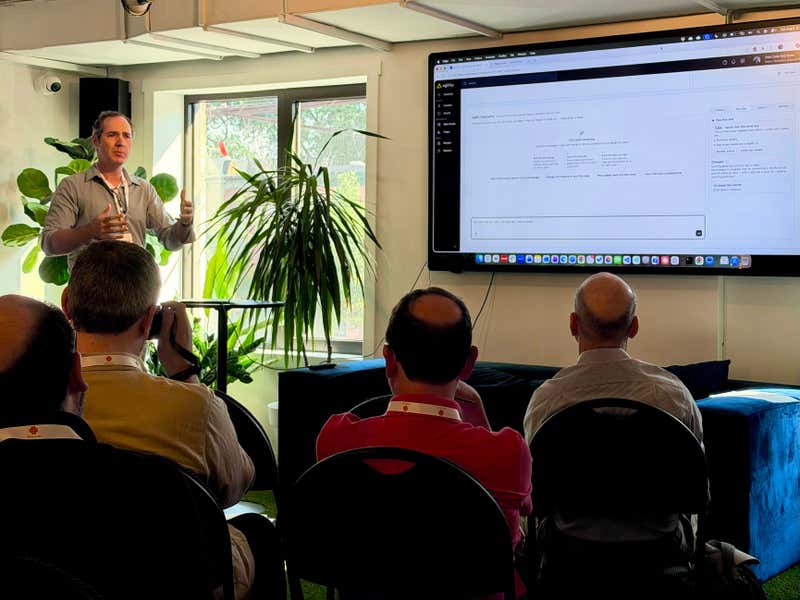
I got to demo, and I will admit I was more nervous than I expected.
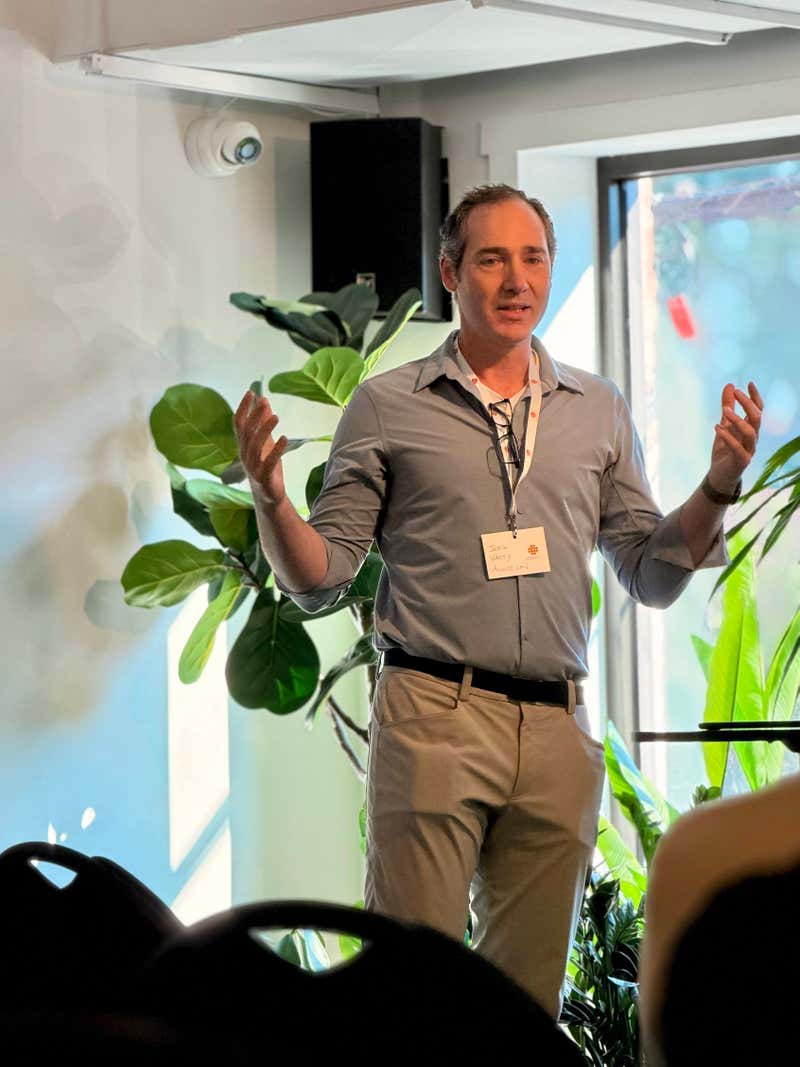
Explaining the idea before showing it, which is always the harder half.
I walked through a prototype AI agent running inside Agility CMS. First part: build a page from an unstructured prompt using the components that already exist in the site, and get visual options back before the agent commits to doing the work. That preview-then-act loop matters more than it sounds. It is the difference between delegating and gambling.
Describe the change. See it on a test site. Put it live when it is right. Nothing goes live until you put it there.
Then the part I was excited about. The agent wrote a brand new component, pushed it to git, and deployed it to Vercel as a preview deployment. I opened that preview inside Agility's Web Studio, reviewed it, and published the code and the content together.
All of it inside the Agility app.
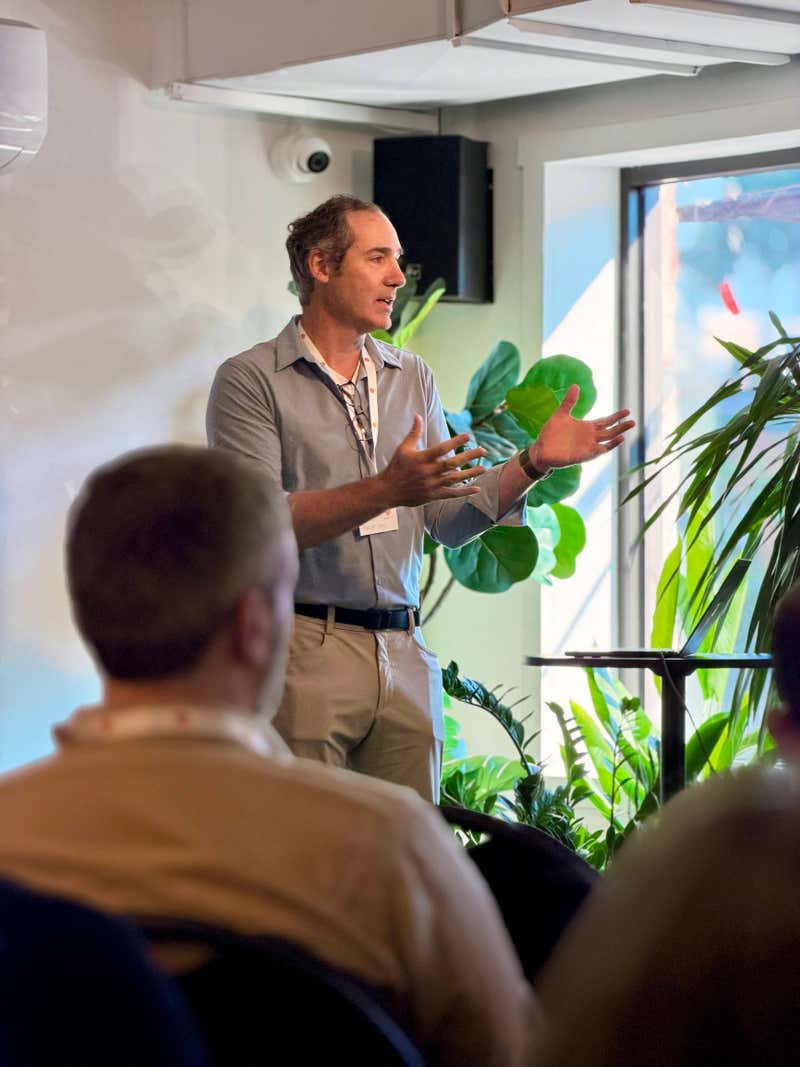
The reaction in the room was the best part of my week.
The judges and the crowd got it immediately, because they had spent the day hearing about the gap between what agents can generate and what an organization can safely ship. That gap is exactly what the preview step closes.
Alka's publishing chain and Meagen's off switch are the same argument from two directions, and they are the reason I think preview-before-act is the right default rather than a nice-to-have. I cannot wait to get this into customers' and partners' hands.
What I am taking home
The website is not dead. The CMS matters more than it did a year ago, not less, because it is the only place in most organizations where content is already structured, governed and reviewed. That makes it the natural substrate for agents. The interface is moving. The system of record is staying put.
But the audience changed underneath us while we were arguing about page builders, and the second audience is now capable of acting.
Four things I would act on Monday if I ran a content operation:
- Find out what level you are on. Use Seb's ladder honestly. If an agent cannot reach your knowledge without a human fetching it, you are at level 2, whatever your roadmap says.
- Make the governed route the fast route. Audit how long your approved path takes versus the workaround. If the workaround wins, fix the path, not the people.
- Write the context files.
LLMs.txt,company.md,voice.md. It is a week of work and it reduces what every model you will ever touch has to guess about you. - Read your web logs. You can only infer how you are showing up in answer engines. You can actually measure what agents do on your site. Start with the measurable thing.
Two arguments I am still chewing on.
Matt's pattern about memory being infrastructure cuts against something uncomfortable. Developer jobs are shrinking except in the 41 to 49 age bracket, apparently because those people carry the collective institutional memory. As someone comfortably past that bracket, I would argue the memory advantage keeps growing rather than shrinking. The people who remember why the load-bearing weirdness is load-bearing are the ones who can safely point an agent at a 13-year-old CMS. That is not nostalgia. That is a moat.
And Morten's myth-marketing point deserves more than a nod from people like me. I build this stuff. I am enthusiastic about it. Enthusiasm is exactly the condition under which you stop noticing whose future you are building. The check is simple enough: does the off switch still work, and does the person using it get to decide?
Human experience is the last moat. That was Matt's bonus pattern on Day 1, and Olivier's seventh shift on Day 2, and Janus's opening argument both mornings. Three people, three framings, one conclusion. After two days of very smart people describing very hard problems, in a room, in person, I believe it.

The room, the one that does not shift. Montreal in August is a good place to have this argument.
Frequently Asked Questions
What is an agentic content system?
An agentic content system is a content platform where AI agents can retrieve, assemble and act on content without a human fetching it for them. It requires content that is structured, governed and machine-reachable rather than locked inside page layouts. Forrester's Chuck Gahun framed it as content serving two distinct consumers: humans browsing deterministic experiences and agents retrieving for nondeterministic ones.
Has peak human web traffic already happened?
Yes, based on current measurement. Between 52 and 62% of internet traffic now comes from bots according to Cloudflare data presented at CMS Connect 2026, a crossover that forecasts had placed at the end of 2027. Optimizely reported a 34% global decline in page views across roughly 9,000 domains. Human attention has not disappeared, but it is no longer the majority of what reaches your site.
Are AI agents replacing websites?
No. Agents change how content is consumed, not whether it is needed. Users increasingly stay inside answer engines, but agents visit websites more than before, so the site's audience shifted rather than vanished. The practical effect is that your CMS becomes more important as a system of record while the interface layer becomes less predictable.
What does cite-ability mean for content strategy?
Cite-ability is whether an AI system trusts a sentence enough to repeat it. Olivier Dobberkau of the TYPO3 Association described the shift as search becoming answer, with the currency moving from rank-ability to cite-ability. Practically, it favours specific, self-contained, well-attributed statements over keyword-optimized pages, because a model extracts sentences rather than positions.
What are context files like LLMs.txt and company.md?
They are plain-language files that tell AI agents what your organization is and offers, so the model infers less. Forrester recommends an LLMs.txt AI sitemap plus company.md for brand identity, offerings.md for products, icp.md for customer profiles, voice.md for tone rules, and messaging.md for citable proof points. Every inference you remove is a hallucination you do not have to correct later.
Why do AI agents fail inside enterprises?
Most often because the organization's knowledge is not reachable, not because the model is weak. Seb Barre of Shopify put most organizations at level 1 or 2 of a five-level readiness ladder, where knowledge is written but scattered, or findable by a human but not by an agent. The jump to agent-reachable knowledge is where most efforts stall.
What is content infrastructure debt?
Content infrastructure debt is the accumulated cost of substance, structure and governance nobody owns. Carrie Hane described it as the layer between interface and engineering that is rarely assessed and yet sets the performance ceiling for both. AI did not create it, but AI exposes it and compounds it faster.

About the Author
Joel is CTO at Agility. His first job, though, is as a father to 2 amazing humans.
Joining Agility in 2005, he has over 20 years of experience in software development and product management. He embraced cloud technology as a groundbreaking concept over a decade ago, and he continues to help customers adopt new technology with hybrid frameworks and the Jamstack. He holds a degree from The University of Guelph in English and Computer Science. He's led Agility CMS to many awards and accolades during his tenure such as being named the Best Cloud CMS by CMS Critic, as a leader on G2.com for Headless CMS, and a leader in Customer Experience on Gartner Peer Insights.
As CTO, Joel oversees the Product team, as well as working closely with the Growth and Customer Success teams. When he's not kicking butt with Agility, Joel coaches high-school football and directs musical theatre.


