The Personalization Paradox: 90% of Companies Invest In It, Almost Nobody Can Execute It
An honest look at the gap between what CMS vendors sell and what organizations actually deploy.


TL;DR: The Personalization Gap
Despite 90% of businesses investing in personalization, a massive "execution gap" remains: brands believe they personalize 61% of experiences, while consumers only perceive 43% as tailored.
Most companies are stuck in "pilot purgatory" because they treat personalization as a CMS feature rather than a business capability. This post explores:
-
The Data Paradox: Why 40% of budgets go to personalization while 63% of executives still struggle to deliver it.
-
The "Formula 1" Problem: Why buying high-end enterprise platforms often leads to expensive, unused shelfware.
-
A Practical Path: Why mastering the basics (geo-targeting, A/B testing) and using a composable, headless architecture is more effective than chasing "AI-powered 1:1" hype before you’re ready.
The Bottom Line: Don’t buy the race car until you’ve built the track and hired the pit crew.
-----
I've been in the CMS industry for over 20 years. In that time, I've watched "personalization" go from a nice-to-have feature to the single most over-promised, under-delivered capability in our entire market.
Almost everybody says they're doing it. Nearly 90% of online businesses are actively investing in personalization. Marketers are now allocating roughly 40% of their budgets to it, nearly double what they were spending in 2023.
And yet.
63% of digital marketing executives say they struggle with delivering tailored experiences. 40% of B2B companies say personalization is a huge challenge. Only 35% of companies deliver any kind of omnichannel personalized experience. And maybe the most damning number: according to Deloitte, brands believe they personalize 61% of customer experiences, but consumers perceive only 43% as personalized.
This isn't just a retail problem. It's not just an e-commerce problem. It's an EVERYWHERE problem. From B2B to healthcare to financial services to media companies, the story is the same: lots of investment, very little follow-through.
And I think it's time someone in the CMS space said it out loud.
The Numbers Don't Lie (But They Do Confuse)
The demand side of this equation is legit. McKinsey reports that 71% of consumers expect personalization across channels. Companies that get personalization right generate 40% more revenue than those that don't. And it's not just B2C: according to Forrester, 66% of B2B customers expect the same or better personalization in their professional lives as they get in their personal ones. Gartner found that 86% of B2B customers expect companies to be well-informed about their personal information during interactions.
People want this stuff. No question.
The supply side, though, is a mess. According to compiled research from Marketing LTB, 67% of retailers rate themselves as "good" at personalization, while only 46% of consumers agree. That's a 20-point perception gap. Companies THINK they're doing it. Customers disagree. And only 17% of marketing executives are actually using AI and machine learning extensively for personalization, despite 84% believing in its potential.
PwC's research puts it bluntly: many companies find themselves stuck in what they call "pilot purgatory," where experimentation begins but meaningful outcomes never scale. The technology is in place but not integrated. The data exists but isn't actionable. Teams are committed but not coordinated.
I've Seen This Movie Before
In previous innovation waves, from headless CMS to SaaS to composability, best practices emerged quickly. Personalization is different. Personalization isn't really a CMS feature at all. It's a business capability that requires a whole stack of things working together, and the CMS is just one piece of it.
Personalization requires three things in concert:
- Clean, unified customer data
- A strategy for segmenting and targeting audiences
- A team with the skills and process to continuously test and iterate
Most mid-market companies don't have a Customer Data Platform. Or if they do, it's barely wired up. Their customer data lives in six different tools that don't talk to each other. They have a small marketing team that's already stretched thin managing campaigns, social, and content production.
So when someone in that situation buys a CMS with "built-in personalization," it's like buying a Formula 1 car to drive to the grocery store. The capability is there. You're just not set up to use it.
The Dirty Secret of the Monolith Era
For years, the dominant pitch in enterprise CMS went something like this: "Buy our all-in-one platform and you get content management, personalization, analytics, A/B testing, and a customer data platform all bundled together."
Sitecore, Adobe Experience Manager, and Optimizely all built their sales motions around this promise. Look, if you're a Fortune 500 company with a dedicated digital experience team and a seven-figure implementation budget, those platforms CAN deliver real value.
But most customers paid for personalization capabilities they barely touched.

Implementation timelines stretched into months. Sometimes years. The licensing costs were staggering. And the complexity meant that actually configuring personalization rules, building audience segments, and running tests required specialized expertise that most teams didn't have in-house.
So what happened? Companies ended up using their expensive DXP as a glorified content management system, with personalization sitting unused on the shelf. I've talked to MANY customers over the years who came to us from these platforms, and the story is almost always the same.
Dynamic Yield's 2026 Personalization Maturity Report backs this up. Among e-commerce companies actively working on personalization, 62% haven't aligned on a singular audience strategy. And 39% report failing to act on their findings in subsequent tests. Even the companies that are trying aren't closing the loop.
What People Actually Use
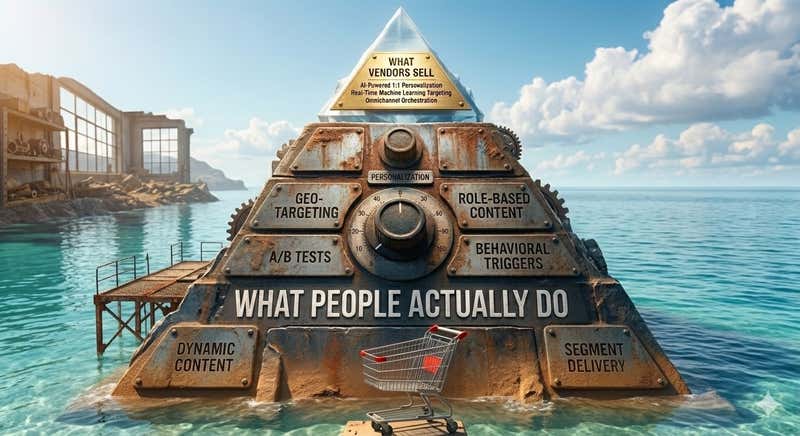
Strip away the marketing hype. Look at what mid-market companies actually deploy. The list is short:
- Geo-targeting to show location-relevant content.
- Role-based content for logged-in users.
- Basic A/B testing on headlines, CTAs, and landing pages.
- Simple recommendation logic like "related content" or "popular in your category."
That's it. That's what the vast majority of companies are doing. Not AI-powered 1:1 personalization across every touchpoint. Not real-time behavioural targeting with machine learning models. Just straightforward, rules-based content variation.
And honestly? Those basics WORK. They move the needle on conversion and engagement without requiring a massive technology investment or a team of data scientists.
Don't believe the hype. Do the basics well first.
The Headless CMS Advantage (Done Honestly)
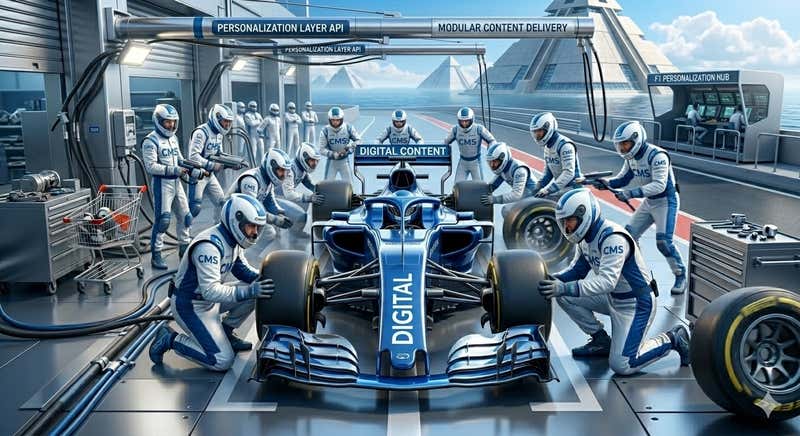
The move to headless CMS fundamentally changes the personalization conversation.
In the old world, your CMS vendor owned the personalization engine. If their personalization didn't work for you, tough luck. You were locked into their ecosystem. Swapping out the personalization layer meant swapping out the entire platform.
Headless CMS flips this. Because content is delivered through APIs and rendered by your frontend, you choose your own personalization tools. Connect Dynamic Yield, Ninetailed, Uniform, or whatever best-of-breed solution fits your needs. Swap it out later if something better comes along. Your CMS doesn't care, and it shouldn't.
At Agility CMS, we made a deliberate choice here. We don't try to be your personalization engine. We give you the APIs and the composable architecture to connect the right tools when you're actually ready for them.
Why? Because we've watched too many of our competitors sell personalization features that customers never deploy. We'd rather be honest about what a CMS should do really well, and let you build your personalization stack at your own pace, with the tools that actually fit where you're at right now.
So, Is Personalization Important?
Yes. 100%. Consumers expect relevant experiences, and the companies that deliver them outperform those that don't.
But most vendors won't tell you this: the question isn't whether you want personalization. It's whether you're ready to operationalize it.
For most mid-market companies, the honest answer is: not yet. And that's OK.
Instead of chasing the "AI-powered 1:1 personalization at scale" dream, try this:
Start with structured content. This is a benefit that MOST organizations don't take enough advantage of. Well-structured content is the foundation that makes personalization possible later. Without it, no amount of personalization tooling will save you.
Nail the basics first. Geo-targeting, A/B testing, and role-based content are low-hanging fruit that deliver real results. Get good at those before you invest in a CDP.
Choose a CMS that doesn't lock you in. When you ARE ready for advanced personalization, you want the freedom to connect the best tools for your needs, not the ones your CMS vendor forces on you.
Build a data strategy. Personalization is downstream of data. If your customer data is fragmented across six different tools, fix that first. The CMS can wait.
Final Thought
Everyone wants personalization. Vendors love selling it. The execution gap remains enormous.
The companies that actually succeed at personalization don't do it because they bought the right CMS. They do it because they invested in the people, process, and data infrastructure to make it real.
As an industry, I think we owe our customers more honesty about that. Let's stop selling the dream and start helping people build towards it in a way that actually works.
Personalization is on everyone's roadmap, but almost no one has perfected the rollout playbook yet. The vendors who focus on giving customers the right foundation and the flexibility to grow will win.
That's something I believe deeply, whether we're talking about personalization, AI, or whatever the next big thing turns out to be. Build the right foundation. Be honest about where you are. And don't buy the race car until you've learned how to drive.
P.S. The images in this post were created with AI via Nano Banana. Yes, I used AI to illustrate a post about overhyped technology. The irony is not lost on me.

About the Author
Joel is CTO at Agility. His first job, though, is as a father to 2 amazing humans.
Joining Agility in 2005, he has over 20 years of experience in software development and product management. He embraced cloud technology as a groundbreaking concept over a decade ago, and he continues to help customers adopt new technology with hybrid frameworks and the Jamstack. He holds a degree from The University of Guelph in English and Computer Science. He's led Agility CMS to many awards and accolades during his tenure such as being named the Best Cloud CMS by CMS Critic, as a leader on G2.com for Headless CMS, and a leader in Customer Experience on Gartner Peer Insights.
As CTO, Joel oversees the Product team, as well as working closely with the Growth and Customer Success teams. When he's not kicking butt with Agility, Joel coaches high-school football and directs musical theatre.