
The Best CMS for Developers in 2026

If you’re a Head of IT or Engineering Lead looking for a CMS for your development team, you need a platform built for how your team actually works. Most developers evaluating a CMS have been burned by plugin nightmares, constant maintenance, and a rigid system that forces them into a certain way of doing things.
This often leads to frustration not only for developers working with the CMS, but also for the marketing team that depends on them to ensure campaigns go out quickly. So when a CMS claims to meet developers' needs but instead greets them with insufficient documentation and forces them to build custom code to handle what should be table stakes, it leads to unnecessary technical debt and burnout.
Instead, here's what actually separates a CMS worth building on from one that costs you migration hours in eighteen months.
-
API-first architecture, with REST and GraphQL for headless content delivery.
-
Native framework support for Next.js, React, Vue, and other modern frameworks
-
Git and CI/CD workflows, so schema and content changes move through version control instead of living only in a UI.
-
Structured content modeling that supports reuse across channels, not just the website.
-
Documentation and support that hold up under a real edge case.
-
Enterprise-grade security and scalability that doesn't require bolting on infrastructure yourself.
In this guide, we’ll introduce you to Agility CMS and show how our headless CMS gives you all of the flexibility and features you need from a modern CMS. We'll also show you six other platforms to help you choose the one that best suits your needs.
Ready to see how Agility CMS's API-first, composable architecture lets you build and ship with any stack you like? Book a personalized demo today.
Agility CMS: A Hybrid Headless CMS that Developers Love
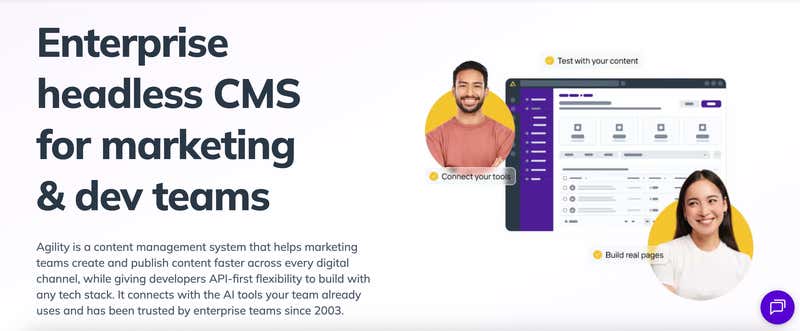
Agility CMS was built for engineering teams building on modern frontend frameworks who don't want marketer independence as the trade-off for getting there.
Our hybrid CMS gives developers full REST and GraphQL API control over content for any frontend, while marketers get a visual, drag-and-drop editing experience built on that same content model, removing the choice a pure headless build usually forces between developer flexibility and marketer autonomy.
Every piece of content in Agility lives in a single, reusable structured content model that spans pages and channels. A schema a developer defines once becomes the same schema a marketer edits inside Web Studio; nothing gets translated or duplicated between the two.
Developer teams evaluating Agility CMS for a headless build can use it to:
-
Fetch content for any frontend through REST or GraphQL that handles millions of requests using a global CDN
-
Connect Claude, GitHub Copilot, Cursor, or Windsurf directly to Agility through its MCP server, so content can be created, updated, or queried from inside the tools you're already working in
-
Launch a frontend with Next.js, Nuxt, or another modern framework using starter kits rather than building the integration layer from scratch.
-
Deploy straight to Vercel or any hosting environment your team already runs.
-
Create structured, reusable components once and let both code and the visual editor read from the same schema.
-
Hand marketers drag-and-drop page building without losing sight of the underlying content
-
Migrate off a legacy platform with dedicated tooling and hands-on support built for that specific transition.
Fetch content at scale without building your own caching layer
Developers at mid-market enterprises with complex, relational content, such as finance, insurance, or entertainment companies, often have to choose between fast page loads and rich linked content. This is because resolving a single page can mean chaining several API calls or choosing between a CMS that scales with traffic and one that requires building a caching layer just to survive a spike. Static builds suffer from the same problem: re-pulling the entire content set on every deployment instead of just what changed.
Agility CMS removes these problems through the Content Fetch API, which resolves linked content in a single request and serves it over a global CDN that never touches the content database directly, and the Content Sync API, which uses a sync token so a build only pulls what's changed since the last one instead of the full content set every time.
Update content without leaving your editor
Developers accustomed to traditional CMSs and modern AI tools often have to step out of the AI coding tool they're already working in just to handle certain tasks. Checking a content model or confirming what's actually live can break their flow, as they have to do it in a separate dashboard.
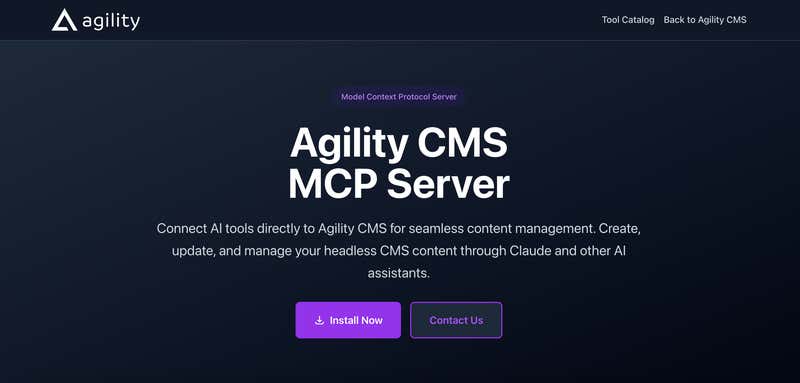
Agility CMS removes this problem through its MCP server, which connects directly to Claude, GitHub Copilot, Cursor, and Windsurf, so content can be created, updated, or queried from inside the same tool a developer is already coding in.
Want to see the MCP server in action? Try it out here.
Build on your stack, not around it
Monolithic CMSs can tie developers to a specific framework or hosting provider, making it difficult to adapt to modern requirements. Additionally, companies might be restricted to integrating only the tools the CMS vendor wants because anything else is too complex or costly to manage.
On the other hand, Agility CMS avoids that type of vendor lock-in by design. It's a cloud-native CMS built framework-agnostic, with starter kits for Jamstack and ASP.NET, and deployed via Vercel, Netlify, or a custom Azure DevOps pipeline.
As a composable CMS adheres to MACH (Microservices, API-first, Cloud-native SaaS, Headless) principles, ensuring a swappable enterprise tech stack that remains pluggable, scalable, and continuously improved through agile development without being locked into anything.
One schema, not two
When a content model lives in two places, one definition in the code a developer wrote and a separate structure inside the CMS's editing UI, the two drift out of sync the moment either side changes without the other knowing.
A field renamed in code doesn't rename itself in the editor, and a field added in the editor doesn't show up in the schema a developer is building against.
Agility CMS uses a single content model rather than two. A developer defines the schema once, and that same schema is what a marketer works from in Web Studio, so there's no separate structure to maintain and nothing to manually keep in sync between the two.
Documentation built to actually be used
Teams moving off a traditional CMS often worry that the headless learning curve will slow them down before they see the flexibility they migrated for.
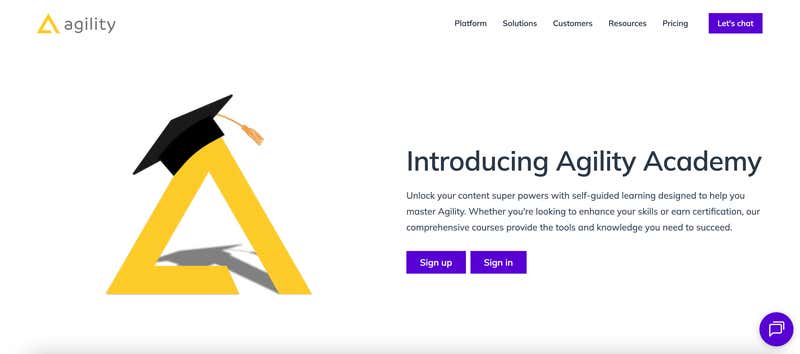
Agility CMS addresses this beyond just being straightforward to use. Agility Academy offers free, self-paced courses and certification, so a team can get up to speed on headless concepts and the platform itself quickly, and documentation organized by role, developers, editors, owners, and admins, means each person is learning against material built for what they'll actually do, not one undifferentiated wall of pages.
See how Agility CMS can handle your content needs. Book a demo.
Strapi
Strapi is an open-source, self-hosted headless CMS built entirely in JavaScript and TypeScript, with REST and GraphQL APIs generated automatically from the content types a developer defines. Key features include:
-
Self-hosted or managed through Strapi Cloud
-
Auto-generated REST and GraphQL APIs from custom content types
-
Role-based permissions and an admin panel built for non-technical editors
-
A free, open-source Community Edition with unlimited entries and locales
Contentful
Contentful is an API-first content platform built for teams delivering content across many channels at once, web, mobile, and connected devices. Structured content modeling and SDKs across eight platforms, including JavaScript, PHP, and iOS, make it a common choice for enterprise teams running high-traffic, multi-channel sites. Key features include:
-
REST and GraphQL APIs with SDKs across major platforms and frameworks
-
Structured, reusable content modeling
-
Role-based access controls and content versioning
-
A marketplace of apps for search, personalization, and asset management
Sanity
Sanity is a developer-first headless CMS built around Portable Text, a structured format for rich content, and GROQ, its own query language for filtering and joining content in a single request. Its Studio, the content editing environment, is built in React and can be customized to match how a specific team works. Key features include:
-
GROQ query language for filtering and joining content in one request
-
Real-time collaborative editing with live presence
-
A fully customizable React-based Studio
-
Structured content stored as Portable Text rather than raw HTML
Directus
Directus connects directly to an existing SQL database, PostgreSQL, MySQL, SQLite, and others, rather than creating its own, and generates REST and GraphQL APIs from that schema automatically. Key features include:
-
Wraps an existing SQL database rather than creating a new one
-
Auto-generated REST and GraphQL APIs with no schema migration required
-
A no-code Studio for non-technical users alongside full API access for developers
-
A native MCP server connecting Claude, Cursor, and other AI tools directly to live data
Payload
Payload is a TypeScript-native, open-source CMS built to run directly inside a Next.js application, sharing the same codebase and deployment as the frontend it powers. Content types, fields, and access rules are defined in code, so schema changes are versioned and reviewed the same way as any other part of the application. Key features include:
-
Installs directly into a Next.js App Router project, no separate backend
-
REST, GraphQL, and a zero-latency Local API for server-side queries
-
Fully typed schema defined in code, with types generated automatically
-
Self-hosted on Postgres, MongoDB, or SQLite, with an MIT-licensed core
Drupal
Drupal is an open-source CMS with deep roots in government and enterprise deployment. Its structured content architecture, granular permissions, and native multilingual tools are built for large, complex sites managed across multiple departments or teams. Key features include:
-
Native multilingual content management across more than 100 languages
-
Granular, role-based permissions for large content teams
-
A multisite architecture that runs several related sites from one codebase
-
A dedicated security team with a public, coordinated disclosure process
Choose Agility CMS for Your Next Build
Agility CMS brings API-first development, AI-native tooling, and marketer-ready governance into one platform, so a developer doesn't have to give up flexibility to get any of the rest. With Agility CMS, developers can:
-
Fetch and sync content through REST and GraphQL, served over a global CDN, without chaining calls to resolve linked content or re-pulling an entire content set on every build.
-
Update, query, or create content from inside Claude, GitHub Copilot, Cursor, or Windsurf through the MCP server, without leaving the tool they're already coding in
-
Define a content model once and let code and the visual editor read from the same schema, with nothing to keep manually in sync.
-
Get a team fully ramped through Agility Academy's free courses and role-organized documentation, not a wall of generic reference pages.
Cineplex made this trade-off by moving away from a platform that tied its developers to constant content-update requests. The team decoupled content from code entirely, freeing frontend developers to focus on the platform itself rather than routine edits. The shift let the team focus on what really matters: building a better product for their users.
Ready to build on a CMS your whole team actually wants to work in? Book a demo.

About the Author
Agility CMS is Canada's original headless CMS platform. Since 2002, Agility has helped companies across Canada and around the world better manage their content. Marketers are free to create the content they want, when they want it. Developers are empowered to build what they want, how they want.
- Get a demo for a personalized walkthrough.
- Try for FREE and experience Agility CMS.
- Contact us with your questions.