
Sanity Alternatives: 7 Enterprise Headless CMS Options for 2026
Sanity is a headless CMS with a customizable, all-code backend for content-driven websites and apps. It includes its own language, GROQ, and content gets edited through the Studio app. While this provides customizability, it can also lead to a frustrating experience for content teams and developers.
Aside from that, if you’re running Sanity at enterprise scale, there are a few other issues to deal with:
-
Your team owns the editing interface. Studio is an open-source React application your developers install, customize, host, and upgrade. Every change a content team wants to the editor becomes a developer ticket.
-
Content model changes ship as code. Schemas live in the repo, so adding or changing a field moves through a branch, a review, and a deploy rather than a settings screen.
-
Usage is metered, and Enterprise doesn't stop the meter. On Growth, API requests bill at $1 per 25k, CDN requests at $1 per 250k, and bandwidth at $0.30 per GB. Enterprise quotas are custom, but compute and AI overages are priced the same on Enterprise as they are on Growth.
None of this makes Sanity a bad platform, but using it to build the best digital experiences for your audience adds more strain on your engineering team than they might like. If any of those issues sound familiar, the Sanity alternatives we cover in this guide may be a better fit for your team.
Want to see the content model and the APIs before anything else? Book a technical demo, and we will start there.
Key Takeaways
-
Sanity Studio is a React application your team installs and maintains, which means the editing experience your content team uses is a product your engineers ship.
-
Because schemas are defined in code, routine content model changes move through the same branch, review, and deploy cycle as application code.
-
Sanity’s pricing meters API requests, CDN requests, bandwidth, assets, and documents, so the invoice moves with traffic and content volume rather than staying flat.
-
The right alternative depends on what you want to stop paying for. Some teams want a managed editor, some want a fixed cost, and some want to stay code-first and only change vendors.
-
Agility CMS gives enterprise teams a hosted page-building interface for marketers, UI-editable content models, and unlimited API requests, locales, and content models on every plan.
Top 7 Sanity Alternatives in 2026
Here are seven alternatives to Sanity to consider in 2026. Each one fits a different type of content operation.
1. Agility CMS: Best overall for enterprise teams that want marketers off the dev queue
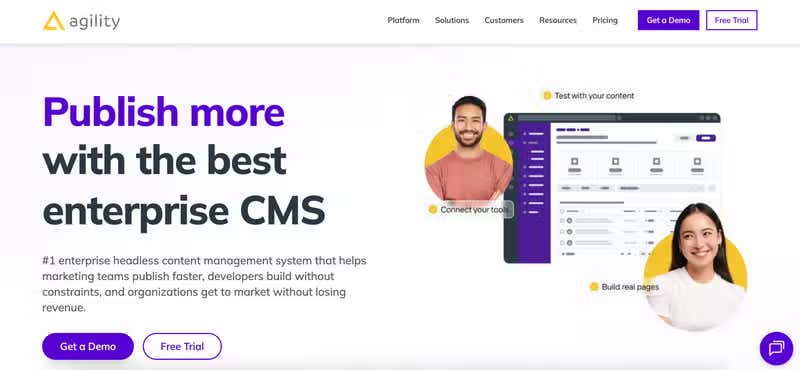
Agility CMS is a hybrid headless CMS and is built for engineering teams who want full API control over content without making marketer dependence the price of getting it. Developers get REST and GraphQL access to content for any frontend, and marketers get drag-and-drop page building in Web Studio on the same content model. One schema is defined once, and both sides read from it, so nothing has to be kept in sync between the code and the editing interface.
Engineering teams evaluating Agility as a Sanity replacement can use it to:
-
Fetch content for any frontend over REST or GraphQL, served through a global CDN
-
Use the Content Fetch API to resolve linked content in a single request and use the Content Sync API to retrieve only the changes made on each build.
-
You can connect Claude, GitHub Copilot, Cursor, or Windsurf to Agility via its MCP server.
-
Start a project using starter kits with Next.js, Nuxt, or another modern framework and deploy it to Vercel, Netlify, or to an existing deployment pipeline.
-
Define a content model once and have both code and the visual editor read from the same schema.
-
Hand marketers page building, scheduling, and approval workflows without giving up structured content
Ready to see it against your own requirements? Book a demo of Agility CMS.
Marketers build and publish pages without a developer in the loop
Sanity gives editors visual editing against a structured document, but page composition, routing, and sitemap structure still come back to the codebase. Agility separates the two jobs. Developers build UI components once, which Agility calls modules. After that, marketers assemble pages from those modules, set the URL structure, and publish, all inside Web Studio.
With Agility, your content team can:
-
Build and reorder pages from existing modules and control sitemaps and routing directly, without a frontend change.
-
Preview changes before they go live and schedule both publish and pull dates for time-sensitive content.
-
Group changes and publish them together with batch publishing, so a campaign launches as one release rather than a sequence of saves.
-
Route work through approval workflows so legal, brand, and regional reviewers sign off inside the CMS instead of over email.
-
Manage localized content across unlimited locales, copying and sharing content between languages and publishing regionally.
Content models change in the interface, not in a pull request
In Sanity, a content model lives in schema files, so adding a field means a branch, a review, a deploy, and a rollback plan if something breaks. That is a reasonable process for application code and an expensive one for a marketing team that wants a new field on a landing page.
Meanwhile, Agility defines content models in the interface. A content architect can add a field, create a new content type, or adjust an existing model without touching the repository, and every plan includes unlimited content models and content types.
Developers still get the extension points they need. Custom Fields let your team build bespoke UI controls inside the Agility interface for unusual content or third-party integrations, and deliver content over both REST and GraphQL with open-source SDKs for JavaScript and .NET.
Traffic growth does not change the invoice
Agility includes unlimited API and asset requests, unlimited locales, and unlimited content models on every tier, including the entry plan. That means a traffic spike, a new market launch, or a larger content model won't create a line item. You size the plan based on how much content you hold and how much asset traffic you serve, not how often your frontend queries the API.
Agility Essentials starts at $699 per month. Enterprise is custom and scales to 500k+ entries, 20TB of asset storage, and 15TB+ of monthly asset traffic. Agility also runs a free proof of concept, where the team builds a working prototype with you before you sign a contract.
Enterprise infrastructure ships with the platform
The last category is everything a procurement and security review asks about, which is usually where a self-serve platform runs out of answers.
-
Digital asset management is built in on every plan, with an image editor, real-time image transformations, and delivery through Fastly.
-
Backups are standard with 30 days of point-in-time recovery on every plan and extended options on Enterprise.
-
Data residency is a choice, with Enterprise customers picking a data center in the USA, Canada, Europe, or Australia.
-
Security controls scale to Enterprise requirements, including enterprise SSO through Auth0, MFA, custom roles, Teams, security audit support, and custom security reporting.
-
Support is not an add-on. 24/7 critical support is included on every plan, and Enterprise adds a customer success manager, a 99.9%+ SLA, and a private Slack channel with our team.
Book a demo to see how Agility CMS handles your content model, your team structure, and your compliance requirements.
2. Contentful: Enterprise headless CMS with the largest integration ecosystem
Contentful is one of the longest-running platforms in the headless category, with a deep app marketplace and a decade of enterprise deployments. Teams moving from Sanity usually look at Contentful because content modeling happens in the interface rather than in schema files so that a content architect can evolve a model without a deploy. Its pricing is also usage-based, so teams leaving Sanity over cost predictability should model it carefully before switching.
Key features
-
UI-based content modeling with a mature editorial interface
-
REST and GraphQL APIs plus a large marketplace of apps and integrations
-
Strong localization and multi-space architecture for global and multi-brand teams
-
Granular roles, audit logs, and SSO on the enterprise tier
3. Storyblok: Component-based CMS with a live visual editor
Storyblok is a headless CMS with reusable components that editors can combine into pages inside a live visual editor. Marketers get side-by-side editing against the rendered page without your engineers building and maintaining that interface. However, pricing is structured around seats and spaces, which can be problematic for multi-brand or multi-market setups.
Key features
-
Live visual editor with real-time preview of the rendered page
-
Block-based content structure that maps to frontend components
-
REST and GraphQL content delivery with a broad app directory
-
Framework-agnostic, with published guides for Next.js, Nuxt, Astro, and others
4. Contentstack: Enterprise CMS for complex approval workflows
Contentstack is an enterprise-focused headless CMS built around structured publishing, branching, and multi-team governance.
It suits organizations where content passes through legal, brand, and regional review before it goes live, which is the kind of process Sanity leaves you to construct yourself. Implementation is a larger project than most platforms on this list, and pricing is enterprise-only.
Key features
-
Multi-step approval workflows and content branching for large editorial teams
-
Visual Builder for WYSIWYG page editing by non-technical users
-
Automation tooling for content operations and integrations
-
Enterprise security posture with SSO, SLAs, and compliance certifications
5. Hygraph: GraphQL-native CMS for federated content
Hygraph is a GraphQL-native headless CMS with a visual schema builder and a content federation layer that exposes external REST and GraphQL sources through a single endpoint. For a team leaving Sanity, the draw is keeping a query-language-first workflow while moving schema definition out of code and into the interface. It is structured-content-first rather than page-first, so teams that want visual page building will need a frontend layer for composition.
Key features
-
No-code schema builder with complex and bidirectional relationships
-
Content federation across external REST and GraphQL APIs
-
Environment-level custom roles, field-level permissions, and audit logs
-
ISO 27001 and SOC 2 Type 2 compliance with SSO support
6. Kontent.ai: Governance-focused CMS for regulated industries
Kontent.ai is a SaaS headless CMS built around editorial governance, with workflow, taxonomy, and role management as core product rather than configuration. It often comes up for teams in healthcare, higher education, and other regulated sectors, where who changed what and who approved it matters as much as delivery. Its Web Spotlight feature gives editors in-context page editing without a custom-built interface.
Key features
-
Configurable multi-step workflows with role-based publishing control
-
Taxonomy and content reuse designed for large content libraries
-
Web Spotlight for in-context editing and preview
-
European headquarters, which matters for teams with EU data governance requirements
7. Payload CMS: Code-first CMS for teams that want to stay in the repo
Payload is an open-source, TypeScript-native headless CMS where the content model, access control, and admin interface are all defined in your own codebase.
It is on this list for teams whose problem with Sanity is the vendor and metered pricing, not the architecture. Everything you like about schema-as-code stays, and you self-host, so infrastructure, scaling, security patching, and uptime become your responsibility.
Key features
-
TypeScript configuration that generates the admin UI and the API
-
Self-hosted with no per-seat licensing and no usage metering
-
Native Next.js integration, running inside your application rather than beside it
-
REST and GraphQL APIs with full access-control logic in code
Find the right Sanity alternative with Agility CMS
Every platform in this guide solves a different version of the same problem, and the right one depends on which cost you are trying to remove. If the answer is that your engineers should stop maintaining an editing interface and your invoice should stop moving with your traffic, Agility CMS is built for that. With Agility, enterprise teams get:
-
A hosted editing environment in Web Studio that we maintain, so no part of the editing experience sits in your repository
-
Page building, sitemap control, scheduling, and batch publishing that marketers run themselves
-
Content models created and changed in the interface, with unlimited models and types on every plan.
-
Unlimited API and asset requests and unlimited locales, so growth does not change the bill
-
Built-in DAM, 30-day point-in-time backups, 24/7 critical support, and datacenter choice across four regions
Cineplex moved to Agility from a platform that kept its developers tied to routine content-update requests. Decoupling content from code freed the frontend team to work on the product instead of the edits. Read the case study to see how that shift worked in practice.
Book a demo today to see why enterprise teams choose Agility CMS over Sanity.