

Your Monolithic Thinking Is Hurting You, Whether You Know It Or Not
After PHP2Shell and now an Optimizely incident, time for a hard rethink of monolithic DXPs!

Joel Varty
CTO

How many more incidents do we have to see before we have a conversation about architecture?
If you lead engineering or product at a company running a monolithic DXP, you probably spent the last week fielding the same question from your security team: are we exposed? On November 16, a supply-chain attack on Optimizely Web pushed malicious JavaScript to roughly 178 organizations, including the BBC, CNN, Zoom, Salesforce, GitLab, HSBC and Ledger. Optimizely has since patched the vulnerability, removed the injected code from affected projects, and added further protections. Credit to them for a fast response. But the incident is worth sitting with for a minute, because it is part of a pattern I want to talk about.
Three weeks earlier, on October 21, the PHP team shipped emergency patches for CVE-2026-109618 and CVE-2026-109619, the pair researchers are calling PHP2Shell. Both rated CVSS 9.2 (BAD!). Both allow unauthenticated remote code execution - which is VERY VERY BAD. Watchtowr and Amazon reported exploit attempts before public disclosure. If you were anywhere on the PHP stack, WordPress, Drupal, Magento, Laravel, you probably spent that week freaking out more than a little bit.
I know I talked to a lot of customers who have PHP somewhere in their stack (outside Agility) that caused them to rethink stuff and to switch to something more modern.
Different vendor, different kind of vulnerability, same pattern. One widely used piece of infrastructure gets compromised, and everyone sitting on top of it has a bad day at the same time.
What these incidents say about architecture, not vendors
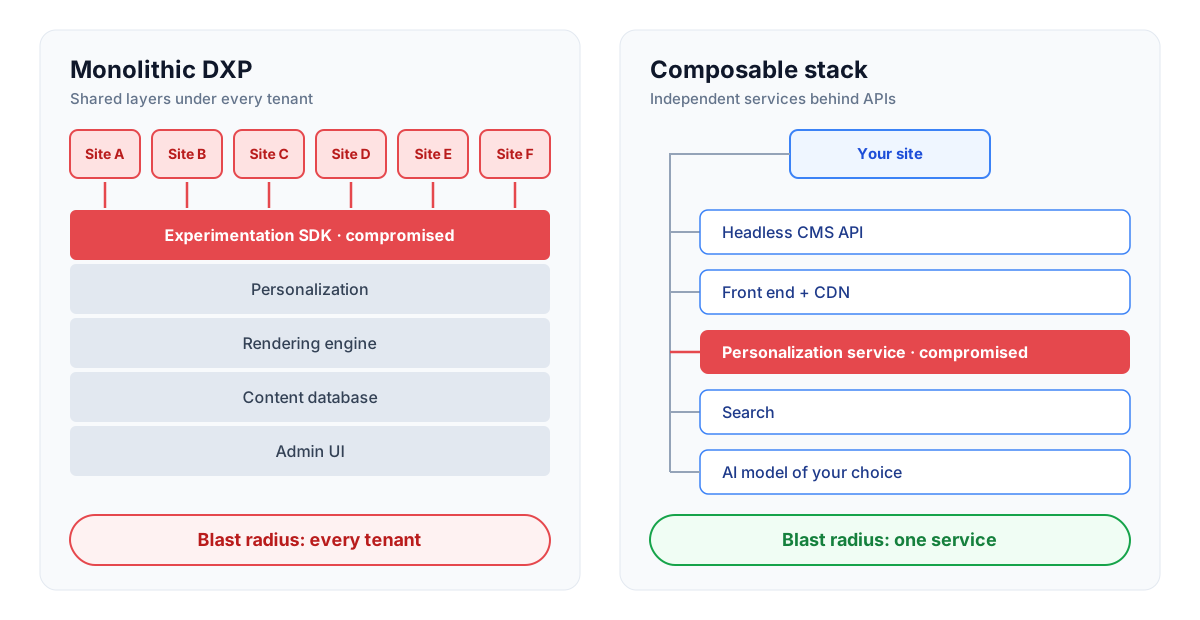
A monolithic DXP bundles the admin UI, the content database, the rendering engine, the personalization layer, and often an experimentation SDK that writes client-side JavaScript into every customer page. The pitch is tight integration, and the integration is real. The side effect is that the attack surface of any single component is the attack surface of every site on the platform.
The Optimizely case is a clean example because the compromise was not in any customer's site code. The malicious JavaScript rode on a host every customer had already told browsers to trust. Content Security Policies that allowed that host let the payload through. Customers who had never deployed a line of bad code found themselves serving a crypto address swapper and a card skimmer. That is what shared surface looks like when it fails.
The PHP vulnerabilities land in the same shape from the other direction. Your WordPress site was not vulnerable because of anything your team wrote. It was vulnerable because the runtime underneath it was. In a monolithic stack, a flaw in any shared layer cascades to every tenant at once, and the only lever you have is patching speed.
The AI argument is bigger than the security one
Security is the headline this month. The bigger argument, for me, is what a monolithic architecture does to your ability to move at the pace AI is moving.
If your DXP ships its own AI features, those features arrive on your vendor's release schedule. The model they picked is the model you get. The eval harness they wrote is the one you can run. The price they negotiate with the model provider is what you pay. When something better ships six weeks later, and these days something better ships every six weeks, you wait until the vendor integrates it.
A composable setup flips that. If your content lives in a headless CMS with clean APIs, you can point any model at it. OpenAI, Anthropic, a locally hosted Llama, a small fine-tuned model your team runs. For content generation, translation, personalization, and search, you pick the tool and swap it when a better one shows up. You run your own evals on your own content. You pay the price you negotiated.
Agentic workflows sharpen this point. Agents need content that is addressable by API, not content that lives inside a rendering pipeline nobody outside the DXP vendor can touch. If your product catalog or your article library is only reachable through a monolith's server-rendered pages, you are building agent tooling on top of scraping. If it is behind a documented content API, you are building agent tooling on top of a contract.
Business agility follows the same logic. Price hike from one vendor? You replace that one piece. New requirement for personalization in a specific market? Add a service, do not wait for the platform roadmap. A product line that needs a different delivery stack for compliance reasons? Same content, different front end.
Where monoliths still make sense
Let’s be fair though - monolithic DXPs are still a defensible choice for some teams. If you want “one thread to choke” (one vendor, one SLA, one support contract, etc), the monolith gets you moving quickly. I have seen teams ship faster on a monolith than they would have on a composable stack they did not have the capacity to assemble. More in a minute on how that math changes with AI.
Composable is not magic. A compromised CDN in front of a headless site serves malware the same way the Optimizely snippet did. A sloppy content API is its own attack surface. A homegrown stack of six services with no owner for the glue code is worse than any monolith. The point is not that composable architectures cannot fail. It is that they fail in smaller, more contained ways, and the blast radius of any single failure is usually one service rather than everything.
Composable APIs + AI = [chef’s kiss]
One of the things that IS magical about a composable architecture with API-based systems talking with each other, is that it works AWESOME with AI. I have helped customers setup their whole stack using Claude to help organize and lay things out in literally minutes when previously it might have been days and weeks of research and futzing around. AI is a game-changer for composable, API-based stacks.
If you haven’t tried using MCP servers yet, these connectors change the game completely. Agility’s MCP is how many of our customers use our system now, even more than the UI.
What I would be thinking about if I were you
If you are on a monolithic DXP right now, I do not think the question is whether to panic. It is whether your next architecture decision keeps you agile enough for what is coming. The security story is one input. The AI story is a bigger one. Both point in the same direction, and together they are worth putting on the agenda for your next planning cycle.


