
What is an Agile CMS?

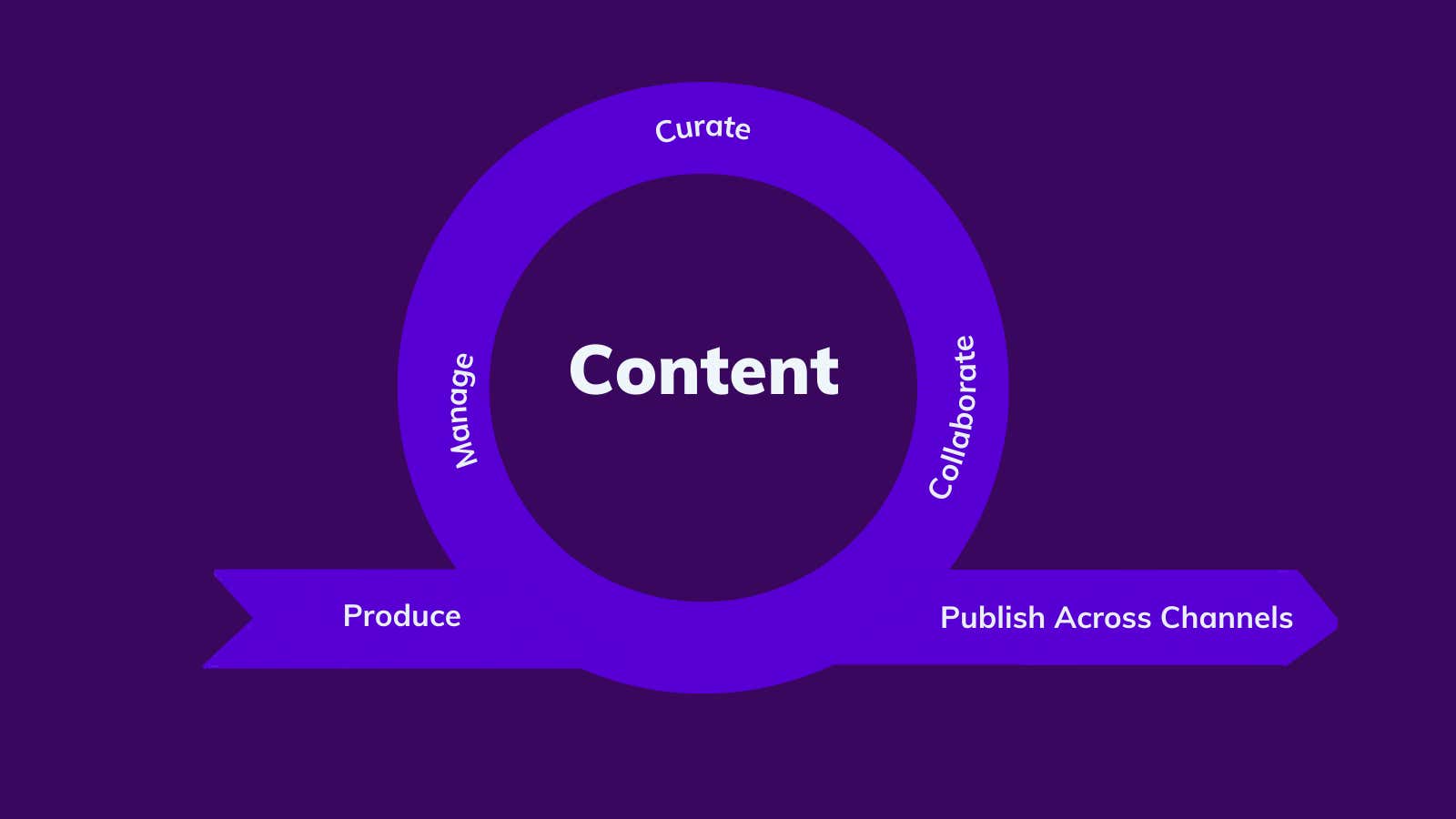
Agile methodologies have changed everything, and content management systems are no exception. The Agile methodology has broken down process and content silos, enabling faster content delivery, greater interdepartmental connectivity, and better business outcomes.
From a CMS perspective, following an agile methodology and, more importantly, using an agile CMS, simplifies content and asset management across enterprise organizations, enabling global brands to engage with customers across multiple countries and platforms.
In this article, we’ll explain what an agile CMS is, the origins of agile, what it means for content management, and the benefits an agile CMS like Agility CMS can provide for enterprises.
What Is an Agile CMS?
The concept of agile CMS builds on headless architecture rather than replacing it. Pure headless platforms give developers a strong technical foundation and deliver content via API to any channel, but on their own, they don't always provide marketers and business users with the same level of built-in collaboration and workflow tooling. Instead, an agile CMS closes that gap.
According to Forrester, Agile CMSs are capable of assembling “...new types of engaging experiences from content, commerce, and data building blocks,” and need at least three features: a content hub, collaboration and planning tools, and flexible deployment.
With that said, there are other vital components a CMS needs to be truly agile and provide enterprises with the best experience.
The Origins of Agile
Agile itself didn't start in marketing or content management. In February 2001, seventeen software developers met at a ski resort in Utah, frustrated with rigid, plan-heavy development processes that struggled to keep up with change. They published the Agile Manifesto, a short set of values prioritizing collaboration, working software, and responding to change over following a rigid plan.
That same thinking, break work into small, iterative pieces and adapt as you go, eventually spread well beyond software, including into how enterprises manage content.
What Does It Mean to Be Agile for Content Management?
For a CMS, being agile means applying those same values to content. Giving teams the ability to collaborate across departments, iterate quickly, and adapt content and delivery as needs change, rather than being locked into a single rigid workflow.
That's a different question from whether a CMS is headless. Headless architecture determines how content gets delivered. Agility, in this sense, is about how teams actually work together to create and manage that content day to day.
Want to see what this looks like in practice? Talk to our team about how Agility CMS supports agile workflows.
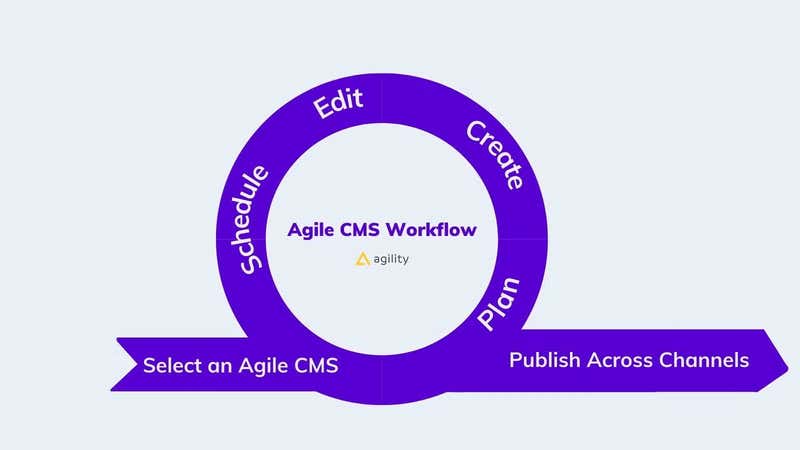
The Anatomy of an Agile CMS
Here's what actually separates an agile CMS from the rest, broken down piece by piece.
Content Hub
Scattered content across disconnected tools makes it hard to keep anything organized, up to date, or secure. To be called agile, a CMS needs to provide enterprise users with an easy-to-use interface to view, organize, and manage content in a single place, while also staying compliant and secure against malicious actors. With Agility CMS, you can:
-
View and manage every piece of content from one interface, across every channel it feeds
-
Control who can access or edit what, without relying on separate tools for permissions
-
Meet compliance and access-control requirements from the same interface editors already use
Omnichannel Content Delivery
Publishing the same update separately for a website, an app, and every other channel wastes time and creates room for inconsistency. The ability to deliver content to different devices and channels is no longer a nice-to-have feature for enterprises. An agile CMS gives enterprise businesses a platform to centralize information and distribute it across devices with a single click. Agility CMS allows teams to:
-
Publish a single update once and have it reach every connected channel through the API
-
Manage web, mobile, and any other channel from the same content source, without duplicating content per channel.
Flexible Deployment
Being tied to a single front-end framework or hosting provider makes it harder to adapt as a project's requirements change. The ability to deploy digital experiences with different front ends and frameworks sets agile platforms apart. An agile CMS platform can also deploy code using other methods and tools to support a robust development workflow. With Agility CMS, developers can:
-
Build with Next.js, React, Vue, or another modern framework, rather than the CMS's required framework.
-
Deploy to Vercel, Netlify, or any hosting environment your team already runs.
-
Move to a different framework or host later without migrating the content itself.
Read More: The Best CMS for Developers
Collaboration and Planning Tools
Agile practices only work if every stakeholder, not just developers, can actually take part in planning and reviewing content. Agile approaches aren't possible without thorough collaboration from every stakeholder in your company. To be considered agile, a CMS needs to offer a collaboration hub or integrate with the best third-party planning tools. Agility CMS offers this flexibility and allows teams to:
-
Manage content and review changes inside Web Studio, without a separate tool for every stakeholder.
-
Connect existing planning and project tools through the API rather than replacing them.
Custom Workflows
A vendor-imposed workflow forces a team to adapt its process to the software rather than the other way around. A workflow is a series of steps toward a desired state or goal. Most CMSs have set-in-stone workflows that you can't change. An agile CMS helps enterprise businesses by creating custom workflows that align with their content and development pipelines. Agility CMS gives teams the ability to:
-
Configure approval steps and reviewers to match how your team actually works.
-
Adjust a workflow directly, without filing a request to a developer.
Content Reuse
Rebuilding the same piece of content separately for every page or channel it appears on multiplies the work every time something changes. Without reusable parts, building digital experiences at scale would be impossible. By treating each piece of your website as an independent module, an agile CMS helps enterprises build digital experiences with less time and effort. With Agility CMS, you can:
-
Build a piece of content once and reference it across pages and channels through Shared Content.
-
Update it in one place and have every page or channel using it update automatically.
User Friendly
A CMS that only developers can comfortably use ends up limiting who can actually publish and update content. If one thing is true about legacy CMSs, it's that they're clunky and hard to use for non-technical users. An agile CMS simplifies processes, making them simple for non-technical and first-time users. With Agility CMS, you can:
-
Create and publish content through Web Studio's visual interface, without writing code.
-
See content exactly as it will appear on the live site before publishing, through the built-in visual preview.
Agile Methodologies
Agile principles only translate into faster content delivery if the platform itself supports working in small, iterative steps rather than one large release. The agile methodology is the backbone of an agile CMS solution. Agile practices empower your employees to do their jobs with maximum creativity while staying in sync, reducing content silos, and fostering greater innovation. With Agility CMS, you can:
-
Publish individual content updates as they're ready, rather than bundling them into a single release.
-
Keep developers and content teams working from the same content model so neither is blocked by the other.
Content Modeling
Content that isn't broken into defined, structured fields is harder to reuse, query, or manage consistently as it grows. Content modeling allows marketers to define and relate content at a granular level. It involves analyzing requirements, determining the type of content you need, and identifying structures so editors can use and manage content more quickly. With Agility CMS, you can:
-
Define fields and relationships once in a content model, then create as many items from it as needed.
-
Query and reuse that structured content through the API, rather than working with unstructured pages
Most of what makes a CMS agile comes down to whether marketers can actually work in it without a developer. That's what Agility CMS built Web Studio to do. See it in action.
Traditional CMS vs. Pure Headless CMS vs. Agile CMS
|
Traditional CMS |
Pure Headless CMS |
Agile CMS |
|
|
Architecture |
Coupled |
Decoupled |
Decoupled, with added tooling for collaboration and workflow |
|
Content delivery |
Single-channel or disjointed multichannel |
Omnichannel across channels and devices |
Omnichannel, with a stronger focus on team collaboration |
|
Workflows |
Unchangeable |
Customizable, developer-built |
Customizable, with built-in planning and collaboration tools |
|
Integrations |
Plugins, limited third-party support |
API-driven, third-party friendly |
API-driven, with added emphasis on tools that support agile workflows |
|
Deployment |
On-premise |
Cloud, SaaS-based |
Cloud, SaaS-based |
|
Best suited for |
Single-channel sites with simple needs |
Organizations with strong development teams |
Organizations that need both headless flexibility and cross-team collaboration |
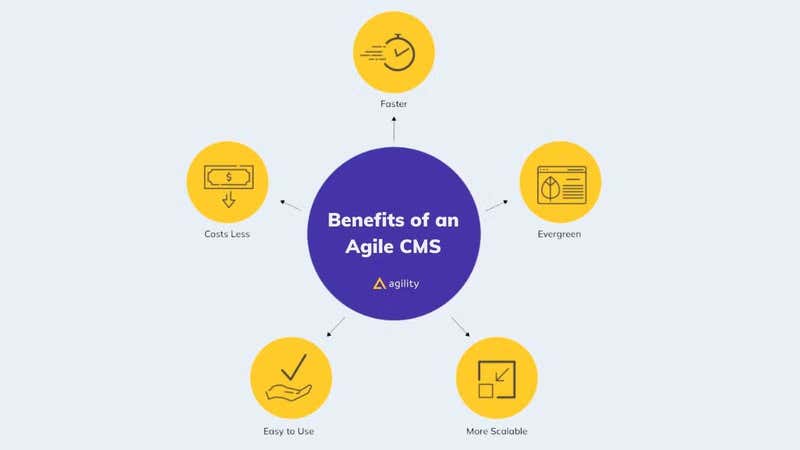
Benefits of an Agile CMS
Faster Speed To Market
Following agile practices enables faster market speed, as they help marketers, business users, and developers build digital experiences and respond quickly to market changes. Enterprises stay nimble, adaptable, and ready to deliver content to as many channels as possible without interruptions or overlapping efforts.
Adaptability
By separating the frontend from the backend, an agile content management system allows developers to build digital experiences and websites using the tools they know and love, without the constraints of a highly opinionated traditional CMS.
Agile CMSs are nimble and prevent vendor lock-in. Agility CMS enables you to build a best-of-breed software stack that solves your unique content needs and increases your ROI.
Customizable Workflows
With the increasing complexity of today's marketing campaigns, which require coordination across multiple integrated touchpoints, an agile CMS solution is the perfect tool for creating granular, personalized workflows without coding.
Third-party Integrations
The agile approach calls for an interconnected web of services that communicate with one another to deliver greater value than the monolithic architecture of a traditional CMS. Agile content management systems leverage APIs and GraphQL, enabling developers and marketers to integrate with third parties.
What Makes Agility CMS Agile?
Agility CMS is built to be agile in a very current sense of the word. Its Model Context Protocol server, currently in beta, connects directly to the AI tools teams already use, including Claude, GitHub Copilot, Cursor, and Windsurf, so developers and content teams can create pages, update content, and manage content models through natural language, without switching tools. Enterprise governance, approval workflows, and role-based permissions stay in place regardless of how or where content gets created.
Agility CMS also enables multidisciplinary teams to complete tasks through workflows and agile principles, using manageable sprints. The platform supports cross-functional operations and the rapid development of digital solutions and content. With Agility CMS, you can:
-
Connect to Claude, GitHub Copilot, Cursor, or Windsurf directly through the MCP server, so content can be created or updated from within the tools your team already uses.
-
Build custom, no-code workflows that match your team's actual approval and review process.
-
Reuse a single content model across all channels via the API, rather than rebuilding content for each channel.
-
Give marketers a visual editing interface in Web Studio while developers keep full API access to the same content.
California State University, Long Beach, evaluated more than 25 CMS platforms, traditional, decoupled, and headless, before choosing Agility CMS specifically for the flexibility it gave both IT and marketing communications. The team found that it delivered the fastest time to market and required the least developer involvement of any option they reviewed, while still giving developers full control to build custom integrations with existing systems like Salesforce and PeopleSoft.
Ready to see how Agility CMS supports the way your team actually works? Book a demo.

About the Author
Joel is CTO at Agility. His first job, though, is as a father to 2 amazing humans.
Joining Agility in 2005, he has over 20 years of experience in software development and product management. He embraced cloud technology as a groundbreaking concept over a decade ago, and he continues to help customers adopt new technology with hybrid frameworks and the Jamstack. He holds a degree from The University of Guelph in English and Computer Science. He's led Agility CMS to many awards and accolades during his tenure such as being named the Best Cloud CMS by CMS Critic, as a leader on G2.com for Headless CMS, and a leader in Customer Experience on Gartner Peer Insights.
As CTO, Joel oversees the Product team, as well as working closely with the Growth and Customer Success teams. When he's not kicking butt with Agility, Joel coaches high-school football and directs musical theatre.