What is a Headless CMS and why are enterprises switching?
A headless CMS stores your content in one central platform and delivers it through an API to every channel you run, simultaneously. Unlike a traditional CMS, content and presentation are separate, so updates do not require a developer every time.
Agility CMS is built on this architecture with visual editing and page management included, so marketing and development teams can both work independently.
Enterprise Headless CMS MACH Alliance Member SOC 2 Type II
TRUSTED BY ENTERPRISE BRANDS
How a Headless CMS Works
What a headless CMS is and why it matters for your team.
A traditional CMS keeps your content and your website tightly connected. Your content is built for a specific template and cannot travel to other channels without rebuilding from scratch. Every new touchpoint means more development work — more tickets, more delays, and more dependency on engineering resources that could be spent elsewhere.
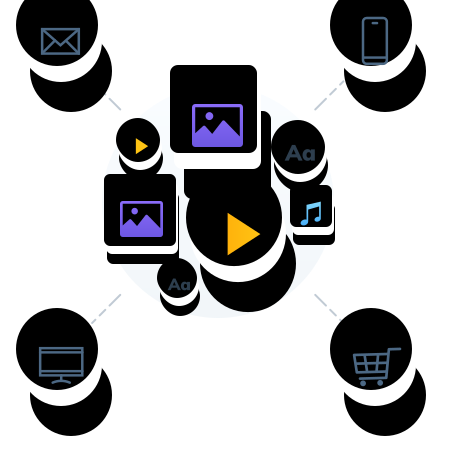
A headless CMS separates the two. Content lives in a central hub and gets delivered via APIs to any channel simultaneously: your main website, a mobile app, digital signage, a voice interface, or an AI agent. Your developers build the front end in whatever framework they prefer. The term "headless" simply means the CMS has no built-in front end — the presentation layer is removed, and you attach whatever front end you need.
Agility CMS is built exactly on this architecture — and adds something most headless platforms leave out: a visual page builder and page management layer so your marketing team can publish independently, without developer tickets. You get the flexibility of a headless architecture without sacrificing the editorial control your content team needs to move fast.
What Makes Agility Different
Pure headless gives developers freedom. Agility CMS gives the whole team freedom.
Pure headless platforms deliver excellent API flexibility but remove something marketing teams depend on: the ability to manage pages themselves. Every page, every navigation change, every new landing page requires a developer ticket.
Agility CMS preserves the full API-first architecture your developers need and adds a page management layer so marketing teams own what they need without slowing down the engineering team or compromising the composable stack.
See Agility CMS in ActionNot a drag and drop site builder
Page management is built on your developer-defined module library. Marketing works within brand guardrails set once by the development team, so every page stays consistent and on-brand.
Not a monolithic CMS
Your front end remains fully decoupled. Developers control performance, code quality, and the technology stack entirely. Nothing about the architecture is compromised.
Both teams, one platform
API delivery for every channel, plus marketer-owned page management for your primary web properties. Marketing and engineering each get what they need from a single platform.
Compare Your Options
How does a headless CMS compare to what most enterprise teams are running today?
Three architecture types, side by side, on the criteria enterprise teams actually evaluate.
| Traditional CMS | Pure Headless CMS | Agility CMS | |
|---|---|---|---|
| API content delivery | Limited | Full REST and GraphQL | Full REST and GraphQL |
| Marketer page management | Built in | Requires a developer | Visual and built in |
| Omnichannel delivery | Web only | Any channel | Any channel |
| Modern framework support | Template locked | All frameworks | All frameworks |
| Enterprise governance | Basic | Varies by platform | SOC 2 · GovRAMP · Azure |
| Time to market | Months of dev work | Dev needed per page | Marketing publishes independently |
The four things that set Agility CMS apart.
Built for enterprise scale from day one. The full capabilities list is available on the platform page.
Page management for marketers
Build and publish full page layouts visually. Manage sitemaps, navigation, and URL structure without code or developer tickets.
API-first content delivery
All content available via REST and GraphQL. Pull structured content into any front end, native app, digital signage, or AI-powered experience.
Enterprise security and compliance
SOC 2 Type II certified. GovRAMP registered. Hosted on Microsoft Azure with 99.95% uptime SLA. SSO, role-based access, and audit trails included.
Multi-site, multi-region publishing
Manage multiple brands and regions from one instance. Shared global content with locale-specific overrides, approval workflows, and full audit trails per market.
99.95%
Guaranteed uptime SLA
on all enterprise plans
94%
Recommend Agility CMS
on Gartner Peer Insights
20+
Years building enterprise
CMS solutions since 2002
4.6★
Average rating on
Gartner Peer Insights
Migration and Onboarding
Switching CMS platforms is easier than you think.
Most teams delay a CMS switch because migration feels risky. Agility CMS is built for phased migration. You move content and channels incrementally, keeping your existing system live until you are ready to cut over.
Every Agility CMS customer gets a dedicated Customer Success Manager from day one, who guides your team through onboarding, content modelling, and go-live. White-glove service is included, not an add-on.
Talk to us about your migrationPhased migration, no forced cutover
Move content and channels incrementally. Your existing site stays live throughout.
Dedicated Customer Success Manager
A named CSM assigned to your account from day one. Included on all plans — not a paid add-on.
Typical go-live in 5 to 8 months
Compared to 12–18 months for Adobe AEM or Sitecore. Starter kits for Next.js, Nuxt, Gatsby, Astro, and .NET accelerate delivery further.
Pricing
Transparent, fixed pricing. No usage-based surprises.
Unlike Adobe AEM or Contentful, Agility CMS pricing is fixed — not tied to page views, API calls, or seats that escalate every renewal. You know what you pay. A free trial is available with no credit card required.
Get Started
Free Trial
30 days, full platform access. No credit card required. See exactly what Agility CMS can do for your team.
Most Popular
Enterprise
Fixed annual pricing, dedicated CSM, 24x7 support, multi-site, SSO, audit trails, and 99.95% uptime SLA included.
Calculate ROI
ROI Calculator
Estimate how much time and budget your team could recover by making the switch. Input your current costs and calculate your annual savings by switching to a headless CMS.
Not ready for a demo yet?
These resources will help you evaluate Agility CMS, understand headless architecture, and make the case internally.
Agility CMS vs Contentful: A Headless CMS Comparison for Marketers
A side-by-side look at how Agility CMS and Contentful compare on page management, governance, and time to market.
Headless CMS ROI Calculator
Estimate how much time and budget your team could recover by reducing developer dependency on content changes.
Five signs your CMS is costing you more than you think
If your marketing team is waiting on dev sprints to publish content, that is the clearest sign your CMS is holding you back.
Try out the platform for free, no credit card required.
Try everything for 30 days and see if Agility CMS fits your organization.
Common Questions
Questions people ask before choosing Agility CMS.
What makes Agility CMS different from other headless CMS platforms? −
Agility CMS combines full API-first headless architecture with a built-in visual page builder and marketer-owned page management — something pure headless platforms don't offer. Marketing teams can publish independently while developers retain full control of the front end and technology stack.
How is a headless CMS different from WordPress or Sitecore? +
WordPress and Sitecore are traditional coupled CMS platforms where content and presentation are tightly linked. A headless CMS separates the two, delivering content via APIs to any channel. This gives developers framework freedom and allows content to power web, mobile, digital signage, and AI experiences simultaneously.
Can we migrate from WordPress, Sitecore, or Adobe Experience Manager to Agility CMS? +
Yes. Agility CMS is designed for phased migration from any legacy CMS. You can migrate content and channels incrementally, keeping existing systems running while your new architecture comes online. The Agility team has migrated hundreds of enterprise organizations from WordPress, Sitecore, and AEM.
Is Agility CMS enterprise-grade for security and compliance? +
Yes. Agility CMS is SOC 2 Type II certified and GovRAMP registered. It is hosted on Microsoft Azure with a 99.95% uptime SLA. Standard features include role-based access control, nine built-in roles, approval workflows, full audit trails, and SSO via SAML and OAuth.
What front end frameworks does Agility CMS support? +
Agility CMS is fully framework-agnostic. Official starter kits are available for Next.js, Nuxt.js, Gatsby, Astro, and ASP.NET. The REST and GraphQL APIs work with any JavaScript or .NET framework. Agility CMS also provides TypeScript and JavaScript SDKs, a content sync SDK for static generation, and webhook support for CI/CD pipelines. You can deploy to Vercel, Netlify, Azure DevOps, or any custom hosting environment.
How does Agility CMS pricing work for enterprise teams? +
Agility CMS offers transparent, fixed enterprise pricing — not usage-based pricing that escalates with traffic. Contact the team for a custom quote based on your organization's size, number of sites, and requirements.
Still have questions?
The Agility CMS team includes real headless CMS experts who have helped hundreds of enterprise teams evaluate, migrate, and build on the platform. No scripts, just answers relevant to your situation.