
Five signs your CMS is costing you more than you think
Is your content management system holding your team back from moving fast and staying ahead of your competition?

Most enterprise teams don't wake up one day and decide to switch their CMS. It happens gradually. A developer queue that never clears. A campaign that launched two weeks late. A new digital channel that took six months to stand up. A platform renewal that made even your CFO raise an eyebrow.
By the time the frustration becomes undeniable, the cost in time, opportunity, and team morale has already been significant.
If any of the five signs below sound familiar, your CMS relationship may have run its course.
Here are five clear signals it's time to move on and what to look for next:
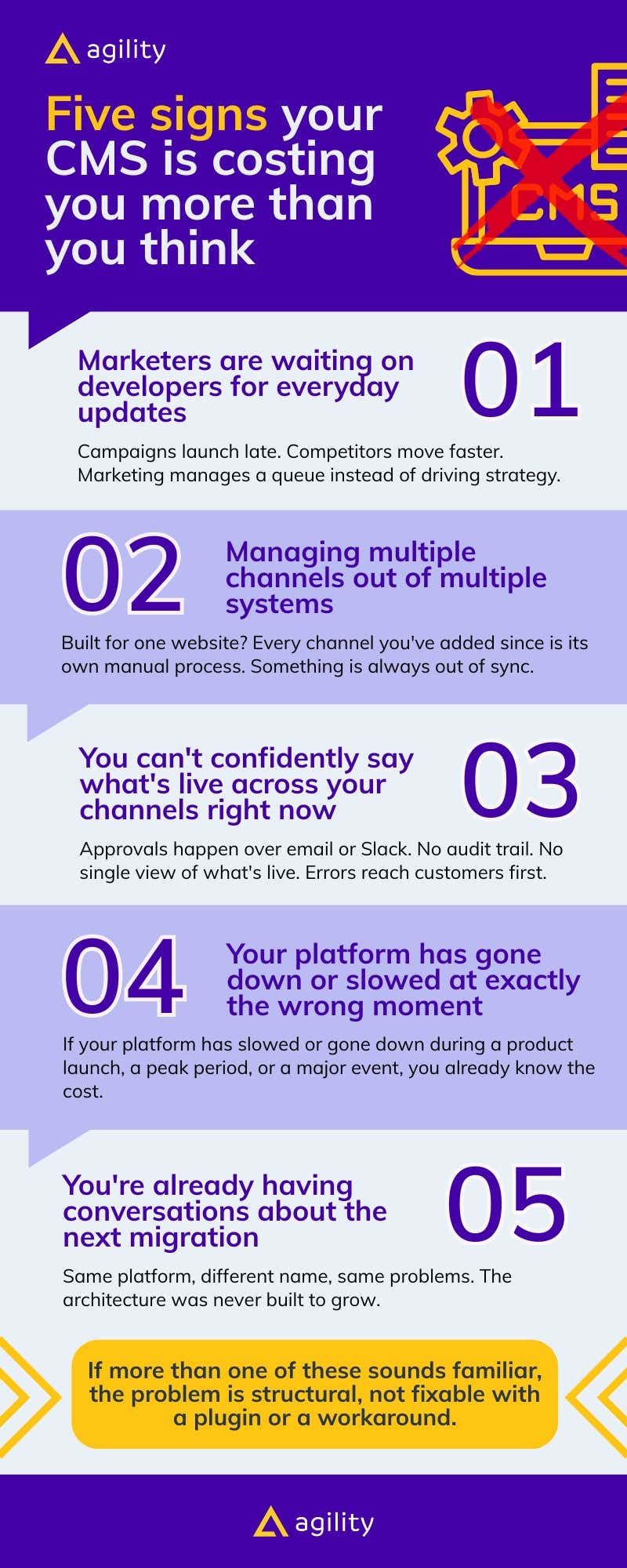
1. Your marketers are waiting on developers for everyday content
This is the most common pain point we hear from marketing leaders in 2025 and 2026: a capable, well-resourced team that can't move at the speed the business needs because every layout change, new landing page, or campaign update requires a development ticket.
The result? Campaigns launch late. Competitors move faster. And your marketing team spends its time managing a queue, instead of focusing on strategy and execution.
A modern CMS should give marketers the ability to publish independently across every channel without touching code while developers keep full architectural control. Neither team has to block the other. If that's not how your system works today, that's a structural problem.
The signal: Your marketing team regularly opens tickets for changes that should take minutes, not days.
2. You're managing multiple channels out of multiple systems
The average customer now interacts with a brand across six or more touchpoints before making a decision. Website, mobile app, kiosk, digital signage, partner portal, customer portal and each one is a surface your team must keep current and consistent.
If your CMS was built to power a single website, every additional channel you've added since has likely become its own manual process. Someone is copying and pasting. Someone is updating the same content in three different places. And somewhere, something is out of sync.
The right architecture is structured, API-first and built for reuse. This means you update content once and it goes everywhere.
Cineplex, for example, manages seven simultaneous digital touchpoints from a single Agility CMS instance, with one team. That kind of operational efficiency doesn't happen by accident. It happens when the content model is built for omnichannel from the start.
The signal: A campaign update requires manual changes in more than one system.
3. You have no real governance over what gets published
In regulated industries like insurance, banking, financial services, and healthcare, this is not only an operational problem but also becomes a compliance risk.
But even outside regulated verticals, governance gaps have real consequences.
Content errors reach customers before anyone catches them. There's no reliable audit trail. Approvals happen over email or Slack or not at all. No one can answer "what is live right now, on which channels?" with confidence.
As organizations scale and digital teams grow, the absence of structured approval workflows, role-based access controls, and full audit trails becomes increasingly expensive. The cost shows up in brand inconsistency, compliance exposure, and the kind of content errors that require public corrections.
SOC 2 certification, structured approval workflows, and role-based access should be built into your CMS from day one, not as an enterprise upgrade tier you pay extra for.
The signal: You cannot tell, with confidence, what content is live across all your channels at any given moment.
4. Your platform can't handle the moments that matter most
Product launches. Black Friday. A breaking news moment. A major event. These are the moments when your audience is largest and your platform needs to perform flawlessly. If your infrastructure has gone offline or slowed to a crawl at exactly those moments, you already know the cost.
For a retailer, it's lost revenue. For a media company, it's lost audience. For a financial services firm, it's a trust event.
Slow load times are not just a user experience problem. With Core Web Vitals heavily weighted in 2026 search rankings, performance directly affects discoverability. A platform that struggles under peak load is an ongoing drag on organic growth.
Modern headless and hybrid CMS architectures, built on cloud-native infrastructure, handle traffic spikes without sacrificing speed or stability. If your platform can't make the same promise, that gap gets more expensive every year.
The signal: You've experienced downtime or degraded performance during a high-stakes moment for your business.
5. You're already thinking about the next migration
If your team has been through a CMS migration before, you know what it costs: 12 to 18 months of engineering capacity, significant budget, business momentum lost, and a team that spent a year building a platform instead of building the business.
If the system you're on now is already showing the same limitations as the one you left — that's the clearest signal of all. Clearly, the problem was not the previous platform, but the content architecture was not built to grow with the business.
The right CMS isn't just the right software for today. It's a content model built to support every channel you run now and every channel you haven't launched yet. Agility CMS has customers who have been with us for nearly 15 years, through multiple website redesigns, rebranding exercises, new app launches, and new digital channels without a single rebuild of the content architecture underneath it all. That's what getting it right at the start looks like.
The signal: Your team is already having early conversations about what comes after the platform you're currently on.
What to look for in a CMS that's actually built to last
If you're evaluating alternatives, here's what the enterprise CMS landscape looks like in 2026:
- Traditional monolithic platforms (like Adobe Experience Manager or Sitecore) offer deep integration and brand familiarity, but tend to be expensive, slow to adapt, and heavily dependent on specialized implementation partners. The operational cost often grows faster than the business value.
- Pure headless platforms (like Contentful or Contentstack) give developers real flexibility, but shift complexity onto the organization. Marketers lose visibility and independence. Preview and governance often require custom development. Support is typically ticket-based.
- The right alternative removes the tradeoff. Developers get API-first flexibility without fighting rigid systems. Marketers get the ability to publish independently, preview content, and manage workflows without relying on development. And the team supporting you stays involved after launch, not just during implementation.
Frequently Asked Questions
How do I know if my CMS is holding back my marketing team?
The clearest signs are a long developer queue for routine content changes, campaigns that consistently launch late, and marketers who describe the platform as a source of frustration rather than a tool for execution. If publishing independence is not built into your current system, it cannot be configured in but requires a different architecture.
What does a CMS migration actually cost?
The visible costs are licensing and implementation. The hidden costs are the ones that hurt most: engineering capacity consumed for 12–18 months, content model rework if the architecture wasn't built for scale, and the business momentum lost while the team is heads-down on infrastructure instead of growth.
What should I prioritize in a new CMS evaluation?
Focus on five areas:
-
Omnichannel delivery from a single content model
-
Marketer independence without sacrificing developer control
-
Built-in governance and compliance features
-
Performance under peak traffic load
-
The quality of human support after go-live.
A platform that excels in all five will serve you through multiple stages of growth.
Is headless CMS right for every enterprise?
Not always. Pure headless architectures offer genuine flexibility, but they require development resources to compensate for what they remove: visual editing, preview, governance workflows. Hybrid headless platforms, which combine API-first content delivery with intuitive editing tools, have become increasingly attractive for enterprise teams in 2026 because they balance flexibility with usability.
How long does a CMS migration typically take?
It depends on content volume, channel complexity, and how well the content model is structured from the start. Well-planned migrations with a structured content architecture can be completed in three to six months.
Migrations that require rebuilding a poorly structured content model from scratch tend to take significantly longer which is why architecture guidance at the start of an engagement matters as much as the software itself.
Ready to See What the Right Fit Looks Like?
Agility CMS is the easy-to-use enterprise CMS with best-in-class human support. Developers get the flexibility they need. Marketers get the independence they want. And your team works with people who stay involved from planning through long-term growth.
Get a Demo — We'll show you how a comparable organization handles multi-channel publishing, governance, and content architecture. No pitch. Just the workflow.
Try It Free for 30 Days — No credit card required.
Agility CMS is a Canadian-founded, bootstrapped enterprise CMS with over 20 years in business. Our decisions are driven by what works for our customers and not by investor metrics.

About the Author
Joanna Olaru-Boyle is a B2B SaaS marketing manager specializing in demand generation and lifecycle campaigns. She has built her career across companies in technology, retail and events, driving multi-channel programs that create demand and attract new customers.
She holds a Bachelor's degree in History and English from the University of Toronto, a Corporate Communications diploma from Centennial College, and is certified as both a Salesforce AI Associate and Salesforce Pardot Specialist.
Joanna thrives where data and creativity meet and is just as passionate about supporting others in their mental health journey as she is about pipeline growth.

