
Best Kentico Alternatives: Secure, Modern CMS Platforms Worth Switching To

Key Takeaways
-
CVE-2025-2749, a path traversal vulnerability in Kentico Xperience 13, was confirmed as actively exploited and added to CISA's Known Exploited Vulnerabilities catalog in April 2026.
-
Kentico Xperience 13 reaches its end of life on December 31, 2026. After that date, Kentico provides no security patches or support, and organizations assume full liability for any incidents
-
Migrating to Xperience by Kentico is a complete platform rewrite, not an upgrade, and should be evaluated on the same terms as switching to any other modern CMS
-
Agility CMS is the strongest overall alternative for mid-market and enterprise teams, offering hybrid headless architecture, SOC 2 Type II compliance, and a marketer-friendly editorial experience without developer bottlenecks
Whether they’re battling with the recent security vulnerabilities, such as CVE-2025-2749, being added to CISA's Known Exploited Vulnerabilities catalog and the upcoming end of life (EOL) on December 31st, 2026, Kentico Xperience 13 (K13) customers need a modern CMS that provides a secure, flexible alternative.
In this guide, we’ll explain what to look for in a modern CMS alternative, and which platforms are worth serious consideration.
Why Kentico Users Are Evaluating Their Options
There are a few reasons why enterprises currently on Kentico Xperience 13 are considering their next CMS.
More Prominent Security Vulnerabilities
In April 2026, the US cybersecurity agency CISA confirmed that CVE-2025-2749 was actively exploited and added it to its Known Exploited Vulnerabilities (KEV) catalog.
CVE-2025-2749 is a path-traversal and arbitrary-file-upload vulnerability in Kentico Xperience 13's Staging Sync Server that could allow attackers to execute content on the server remotely.
While the vulnerability was patched in Version 13.0.178, the exploit's appearance in CISA's KEV catalog indicates it has been actively used in real-world attacks, not just flagged theoretically. Given this scenario, businesses on Kentico can’t be sure their CMS won’t be compromised again before it reaches the end of life.
Kentico Xperience 13 Reaches EOL on December 31, 2026
From January 1, 2027, K13 will receive no support, maintenance, updates, hotfixes, or security patches of any kind. Kentico's own support lifecycle page also states that continued use after that date is "at your sole risk" and that organizations assume "full liability for any claims, damages, losses, costs, or expenses, including those arising from security incidents."
Running unsupported software after EOL can create compliance gaps in regulated industries like healthcare, finance, government, and education. However, as with many other end-of-life scenarios, it can be difficult for enterprises to quickly migrate to another platform unless the vendor can also provide the enterprise-caliber customer support, onboarding, and migration support they need.
The Xperience by Kentico Migration Problem
For anyone within the Kentico ecosystem, the next step is likely to include migrating to Xperience by Kentico (XbyK). But they should also note that XbyK is a complete platform rewrite and not an upgrade.
The platform moves from ASP.NET Web Forms to .NET Core, replaces the admin UI with a React-based interface, and deprecates the legacy Page API, among other changes. While this does give Kentico customers a modern alternative, it’s also as intensive as migrating to another CMS entirely, so it’s worth considering other options.
Total Cost of Ownership and Lack of Marketer-Friendliness
Aside from immediate security concerns, Kentico users have also had a hard time dealing with its higher total cost of ownership, driven by unexpected licensing costs and add-on fees for features that are standard on competing SaaS platforms. Additionally, the slower editorial workflows force marketing teams to depend on developers for routine publishing tasks.
As one mid-market user on G2 said, “Compared to simpler CMS platforms, the learning curve is steeper, and customization can sometimes require a deeper understanding of ASP.NET. On top of that, licensing costs can be on the higher side for some teams.”
The Causes of Kentico’s Issues
Many of the problems faced by Kentico customers stem from its monolithic architecture. Monolithic, server-rendered platforms couple the frontend and backend together, which means the attack surface is larger by design. When the backend is exposed, so is everything connected to it. This monolithic architecture is also the reason behind end-of-life concerns and higher total cost of ownership, which don’t plague modern cloud-native CMSs.
What to Look for in a Kentico Alternative
While every enterprise will have a unique checklist, there are a few key considerations that modern CMS alternatives should provide to deliver a better experience:
Enterprise-Grade Security
Headless CMSs separate the content backend from the frontend delivery layer, reducing the attack surface substantially and improving security right away. Beyond architecture, security-conscious enterprises will want to look for SOC 2 Type II compliance, a published vulnerability disclosure process, and a vendor with a clear long-term commitment to security patching.
User-Friendly Marketer and Content Team Experience
Any platform that requires developer involvement for routine content tasks is creating a content operations bottleneck. Enterprises should look for solutions that offer intuitive editorial interfaces, visual page-building, content workflow tools, and role-based access, enabling non-technical users to operate independently.
Headless and Composable Architecture
API-first, headless delivery is table stakes for modern CMS platforms. It means content can be delivered to any channel, web, app, digital signage, email, and integrated cleanly with the rest of the stack.
That also facilitates a composable approach, allowing the CMS to handle everything content-related while connecting to best-of-breed tools for everything else, rather than trying to bundle everything and doing most of it poorly or excessively raising prices.
The 6 Best Kentico Alternatives
Agility CMS
Best For: Mid-market and enterprise teams that need a secure headless CMS and don’t want to sacrifice editorial usability.
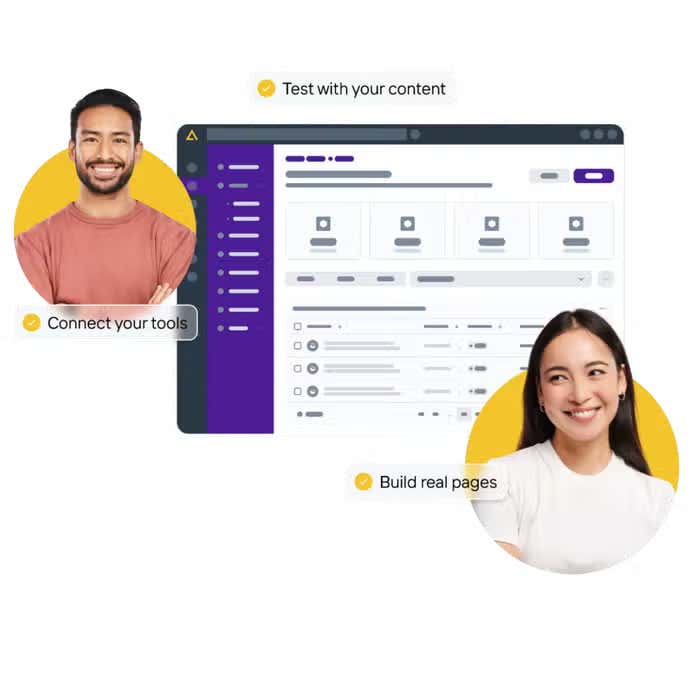
Agility CMS is built on a hybrid headless architecture that serves both marketers and developers. Content is managed through a structured, API-first backend and delivered via REST and GraphQL APIs to any frontend. So developers can use any front-end frameworks they prefer to build omnichannel digital experiences.
At the same time, the editorial experience is designed for content teams, featuring page management, visual previews, content workflows, and publishing controls. These not only enable marketers to manage content experiences but also allow non-technical users to operate without developer support.
That balance is where Agility CMS consistently outperforms both more developer-centric headless platforms and legacy monolithic systems.
What Makes Agility CMS the Right Move from Kentico
Security-Focused: Agility CMS is built for enterprise security and data sovereignty. Hosted on Microsoft Azure’s globally distributed cloud infrastructure and includes SOC 2 Type II compliance. Because the CMS backend is never publicly exposed and content is served via APIs, the attack surface is fundamentally different from what Kentico customers experienced in past security breaches.
Page management without developer bottlenecks: Unlike many pure headless platforms that abstract the page-building experience entirely, Agility includes a Page Management layer that lets editors create and arrange pages visually without writing code. Developers define the components, and then editors create the pages.
Content architecture built for scale: Agility CMS’s headless architecture separates content from the presentation layer at the schema level. This means that content created once can be syndicated across multiple sites, apps, or channels without duplication, which is crucial for enterprises managing multiple sites or brands.
Migration support. Agility works directly with teams migrating from K13 to map content structures, assess migration scope, and define a realistic transition plan. The content model rebuild is required for any migration (including to XbyK), but Agility's flexible Content Type system makes it straightforward to port existing K13 structures without starting from scratch.
Contentful
Contentful is one of the most widely adopted pure-headless CMS platforms on the market. Its APIs are mature and well-documented, and its integration ecosystem is extensive. For large development teams building complex, multi-channel architectures, Contentful is a capable platform.
That said, the pricing is significantly higher than comparable platforms, and the editorial experience, while improving with Contentful Studio, still requires more developer configuration than teams coming from Kentico (already frustrated by developer dependency) may want to trade into.
Contentstack
Contentstack works for large enterprise teams with complex content operations and strict governance requirements. This may be a fit for enterprises coming from Kentico who expect similar third-party agency-driven implementations, along with onboarding and ongoing management.
However, the price point and implementation complexity put it out of reach for most mid-market organizations, so the same total cost of ownership issues that arose with Kentico could quickly return.
Optimizely
Optimizely is a fit for enterprises that need native experimentation and personalization in a single platform and have the budget and implementation resources to match. But for teams primarily looking for a modern CMS replacement, it's likely more than you need and more than you'll want to pay. For Kentico customers, a composable stack with best-of-breed tools can serve the same goals with less overhead.
Sanity
Sanity is well-suited for developer-led product teams looking to build a fully custom editorial experience. But isn’t the right choice for teams without strong in-house development capacity or teams that need marketers to operate quickly. For Kentico customers whose pain points are editorial workflow and marketer independence, Sanity trades one developer dependency for another.
Hygraph
Hygraph is a fit for organizations that need to unify content from multiple existing systems into a single delivery layer. Its content federation feature connects those systems through a single GraphQL API. For enterprises on Kentico with a fragmented content infrastructure that they can't fully decommission, this can be a huge help. However, the editorial experience isn’t likely to resolve their complaints about marketer-friendliness.
Which Kentico Alternative Is Right For You?
Most enterprises currently evaluating Kentico alternatives are grappling with two overlapping problems. First, multiple security issues threaten their reputation, and second, an end-of-life deadline forces a decision. The right alternative solves both.
For the majority of mid-market and enterprise teams, Agility CMS is the strongest fit. The hybrid headless architecture means developers get the API flexibility they need without forcing marketers back into a developer-dependent workflow. The decoupled infrastructure addresses the security architecture concerns raised by CVE-2025-2749. And the migration process is scoped and supported in a way that makes any end-of-life deadline manageable for teams starting now.
If you're not sure where to start, the fastest way to get clarity is to see Agility CMS in action. Contact us for a demo.

About the Author
Joanna Olaru-Boyle is a B2B SaaS marketing manager specializing in demand generation and lifecycle campaigns. She has built her career across companies in technology, retail and events, driving multi-channel programs that create demand and attract new customers.
She holds a Bachelor's degree in History and English from the University of Toronto, a Corporate Communications diploma from Centennial College, and is certified as both a Salesforce AI Associate and Salesforce Pardot Specialist.
Joanna thrives where data and creativity meet and is just as passionate about supporting others in their mental health journey as she is about pipeline growth.